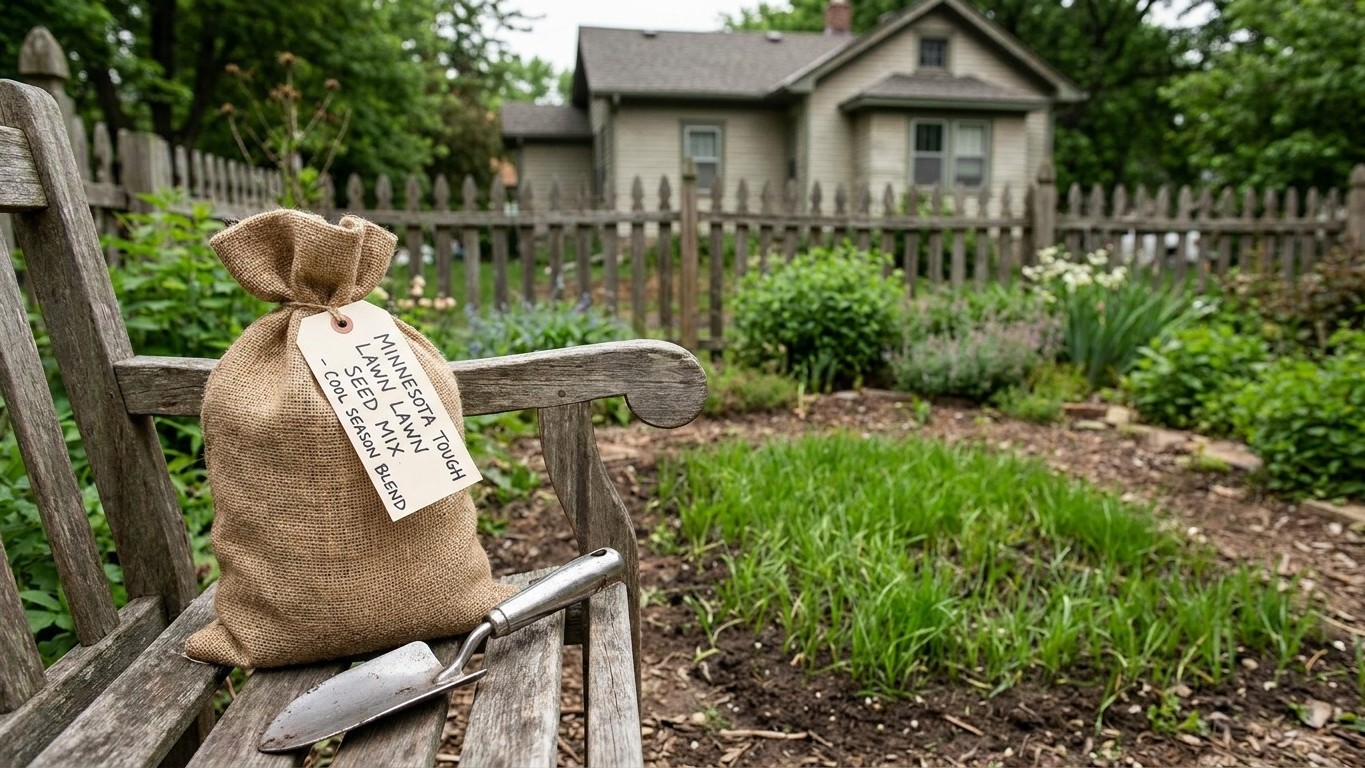

Bermuda seed sown into a Minneapolis yard in May looks thick and green by August, then turns to dead straw the moment the first hard freeze hits — because that grass was built for southern summers, not northern winters. That’s the mistake that wastes a whole growing season and the cost of the bag: picking seed for how it looks on the shelf instead of what the ground here demands in January. Minnesota narrows the real choices down to five species, and which one wins depends on your yard, not the label.
The short answer for Minnesota
Minneapolis sits in the cool-season turf zone, the classification Clemson Cooperative Extension’s HGIC 1214 uses for grasses that green up in spring and fall and slow down or brown off in summer heat. Warm-season grasses like Bermuda or zoysia work the opposite way: they thrive in summer heat and go dormant at the first hard freeze. Minnesota’s winters rule those out for anything but a novelty patch, so the working list narrows to five species: Kentucky bluegrass, tall fescue, fine fescues, perennial ryegrass and rough bluegrass, per Clemson’s HGIC 1214 and Penn State Extension’s cool-season list.
None of the five is the single best grass seed for every Minnesota yard. The right call depends on three things: how many hours of direct sun the area gets, how much foot or paw traffic it takes, and how much irrigation you’re prepared to run through a dry stretch. A full-sun front yard with kids and a dog wants a different bag of seed than a shaded side yard under mature oaks.
That classification comes from Minneapolis’s climate record, and higher, more northern ground in the state pushes the season tighter at both ends, which the next section covers in detail. For the broader routine beyond seed selection, including mowing and feeding through the season, see Minnesota Lawn Care.
Working through the year

Cool-season grass establishes best in the weeks before the growing season shuts down for winter, not in the heat of summer. NOAA’s 1991-2020 climate normals put Minneapolis’s first fall freeze at October 11 to October 23, the 30 to 70 percent probability band for a 32°F freeze recorded at the NOAA station serving the Twin Cities. Counting back the six to eight weeks that cool-season seed needs to root before frost lands, the seeding window opens in mid-August and runs through mid-September for the Twin Cities area. Northern Minnesota, where frost arrives sooner, needs to start that count earlier, a difference covered in the next section.
Spring seeding is possible but riskier. Cool nights slow germination, and any pre-emergent crabgrass control put down in spring will also stop grass seed from sprouting. Fall avoids that conflict entirely, which is why fall overseeding is treated as the primary seeding season for these species. For the month-by-month mowing, feeding and aeration schedule that surrounds this window, see The Minnesota Lawn Care Calendar, Month by Month.
Kentucky Bluegrass

Kentucky bluegrass spreads by underground rhizomes, so it fills in bare patches on its own once cooler weather returns after a summer scald. The cost is patience: bluegrass seed typically takes two to four weeks to germinate, and a new stand needs steady watering through that stretch. It also wants more nitrogen and more water through summer than the other four species, so a bluegrass-dominant lawn assumes a sprinkler schedule to match.
Tall Fescue

Tall fescue germinates faster, usually in seven to fourteen days, and its deep root system gives it the best heat and drought tolerance of the cool-season group. The trade-off is that it grows in clumps rather than spreading, so a bare or thinned patch stays bare until reseeded directly. Clemson’s HGIC 1219 tall fescue maintenance calendar, written for a different climate but built around the same species biology, treats fall overseeding as the routine fix for that clumping habit.
Perennial Ryegrass

Perennial ryegrass is the fastest germinator of the group, often breaking ground in five to ten days, which is why it turns up as a nurse grass mixed with slower bluegrass in new-lawn blends. On its own it tends to thin out after a few Minnesota winters and rarely makes a good long-term stand by itself.
Fine Fescues

Fine fescues carry the best shade tolerance of the five and need the least water and fertilizer once established, which suits a lawn shaded by mature trees. They give up traffic tolerance for that trade: fine fescue thins quickly under regular foot traffic or a dog run, so it fits a shaded side yard better than a play area.
Rough Bluegrass

Rough bluegrass, also sold as Poa trivialis, is a narrow specialist that wants constant moisture and shade and struggles almost everywhere else. Most Minnesota homeowners will only use it as a small component in a shade seed mix for a wet, low-light corner, not as a stand-alone lawn.
What changes across Minnesota
The cool-season classification and the October 11 to October 23 frost window above both come from NOAA’s climate station near Minneapolis-St. Paul, the mild south of a large state. Nothing about Minnesota’s climate is uniform enough to hang one statewide seeding date on.
Northern Minnesota, including the Iron Range and the area near International Falls, runs the season tighter at both ends. NOAA’s own caution on this data notes the far north sees its first fall frost two to three weeks earlier than Minneapolis, with the last spring frost lingering two to three weeks longer. That shifts the safe fall seeding window earlier by roughly the same margin, landing closer to late July through late August rather than the mid-August to mid-September range that works around the Twin Cities.
Along Lake Superior’s North Shore, the lake itself moderates the swings, delaying both the spring warm-up and the fall freeze compared to inland spots at the same latitude, though NOAA does not publish a station-level figure for that stretch in the normals cited here. A homeowner in Duluth or points northeast should treat the Minneapolis window as a rough guide and confirm timing locally rather than count on it exactly.
Even within one yard, a south-facing slope that catches full sun warms and dries out earlier in spring than a shaded north-facing side of the same house. That is worth remembering when the calendar says it is time to seed but one corner of the lawn still hasn’t thawed.
The mistakes this climate punishes
Seeding or feeding at the wrong time
Seeding any of these five species in late May or June, once the ground has warmed and summer heat is close behind, wastes the bag. Seedlings that do sprout get only a few weeks of mild weather before Minnesota’s summer humidity and heat set in, and a thin, shallow-rooted stand rarely survives its first August. The damage shows up as bare, thinning turf by mid-summer, right when it’s hardest to fix without waiting for fall.
A related mistake is a heavy spring nitrogen feeding meant to green the lawn up fast. It pushes soft top growth that looks good in May and then struggles once summer heat and any dry spell hit, because the plant put its energy into leaf blades instead of roots. Save the heaviest feeding for fall, when cool-season grass is building root mass rather than top growth, instead of front-loading it in spring.
A few big-box seed blends sold nationally lean on warm-season species such as Bermuda grass because they’re cheap to produce, and a shopper who skips the label can end up seeding a species that goes fully brown and dormant at the first fall frost and never returns in spring. That’s a wrong species for the climate, not damage to a right one that will recover.
Mowing too short in summer heat
Cutting a cool-season lawn short to stretch the time between mows is one of the most common ways to weaken it here. A lawn scalped down in July loses the leaf area it needs to shade its own root zone, cutting into photosynthesis right when heat stress is already working against it. That damage does not show immediately. It shows up two or three weeks later as a lawn that browns faster than the neighbor’s and takes longer to recover once cooler weather returns.
- Seeding cool-season grass in late spring instead of the fall window
- Buying warm-season seed like Bermuda or zoysia sold cheap in big-box stores, which will not survive a Minnesota winter
- Loading on nitrogen in spring instead of fall
- Mowing shorter than usual during a hot, dry stretch
- Skipping fall aeration on compacted soil, so water and fertilizer never reach the roots
Checking this against your county
County-level advice on seed timing, mowing height and disease pressure varies enough across a state this size that one page can’t replace a local check. The University of Minnesota Extension (extension.umn.edu) publishes county-specific lawn and turf resources and staffs offices that can confirm species and timing for an exact location. Check with your county’s extension office before buying seed or setting a mowing schedule, especially if you garden in the Iron Range, along Lake Superior’s North Shore, or in far southern Minnesota, where the frost calendar looks different from Minneapolis’s.
Common questions
Do I need a special grass seed blend for Minnesota, or will any cool-season bag work?
Not automatically. Bags labeled simply “cool-season mix” and sold nationally often lean heavy on perennial ryegrass because it’s cheap and fast-germinating, which is fine as a nurse grass but weak as the long-term backbone of a Minnesota lawn.
Check the label’s percentage breakdown and look for a blend where Kentucky bluegrass or tall fescue makes up most of the mix if you want the lawn to still be there in five years.
What’s the best grass seed for a shady Minnesota yard?
Fine fescues handle shade better than the other four species covered here and need less water once established. For a wet, low-light corner where even fine fescue struggles, rough bluegrass is the more specialized fallback, though it won’t tolerate any real foot traffic.
Can I seed my lawn in spring instead of waiting for fall?
You can, but it carries more risk than fall seeding. Spring seeding competes with any pre-emergent crabgrass control, cool nights slow germination compared to the warmer soil of late summer, and the young stand has less time to root before summer heat arrives.
If spring is the only option, skip the pre-emergent that year on the seeded area and expect slower establishment than a fall planting would give.
Is rough bluegrass the same thing as Kentucky bluegrass?
No, despite the shared name. Rough bluegrass (Poa trivialis) is a distinct, shallow-rooted species that spreads by surface runners called stolons rather than the underground rhizomes Kentucky bluegrass uses, and it needs far more shade and moisture to survive.
Treat it as a shade specialist for a small trouble spot in the yard, not as a substitute for a full lawn.