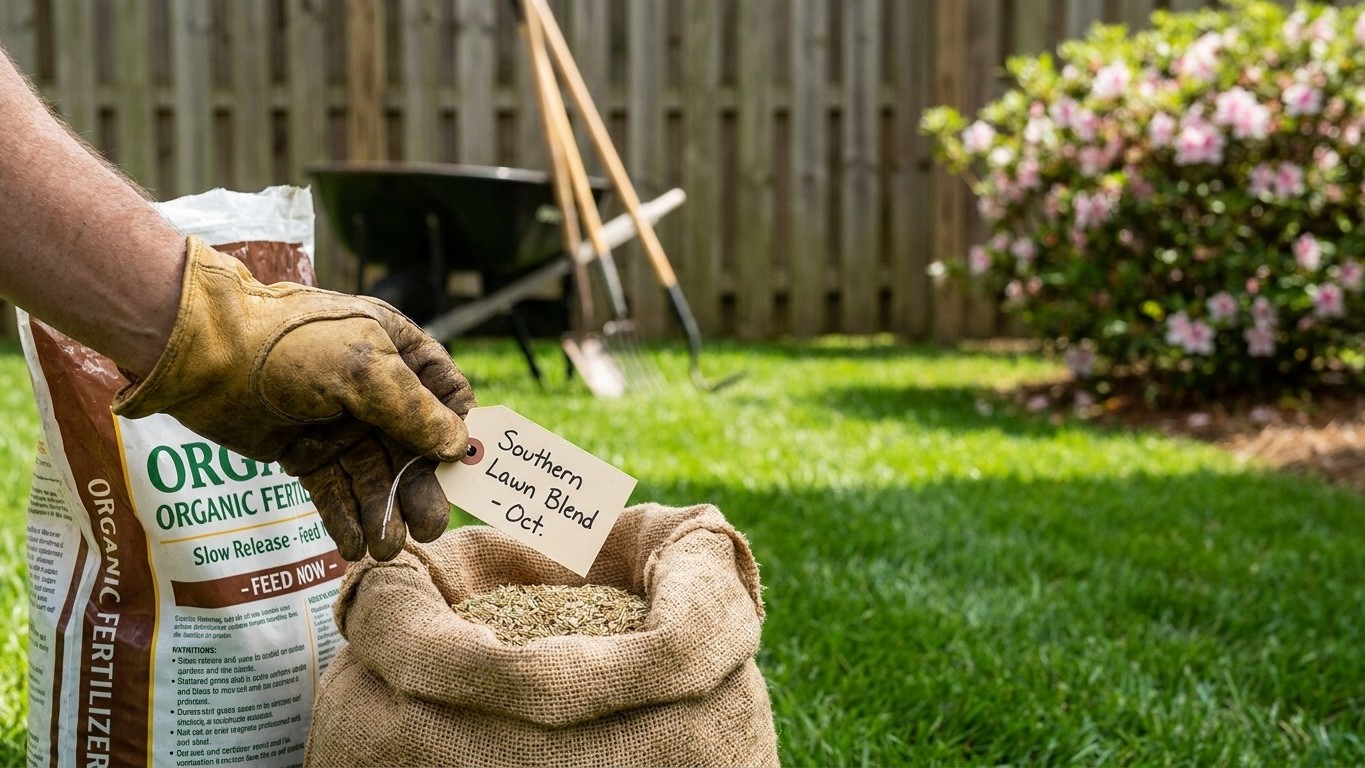

Seventy-one days a year with the thermometer at 90F or higher, and a coldest month that still averages 35F at night — that pairing is what decides which grass survives here, not personal taste or what looks good at the garden center. Mississippi summers run too long and too brutal for a lawn that needs winter dormancy, while the winters never turn cold enough to grant that dormancy anyway. So the choice narrows fast, down to grasses built specifically for heat.
Which grass belongs in Mississippi

The numbers that rule out cool-season grass
The two figures that settle this are both from NOAA’s NCEI 1991-2020 climate normals at the Jackson reference station. Jackson runs 71.1 days a year at or above 90F, and its coldest month has a mean daily minimum of only 35.3F. Long, hot summers plus winters that barely dip below freezing add up to a climate that never gives a cool-season grass the cold dormancy it needs, and never lets up long enough in summer for it to survive. That combination puts Mississippi squarely in warm-season turf territory, not the kind of split call you get in a transition-zone state like North Carolina, where cool-season and warm-season grasses genuinely compete for the same yard and neither one has a clean advantage.
Clemson Cooperative Extension’s HGIC 1214 fact sheet on selecting a lawn grass lists the species built for this kind of heat: Bahiagrass, Bermudagrass, Carpetgrass, Centipedegrass, Seashore Paspalum, St. Augustinegrass and Zoysiagrass. A lawn built from tall fescue or Kentucky bluegrass, the kind that does fine in a cooler state like Connecticut, will thin out and die back across a Mississippi summer no matter how well you water it. This isn’t a matter of picking a hardier cultivar. It’s a matter of the species being built for a different season entirely.
Choosing among the warm-season options
Once cool-season grass is off the table, the choice among the remaining species comes down to sun, traffic and how much upkeep you want to do — a decision covered in more detail in this guide to Mississippi lawn Best grass, with timing that’s easier to plan around with a Mississippi lawn Calendar in hand.
- Bermudagrass: fastest to establish, toughest under foot traffic, needs full sun and turns brown fast at the first hint of cold.
- St. Augustinegrass: the most shade-tolerant of the warm-season group, coarse-bladed, and less cold hardy than the others on this list.
- Zoysiagrass: dense and slow to establish, with better shade tolerance than Bermudagrass but a longer wait for full coverage.
- Centipedegrass: bred for low-fertility soil, needs the least feeding of any grass here, and struggles under heavy foot traffic.
- Bahiagrass: deep-rooted and drought tolerant, coarse in texture, common along roadsides and in low-maintenance lawns.
- Carpetgrass: tolerates wet, poorly drained ground better than the rest, but has poor traffic and drought tolerance.
- Seashore Paspalum: notably salt tolerant, useful on ground near brackish water, less common in interior lawns.
When to seed or sod here
Sodding and seeding warm-season lawns
Warm-season grasses go in around May, once the soil has warmed and the growing season has real momentum behind it, according to Clemson Cooperative Extension’s HGIC 1203 planting guidance. Sod or plugs planted before the soil is warm enough sit there without rooting, and a cool snap right after planting can set the whole lawn back a full season. Jackson’s own frost record from NOAA’s 1991-2020 climate normals puts the first fall frost between November 7 and November 22, which is a range, not a single date, and it comes from an airport weather station. A suburban or rural yard nearby often sees frost a week or two earlier than that. Whatever your county’s actual date turns out to be, the practical rule is the same: get sod or plugs down early enough in the growing season that the grass has months, not weeks, to root before growth slows for the year.
The later you plant into summer, the more watering it takes to keep new sod alive through Mississippi’s heat, and the less time the roots have to establish before fall. If you’re seeding rather than sodding, that time pressure matters even more, since seedlings are far more vulnerable to a dry spell than established sod.
Some Mississippi homeowners overseed an established warm-season lawn with annual ryegrass in the fall purely for winter color, timed the way HGIC 1203 lays out for cool-season seeding generally, in mid to late September. That’s a cosmetic step on top of a warm-season lawn, not a way to convert the lawn to a cool-season species. The permanent grass underneath is still Bermudagrass, Zoysiagrass, Centipedegrass or whatever warm-season species you planted, and it still goes dormant on its own schedule regardless of what’s growing on top of it for winter.
The feeding calendar that fits this climate
Feeding a warm-season lawn
Because every recommended species here is warm-season, the whole feeding calendar runs opposite a cool-season lawn’s. A warm-season lawn gets fed while it’s actively growing, from late spring through summer, and gets nothing once it starts hardening off for winter. Feed it on a September schedule the way you would fescue in a state like Connecticut, and you push soft new growth right into the cold instead of into dormancy prep, which leaves it more exposed to winter damage, not less.
Why species differ
Clemson Cooperative Extension publishes a separate maintenance calendar for each major warm-season species, and the nitrogen rate and number of feedings differ by grass, not by county. The Bermudagrass calendar (HGIC 1216) calls for the heaviest schedule of the group, because Bermudagrass recovers from mowing and traffic fastest and burns through nitrogen quickly to keep up. The Centipedegrass calendar (HGIC 1215) sits at the other end. Centipedegrass is bred for low-fertility soil, and it’s one of the few common lawn grasses that actually fails from too much nitrogen rather than too little. Zoysiagrass, covered in HGIC 1217, and St. Augustinegrass, covered in HGIC 1218, fall in between the two.
As a general rule across these species, individual feedings tend to run from about a half pound to one pound of actual nitrogen per 1,000 square feet, with the total for the season set by which grass you’re growing and how many feedings its calendar calls for. The exact rate and the exact number of feedings belong to the species, not to the calendar month, so check the specific HGIC page for your grass rather than copying a rate off a bag of general-purpose fertilizer.
Mowing height and watering here
Mowing height
Each warm-season species has its own target mowing height, and Clemson’s per-species maintenance calendars spell out the range for each one.
| Grass | Typical mowing height | What happens if you mow it shorter |
|---|---|---|
| Bermudagrass | 1 to 1.5 inches | Tolerates it, but scalps fast if the mower deck is uneven |
| Zoysiagrass | 1 to 2 inches | Thins out and lets weeds in |
| Centipedegrass | 1.5 to 2 inches | Stresses the grass and slows recovery |
| St. Augustinegrass | 2.5 to 4 inches | Exposes stolons and invites weeds and disease |
Whatever the target height for your species, never remove more than a third of the blade in one cut. Mowing back past that in a single pass stresses the grass and opens the door to the same disease problems covered below.
Watering in Mississippi’s heat
An inch of water a week, delivered in one or two deep soakings rather than daily light sprinkling, is the common starting figure for warm-season turf. Jackson’s 71.1 days a year at or above 90F, per NOAA’s 1991-2020 climate normals, means that figure often isn’t enough during the hottest stretch of summer, when heat and humidity push evaporation well past what a single weekly soaking replaces. Sandy soil drains faster and needs more frequent, lighter watering to avoid drought stress between soakings, while heavier clay holds water longer and can be overwatered on the same schedule that works fine for a sandy yard nearby. Watch the grass itself rather than the calendar. A lawn that springs back within a few seconds of a footprint doesn’t need water yet, whatever the calendar says.
What goes wrong on lawns in Mississippi

Brown patch in humid summers
A humid Mississippi summer is exactly the kind of weather that brown patch fungus needs, and it shows up as roughly circular patches of collapsed, matted grass, often with a darker ring at the edge. It hits Centipedegrass and St. Augustinegrass especially hard in wet, muggy stretches. Overwatering in the evening, when the grass stays wet overnight, is the single biggest thing that invites it, more than the humidity itself.
Dormancy mistaken for death
Warm-season turf browns off after the first hard frost, and that browning is dormancy, not death. Jackson’s own frost record from NOAA’s 1991-2020 normals puts that first frost between November 7 and November 22, and a lawn that goes brown right around then is doing exactly what it’s supposed to do. The same confusion runs the other way in a hot, dry summer, when Bermudagrass or Zoysiagrass can go brown from drought stress and still green back up once rain or irrigation returns. Digging up a plug to check for a white, firm root before you decide to replace anything is worth the five minutes it takes.
Weeds that never quit
A mild Mississippi winter, with a coldest-month low that only averages 35.3F at Jackson per NOAA’s normals, doesn’t reliably knock back cool-season weeds the way a harder freeze would further north. Winter annual weeds like chickweed and henbit can keep growing through a mild winter while the warm-season lawn above them sits dormant and can’t compete. That’s the trade-off of living in a warm-season zone: the lawn gets a long growing season, and so do the weeds trying to take it over.
Local help
Soil test results and county-level advice both come from the same place: the Mississippi State University Extension Service. A soil test tells you the one thing none of the figures above can, which is what your particular yard’s soil actually needs before you buy fertilizer or lime. Get that test done before your first feeding of the season, not after, so you’re not guessing at a rate that may not match your soil at all.
Common questions
Can I grow a cool-season lawn in Mississippi if I really want one?
Not reliably. Jackson’s 71.1 days a year at or above 90F, per NOAA’s 1991-2020 climate normals, is enough heat to thin out and kill fescue or bluegrass over a summer, even with heavy watering. A few shaded, higher-elevation pockets in the far north of the state may do slightly better, but it’s not a bet worth building a lawn around.
My Bermudagrass turned brown right after the first cold snap, did I lose it?
Probably not. Warm-season grass browns off with the first hard frost as a normal part of going dormant for winter. Jackson’s first fall frost, per NOAA’s normals, falls between November 7 and November 22, and a lawn browning around then is on schedule. Dig up a small plug and check the roots. Firm, white roots mean the lawn is dormant, not dead.
How do I tell my grass species apart if I don’t already know what’s planted?
Look at the blade and how it spreads. Bermudagrass has fine, pointed blades and spreads aggressively by both stolons and rhizomes. Centipedegrass has a lighter, apple-green color and a slower, coarser spread. St. Augustinegrass has broad, blunt-tipped blades and spreads only by above-ground stolons. If it’s still not obvious, your county extension office can usually identify it from a sample.
When should I stop fertilizing before winter?
Stop nitrogen well before the grass starts slowing down for dormancy, not on a fixed date. Feeding too close to the first frost pushes soft new growth that has no time to harden off before cold weather arrives. Check the maintenance calendar for your specific species, since Bermudagrass, Zoysiagrass, Centipedegrass and St. Augustinegrass all wind down their feeding schedule at slightly different points in the season.
Is there one best warm-season grass for a shady yard in Mississippi?
St. Augustinegrass is generally the most shade-tolerant of the warm-season species listed by Clemson Cooperative Extension’s HGIC 1214, but even it needs a reasonable amount of direct sun each day to hold up over time. Zoysiagrass tolerates moderate shade better than Bermudagrass but still thins out under heavy tree cover. No warm-season grass on this list does well in deep, all-day shade.