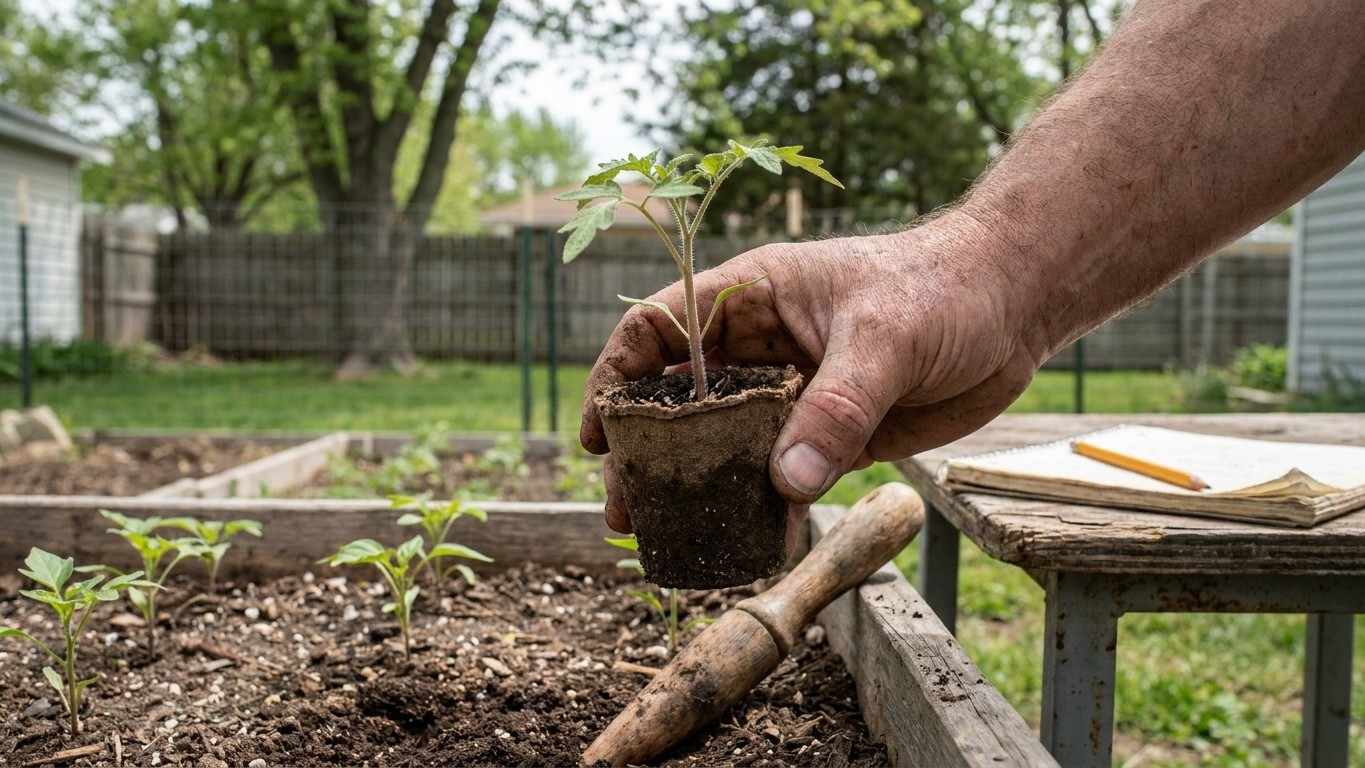

Most Nebraska gardeners transplant tomatoes outdoors after the local last spring frost, which NOAA’s 1991-2020 climate normals put at April 12 to April 23 for the Omaha area. That gives a growing season running to the first fall frost, which the same NOAA data puts at October 15 to October 26 for Omaha. Check your own county’s frost record against this reference-city range before you count backward from it, since gardens outside Omaha typically see frost later in spring and earlier in fall.
What this comes down to in Nebraska

Omaha’s last frost can land ten days earlier or later than the average, and a tomato set out on the strength of that average alone can end up blackened on a cold May morning, or sitting stunted in soil that never warmed up enough for it. Either way, the plant loses weeks it won’t get back before fall. The zone map won’t save you here since it tracks winter cold, not spring timing. What actually protects a transplant is knowing how to work backward from the real spread of dates at your own end of the state.
That’s a wide, workable growing season for tomatoes by Midwestern standards, but it is not a single day you can circle on a calendar. The ten-day spread at each end reflects real year-to-year variation at one station, and your own frost date could land anywhere inside it, or well outside it if you garden away from Omaha. The USDA’s hardiness map places the state across zones 4a to 5b, which tells you how cold winters get but says nothing about when spring settles down enough for tomatoes, so lean on the NOAA frost data for that instead.
The arithmetic turns a frost-date range into a seed-starting range and a transplant range, with confidence depending on where in the state you garden. It assumes you’ve already sorted out growing tomatoes in Nebraska generally and picked a cultivar from a page like Tomato Varieties That Ripen in Time in Nebraska. Here the question is only when to put it in the ground, and once it’s there, what shows up to bother it is covered separately in Tomato Pests in Nebraska: Which Ones Actually Show Up Here.
Working it out for your own garden
The method is the same whether you start seed indoors or buy transplants at a garden center: count from the frost window, not from a single date, and keep the range intact at every step of the arithmetic.
Counting back for seed starting
Start with NOAA’s 1991-2020 last-spring-freeze window for Omaha, April 12 to April 23. Tomato seed packets generally call for starting indoors six to eight weeks before the transplant date. Run both ends of that arithmetic and you land on a sowing range, not a sowing day:
- Eight weeks before the earliest frost date, April 12, lands near mid-February.
- Six weeks before the latest frost date, April 23, lands near mid-March.
- So the sensible indoor sowing window is roughly mid-February to mid-March, shifting later if your county’s frost date runs later than Omaha’s.
Transplant outdoors only after the April 12 to April 23 window has passed at Omaha, or your own local equivalent of it. Tomatoes are a warm-season crop, so many growers wait a bit past the calculated last-frost range until nights are reliably mild and the soil itself has warmed, rather than moving seedlings out the moment the frost window closes.
Testing a cultivar against the calendar
Take ‘Celebrity‘, a determinate slicer with a catalogue days-to-maturity of about 70 days counted from transplant, as most catalogue figures are. Transplant at the early end of the Omaha window, April 12, and 70 days puts first ripe fruit in late June; transplant at the late end, April 23, and first fruit lands in early July. Either way, that clears NOAA’s first-fall-freeze window of October 15 to October 26 with weeks to spare, so ‘Celebrity’ fits the season comfortably.
Now take ‘Brandywine‘, a large heirloom slicer often listed at 80 to 100 days to maturity. At 100 days, an April 23 transplant puts first fruit near the start of August, which still fits inside the Omaha reference window on paper. But the caution attached to that frost data matters here: gardens outside the Omaha airport station typically see the last frost run later and the first fall frost run earlier, sometimes by a week or two. Stack both shifts onto a 100-day heirloom and the harvest window that looked comfortable gets tight fast, particularly in the cooler zone 4a country toward the west and north of the state. That’s the point where a long-season variety stops being a safe default and starts being a gamble.
What changes across the state
Omaha’s frost dates describe one river-valley location in the southeast corner of Nebraska. The state’s own hardiness range, per the USDA Plant Hardiness Zone Map, runs from zone 4a to 5b, and that spread alone tells you the frost calendar cannot be the same from the Panhandle to the Missouri River bluffs.
Elevation and geography
Elevation is the biggest driver of the difference. Western Nebraska sits considerably higher than the Omaha area, and higher ground cools faster at night and holds cold longer into spring. Gardeners there should expect a later last frost and an earlier first frost than the Omaha figures show, which shortens the whole season from both ends at once. The northern tier of the state and the Panhandle, both closer to zone 4a, carry that shortened season more than the southeastern counties nearer zone 5b.
Nebraska has no ocean or large lake nearby to soften temperature swings the way coastal states experience, so its continental climate tends to swing harder and faster between a warm spell and a hard freeze. That’s part of why NOAA describes its frost window as a 30-70% probability band rather than a hard cutoff: even at one station, the actual last frost lands outside that range in some years. Local terrain matters too. A low spot that collects cold air overnight, a north-facing slope, or a garden shaded from the morning sun will all run colder at frost time than an open, south-facing bed a few miles away, regardless of what the regional zone map says. None of that reduces to a second precise date for your particular town. It’s a reason to treat the Omaha figures as a starting point and adjust toward caution the farther you are from that station or the more exposed your site is to cold air pooling.
The mistakes this state punishes

The most common error is transplanting on the strength of a warm week rather than the frost window itself. Nebraska can throw a run of unseasonably warm days well before NOAA’s April 12 to April 23 last-frost range for Omaha has even run its course, and a cold snap behind that warm spell will take tender transplants down fast. Wait out the frost window, not the weather forecast of the moment.
The second is picking a variety whose catalogue days-to-maturity leaves no margin once the local season runs short, as shown above with a 100-day heirloom stacked against a shortened frost window. This bites hardest in the cooler zone 4a parts of the state, where the safe season is shorter than the Omaha figures suggest on their own. A grower there planting a long-season heirloom on Omaha’s calendar, rather than adjusting for a later spring and earlier fall locally, can end up with a plant still loaded with green fruit when frost finally arrives. For a rundown of which cultivars actually finish in time in this state, see Tomato Varieties That Ripen in Time in Nebraska.
The third is planting into cold, wet soil that hasn’t caught up with the air temperature. A few warm afternoons don’t mean the ground four inches down has warmed to match, and tomato roots set into cold soil sit stalled for weeks even if no frost ever touches the leaves. Give the soil, not just the calendar, a chance to catch up before transplanting.
Checking this against your county
The Omaha figures are a reference point, not an instruction for every county in Nebraska. Before you commit to a planting date, check your own frost history against records from the University of Nebraska-Lincoln Extension service, which maintains county offices across the state and can point you to more localized frost data and tomato guidance than a single airport station can offer. If you garden well outside the Omaha area, especially at higher elevation or in the Panhandle, treat the ranges here as the earliest and latest you’d try, then lean later in spring and earlier in fall until you’ve tracked your own site’s frost pattern for a season or two.
Common questions
Can I push my planting date earlier if I use wall-o-water covers or row cover?
Season-extending covers can let you set transplants out a bit ahead of the bare-soil date, since they buffer the plant from a light frost and warm the immediate air around it. They don’t erase the risk of a hard freeze, though, so most growers still wait for the local frost window to be substantially behind them before relying on a cover alone.
What if my town’s frost date is nowhere near Omaha’s?
That’s expected, not a sign you’re reading the data wrong. NOAA’s figures come from one specific weather station, and towns at different elevation, latitude, or distance from a river valley can differ by a week or more in either direction. Your county extension office is the better source for a number specific to you.
Do I still need to wait after the last frost date passes, or can I plant right on it?
Most growers wait past the calculated last-frost range rather than planting the moment it closes, because tomatoes stall in cold soil even without an actual frost. Watching soil temperature and overnight lows matters more than the calendar date alone.
I missed my transplant window. Is it too late to plant tomatoes this year?
Not necessarily. A shorter-season determinate variety, or a larger, already-flowering transplant instead of a small seedling, can still produce a worthwhile harvest before the first fall frost even on a late start. Check the catalogue days-to-maturity against how many weeks remain until your area’s typical first fall frost before deciding.
If you follow the almanac, here is when to plant tomatoes by the moon. It is a tradition, not a proven method.