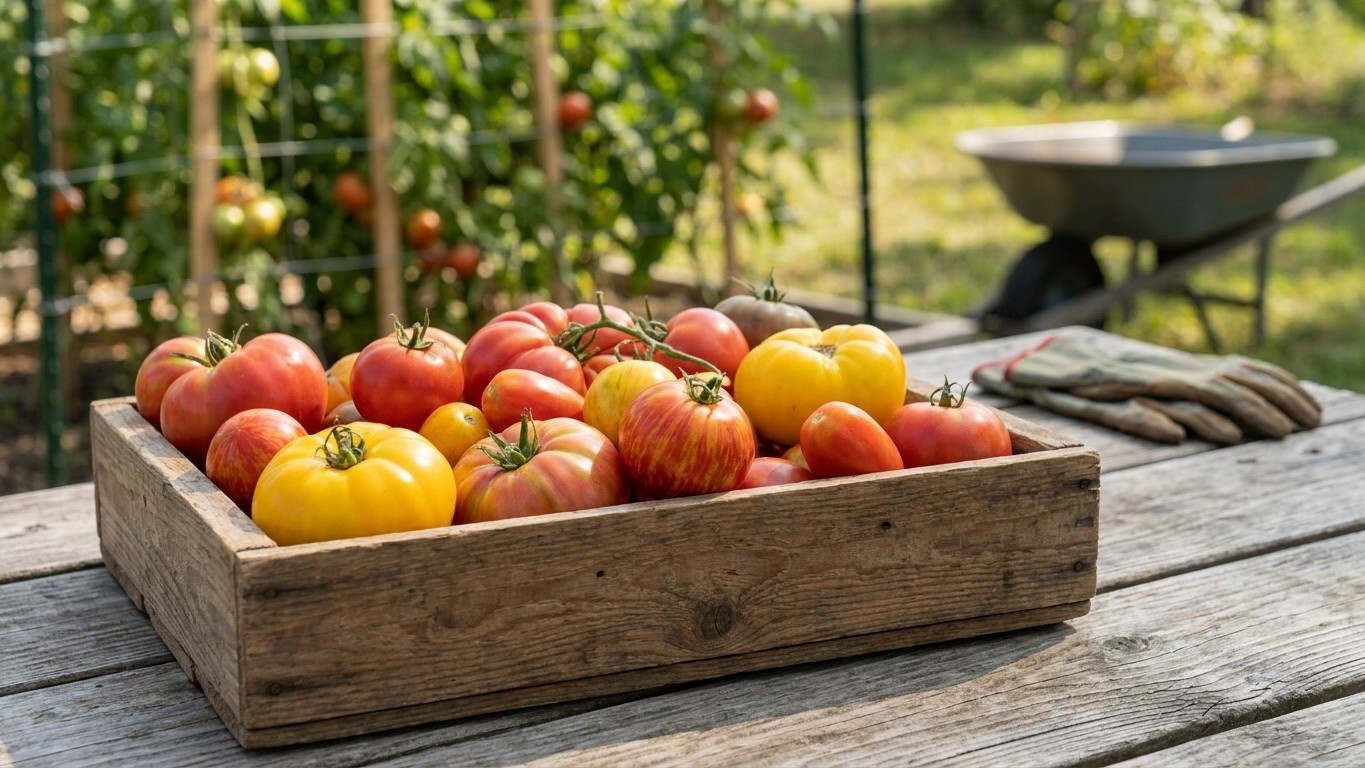

Omaha’s frost-free window looks generous on paper — April into late October, six months or more — which is exactly why so many 85-day tomatoes still end up green on the vine here. The season isn’t short in Nebraska; the trouble is a mismatch between a variety’s clock and where your own spring and fall actually fall within that range. Some cultivars finish with weeks to spare, others cut it close enough that one early cold night undoes the planting. The difference comes down to which variety you started with.
What this comes down to in Nebraska

At Omaha, NOAA’s 1991-2020 normals put the last spring freeze between April 12 and April 23 and the first fall freeze between October 15 and October 26. Stretch that out and the frost-free season runs somewhere between roughly five and a half and six and a half months, depending on where in that range your own spring and fall land. That’s a generous season by national standards, and it means the limiting factor for most Nebraska gardeners isn’t whether a tomato can ripen at all, it’s whether you’ve picked one that ripens with room to spare instead of one that’s still green when the first cold night rolls through.
If you’ve already worked through the basics of growing tomatoes in Nebraska, the list below picks up where that leaves off: which cultivars actually make good on that season, ordered from the ones that finish fastest to the ones that ask the most of it. Days to maturity on a seed packet is counted from the transplant date, not the sowing date, and catalog figures can shift by a week or two depending on the season, so treat every number below as a starting point for your own math, not a guarantee.
Fourth of July

Rated at about 49 days to maturity, this hybrid is one of the fastest slicers on the market and the earliest realistic pick for Omaha’s frost window. Fruit runs smaller than a standard slicer, which is the tradeoff for that speed. It’s the variety to grow for the earliest possible harvest, or as insurance against a cool, late spring.
Early Girl

At roughly 50 days to maturity, Early Girl is the standard early slicer most garden centers stock as transplants each spring. It’s indeterminate and keeps producing into fall once it starts. It gives an early first harvest without giving up much size, which makes it a safer bet than Fourth of July for a gardener who wants speed and a normal-sized tomato both.
Stupice

This Czech heirloom matures in about 52 to 60 days and was bred specifically for short, cool seasons, which is exactly Nebraska’s situation in a late spring. Fruit is small, with a strong, acidic flavor rather than the mild taste of most early hybrids. The potato-leaf foliage sets the plant apart visually from every other variety on this list.
Sun Gold

A cherry tomato at about 57 days to maturity, Sun Gold produces long trusses of small, thin-skinned fruit. It’s indeterminate and keeps setting new fruit until frost, so an early start pays off across the whole season rather than just at the front end. Fruit cracks easily after a heavy rain, so pick a day or two before you think it’s ready if a storm is coming.
Celebrity

Celebrity is a semi-determinate hybrid rated at about 70 days to maturity, bred for disease resistance and steady yield rather than for size or novelty. Fruit holds up well for both slicing and canning. It sits close to the midpoint of what Omaha’s season allows, which makes it a dependable main-crop choice rather than an early or a specialty pick.
Cherokee Purple

This beefsteak heirloom runs 80 to 85 days to maturity, among the longer common varieties that still fit comfortably inside Omaha’s frost window. Fruit is large and full-flavored, which is what draws gardeners to it despite the wait. It rewards an early, healthy transplant more than any variety above it on this list, since a slow start eats directly into an already thin margin.
Brandywine
Brandywine‘s catalog days-to-maturity spans 80 to 100 days depending on the seed source, making it the longest-season variety a Nebraska gardener is likely to plant. Fruit is large, ribbed, and full-flavored, the classic heirloom beefsteak. It’s the variety where the arithmetic in the next section matters most, because at the long end of its range it uses most of the slack Omaha’s season provides.
| Variety | Days to Maturity | Fruit Type | Habit |
|---|---|---|---|
| Fourth of July | 49 days | Small red slicer | Indeterminate |
| Early Girl | 50 days | Medium red slicer | Indeterminate |
| Stupice | 52 to 60 days | Small red heirloom | Indeterminate |
| Sun Gold | 57 days | Orange cherry | Indeterminate |
| Celebrity | 70 days | Medium-large red slicer | Semi-determinate |
| Cherokee Purple | 80 to 85 days | Large purple-pink beefsteak | Indeterminate |
| Brandywine | 80 to 100 days | Large pink beefsteak | Indeterminate |
Working it out for your own garden
The method is the same no matter which cultivar you’re weighing: take the transplant date your own frost record allows, add the catalog days-to-maturity, and see where that lands against your first fall frost. At Omaha, NOAA’s 1991-2020 normals put the transplant window at April 12 to April 23, so that’s the starting range for the two examples below. For the fuller week-by-week version of this calculation, including how to adjust it for a cold spring, see Tomato Planting Dates in Nebraska: Counting Back From Your Frost Window.
Take Celebrity, rated at 70 days to maturity. Transplant at the start of Omaha’s window (April 12) and the math lands the first ripe fruit around June 21. Transplant at the tail end of that window (April 23) and it lands around July 2. Either way, that’s roughly three and a half months of slack before Omaha’s first fall frost arrives, plenty of room even for a slow, cool summer.
Now run the same math on Brandywine, whose catalog days-to-maturity spans 80 to 100 days. At the earliest transplant date and the low end of that range, first fruit lands around July 1. At the latest transplant date and the high end of the range, first fruit doesn’t land until around August 1. That’s still ahead of Omaha’s fall frost window, but the cushion has shrunk from three and a half months to a little over two. A stretch of cool, cloudy weather in September, which slows ripening on any tomato, eats into that cushion fast, and it can disappear entirely once you’re working from a shorter local season than Omaha’s own.
The rule that falls out of both examples: anything under about 75 days to maturity finishes with months to spare in Omaha, and anything past 80 days is spending down a buffer that other parts of the state may not have.
What changes across the state
Omaha sits in the eastern part of the state, toward the milder end of Nebraska’s climate. The USDA’s Plant Hardiness Zone Map puts the state as a whole across zones 4a to 5b, with Omaha itself falling toward the warmer 5b end of that range. Move west toward the Panhandle, or up in elevation almost anywhere in the state, and the same map shifts to colder zones, which in practice means a shorter frost-free season than the one Omaha’s weather station records.
Where the season runs shorter
The difference isn’t uniform even within a single county. A garden sitting in a low spot that collects cold air overnight will frost out ahead of a garden a mile away on higher ground, regardless of what the nearest weather station reports. Northern and higher-elevation counties tend to see both a later last spring frost and an earlier first fall frost than Omaha, which shortens the season from both directions at once, right where the Brandywine-style calculation above loses its cushion.
This is also why the frost dates in this article come with a built-in caution: they’re measured at an airport weather station, and NOAA’s own data notes that surrounding suburban and rural gardens typically see the last spring frost later and the first fall frost earlier than the station figures, often by a week or two and more at elevation. A gardener forty minutes from Omaha shouldn’t assume the same dates apply, and one in the Panhandle should plan on the real season running shorter still.
The mistakes this state punishes

A few habits show up again and again in Nebraska gardens, and each one costs a real chunk of the season.
- Planting into cold soil after one warm week. A stretch of warm days in early spring convinces a lot of gardeners the frost risk has passed, but Omaha’s own last-frost window runs from April 12 to April 23, and a warm spell in late March doesn’t move it. Transplants set out too early just sit, stalled, until the soil actually warms.
- Choosing a variety that outruns the season. A 90 or 100-day heirloom like Brandywine works fine in an average Omaha year but leaves little room for a cool September or a garden whose own season runs shorter than the reference city’s.
- Ignoring the gap between the airport and the backyard. The frost dates above come from a single weather station, and a low-lying or rural garden can run a week or two colder on both ends, per NOAA’s own caution, so treating the station date as gospel is how a late frost catches a whole bed of tomatoes.
- Missing the point in the season when pest pressure shifts. Once fruit sets, watch for the pests that actually show up in Nebraska, covered separately in Tomato Pests in Nebraska: Which Ones Actually Show Up Here, rather than assuming a slow start was the only risk worth managing.
Checking this against your county
Every figure above comes from Omaha, one city in a state that the USDA’s hardiness map spreads across zones 4a to 5b. Before you lock in a planting date or a long-season variety, treat the Omaha numbers as a starting point and check them against your own county extension office or the University of Nebraska-Lincoln Extension, since a garden in the Panhandle or a low-lying rural plot can run a week or two colder on either end of the season. This article settles the general shape of the problem, but it’s not the final word for your own backyard.
Common questions
Can I grow Brandywine in Nebraska or is it too risky?
Yes, but give it every advantage the season allows. Start seed indoors early enough to transplant a stocky, healthy plant right at the start of Omaha’s frost window rather than after it, and pick a warm, sheltered spot in the yard. It carries less margin than a 50 to 70-day variety, so it suits a gardener who controls their own transplant date better than one buying whatever’s left at the garden center in late May.
Does the days-to-maturity number start from when I sow the seed or when I transplant?
From transplant, not from the sowing date on the seed packet. A 70-day tomato started indoors in late winter still lands its first ripe fruit something like 70 days after it goes into the ground outside, not 70 days after you planted the seed.
What if my town’s frost dates are different from Omaha’s?
They probably are, at least a little. Check your county extension office or NOAA’s data for the station nearest you, since the Omaha figures in this article are a reference point, not a state-wide rule, and rural or higher-elevation gardens commonly run a week or two colder on both ends of the season.
Is it better to buy transplants or start my own seed for a long-season variety?
Starting your own seed gives you control over the one thing that matters most for a long-season heirloom: hitting the early end of the transplant window with a plant that’s already several weeks old, rather than waiting on garden centers to stock transplants, which is often later than the earliest safe date allows.