
Nebraska gardens see a short, predictable rotation of tomato pests, not the long national list you find in a general guide. Cutworms and flea beetles show up as soon as transplants go into the ground, which for the Omaha area falls after NOAA’s 1991-2020 climate normals put the last spring freeze between April 12 and April 23, and hornworms and stink bugs build through summer toward Omaha’s typical first fall frost of October 15 to October 26. Walk your rows twice a week from transplant through harvest and match what you find against the seven pests below before you reach for any spray.
What this comes down to in Nebraska

The pests that matter here follow the calendar as much as the plant. Early-season damage is almost always cutworms or flea beetles working on young transplants. Midsummer brings aphids, spider mites and sometimes Colorado potato beetle, which will happily move onto tomatoes from a nearby potato patch. Late summer through the run toward fall frost is hornworm and stink bug season. Knowing which stage of the season you’re in narrows the list before you even look at the plant.
Cutworms

These show up right at transplant, which lines up with the stretch after the local frost window closes. A seedling that’s been sliced clean through at the soil line overnight, with no beetle or caterpillar visible on the plant itself, is cutworm work. The caterpillar hides in the soil during the day and feeds at night, so you won’t catch it unless you dig around the base. A cardboard or foil collar pushed an inch into the soil around each transplant stops it cold, and it’s cheaper than replacing seedlings twice.
Flea Beetles

These arrive around the same time as cutworms but attack the leaves instead of the stem. Young transplants riddled with tiny round holes, like they’ve been hit with fine buckshot, are the signature. Established plants shrug off light feeding, but a bad flea beetle year can stall a transplant before it ever takes hold. A floating row cover over the bed until plants are established keeps them off without a spray.
Colorado Potato Beetle

This one is a potato pest first, but it moves onto tomatoes without much hesitation, especially in a garden where the two crops share a bed or a fence line. Look for the striped adult and the orange, humpbacked larvae feeding together and stripping leaves back to the ribs. Handpicking works if you catch it early; on a bigger planting, rotating tomatoes away from last year’s potato ground cuts the carryover population.
Aphids

Soft-bodied and slow-moving, aphids cluster on new growth and the undersides of leaves, and you’ll usually spot the sticky honeydew they leave behind before you spot the insect. Heavy infestations curl and yellow the foliage. A strong water spray knocks most colonies down, and insecticidal soap handles the rest without wiping out the lady beetles that would otherwise keep the population in check on their own.
Two-Spotted Spider Mite

Mites show up in the hottest, driest stretch of summer, when dust and heat favor them. The damage looks like fine pale stippling on the leaves, almost a bronzing, and fine webbing on the undersides confirms it since the mite itself is nearly too small to see. A forceful hosing of the foliage every few days breaks up colonies; a hot, dry August is exactly when to start checking.
Tomato Hornworm

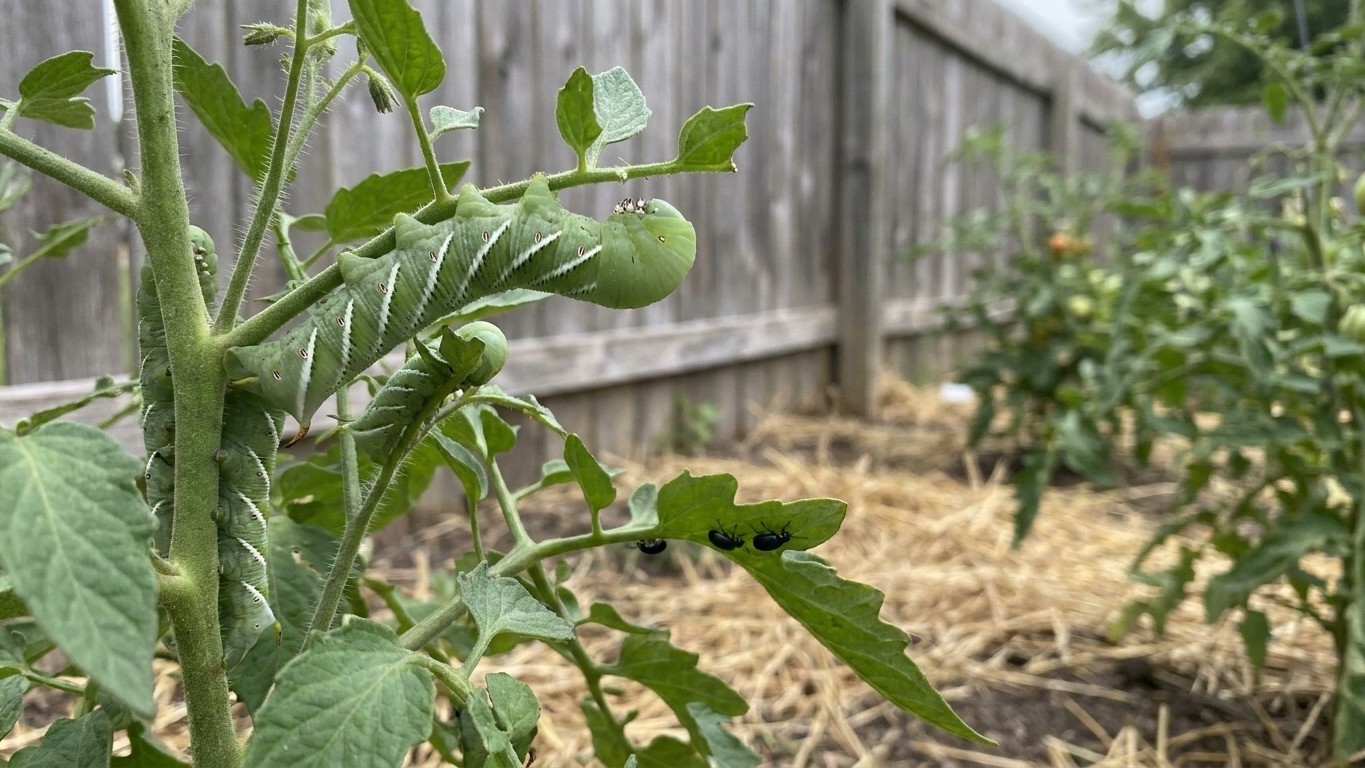
By midsummer this is the pest most gardeners actually notice, because the damage is dramatic: whole branches stripped of leaves almost overnight, with dark green droppings on the leaves below giving away the caterpillar’s location before you spot the caterpillar itself. It’s large and well camouflaged against the stem, so run your hand along the stripped branches rather than relying on your eyes alone. Handpicking is effective on a home planting; Bacillus thuringiensis (Bt) works if the population gets ahead of you.
Stink Bugs
These arrive late, feeding on fruit as it ripens through the stretch toward the first fall frost. The bug itself is easy to miss, but the damage isn’t: hard, pale, cloudy spots just under the skin where it pierced the fruit to feed. Damaged fruit is still edible once you cut around the spot, but heavy feeding late in the season can cost you a chunk of the last harvest before frost ends things anyway.
Working it out for your own garden
Diagnosis is mostly a process of elimination, and the order you check things in matters more than any single clue. Start with the calendar: a plant sliced off at the base right after you set it out is a different problem than a plant losing whole branches in August. Then look at which part of the plant is damaged: stem, leaf, or fruit. Then look for the insect itself, checking at dawn or dusk for the pests that hide during the heat of the day.
A quick diagnostic table
| What you see | Likely pest | When it shows up |
|---|---|---|
| Seedling cut off at soil line | Cutworm | Right after transplant |
| Small round holes across leaves | Flea beetle | Right after transplant |
| Leaves stripped to the ribs, striped beetle present | Colorado potato beetle | Early to mid summer |
| Curled, yellowing new growth, sticky residue | Aphids | Mid summer |
| Fine pale stippling, webbing underneath | Two-spotted spider mite | Hot, dry stretch of summer |
| Whole branches defoliated, droppings below | Tomato hornworm | Mid to late summer |
| Hard pale blotches under ripening fruit skin | Stink bug | Late summer into fall |
This is where it pays to already have your Tomato Planting Dates in Nebraska: Counting Back From Your Frost Window worked out, because knowing exactly when you transplanted tells you immediately whether new damage is a transplant-stage pest or a midseason one. The single most useful habit is checking the underside of the leaves, not just the top, since aphids, mites and young hornworms all show themselves there first.
What changes across the state
The frost figures above come from Omaha, and USDA’s hardiness map puts the state as a whole across zones 4a to 5b, which tells you plainly that a single set of numbers doesn’t hold from the Panhandle to the Missouri River. Western Nebraska runs drier and often cooler at higher elevation, and that dryness favors spider mites, which thrive on dusty, stressed foliage and can build up faster there than in a more humid eastern garden. Eastern Nebraska’s higher humidity in a wet year tends to favor aphid populations instead, since aphids don’t cope as well with heavy rain knocking them off the plant, so you may see more washed-out colonies there naturally.
Elevation also shifts the calendar itself. A garden higher up or further west typically sees its first fall frost arrive earlier than Omaha’s, which shortens the window for late pests like stink bugs and gives the hornworm generation less time to do damage before the season ends outright. None of this changes which seven pests to watch for, only how much pressure each one puts on your plants and how long that pressure lasts. If you garden anywhere outside the Omaha area, treat the frost dates above as a starting reference and expect your own to run a bit later in spring and a bit earlier in fall.
The mistakes this state punishes

The most common mistake is skipping cutworm collars because the spring looked warm and the seedlings seemed sturdy. A run of mild days before a cold snap does nothing to change cutworm behavior, and gardeners who plant during a warm stretch right after Omaha’s frost window closes still lose seedlings to cutworms working at night in soil that hasn’t fully warmed. Put the collar on anyway.
The second mistake is reaching for a broad-spectrum insecticide the first time aphids or mites show up. That kills the lady beetles and predatory mites that would otherwise hold the population down on their own, and the pest population often rebounds worse than before because its predators are gone and it isn’t. Scout before you spray, and spray the narrowest option that will do the job, whether that’s a strong water spray, insecticidal soap, or handpicking.
The third is waiting too long on hornworms. Because the caterpillar is so well camouflaged, gardeners often don’t notice it until a branch or two is already stripped bare, and by then the caterpillar has usually grown large enough that it’s doing damage fast. Checking the stripped branches for droppings every few days during peak summer catches it earlier than waiting to spot the caterpillar by eye.
The fourth is planting tomatoes in the same bed as last year’s potatoes, which hands Colorado potato beetle a head start since the larvae overwinter in the soil near their host plant. Rotating the bed, even a modest distance, cuts down how many beetles find your tomatoes in spring without any spray at all.
Checking this against your county
Everything above is a starting point built around Omaha’s frost record, and pest pressure in your own yard depends on your soil, your neighbors’ gardens, and how wet or dry your particular season runs. Your county extension office can tell you what’s actually being reported nearby in a given year, and UNL Extension’s own resources at extension.unl.edu are the right place to check current guidance before you treat anything with a broad-spectrum product. If you haven’t nailed down the basics of growing tomatoes in Nebraska yet, sort that out first, since a healthy, properly spaced plant shrugs off far more pest pressure than a stressed one.
Common questions
Do I need to spray for hornworms every year?
No. Some years you’ll find one or two caterpillars total and handpicking is plenty; other years, especially if a moth laid a heavy batch of eggs nearby, you’ll see enough to justify Bt. Check plants every few days in mid to late summer rather than spraying on a schedule.
Are the little green worms on my tomatoes hornworms or something else?
If it’s large, plump, bright green with white diagonal stripes and a horn at the tail, it’s a hornworm. Smaller green caterpillars without the stripes or horn are more likely armyworms or cabbage loopers, which occasionally wander onto tomato foliage but don’t cause the same scale of damage.
Why do my tomato leaves have holes but I never see a bug?
Flea beetles feed briefly and then drop or hop away the second the plant moves, so you’ll often see the shot-hole damage without ever catching the beetle in the act. Check very early in the morning when they’re sluggish from the cooler temperature, or shake a leaf gently over a white sheet of paper to see what falls off.
Is it too late to plant tomatoes if pests already got my first batch?
That depends entirely on how much of the season is left and which cultivar you’d be replanting with. Work backward from your local first fall frost using the days-to-maturity on the seed packet, and check Tomato Varieties That Ripen in Time in Nebraska for shorter-season options if you’re replanting later than you’d planned.