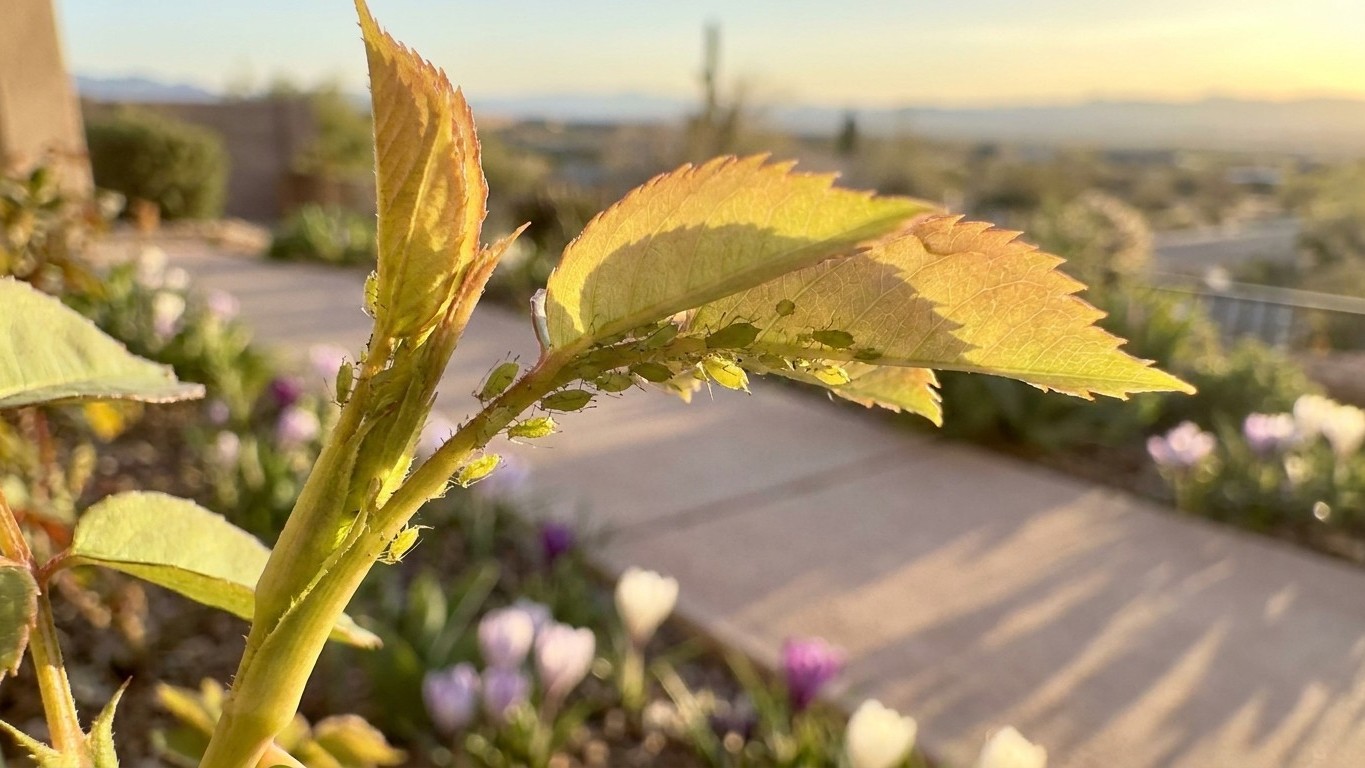

Aphids in Nevada follow the water, not the calendar. In Las Vegas and Henderson, they cluster on new growth in March and April, vanish once summer temperatures pass the century mark, then reappear on a second wave in late September. In Reno, Carson City, and the high desert valleys, the season starts later, usually late April through June, and can stretch into fall because the heat never gets brutal enough to knock populations back. In the farming valleys around Fallon and Lovelock, timing tracks alfalfa cutting cycles more than the thermometer.
What actually stops them isn’t a single product. It’s a mix of dry-climate physics, beneficial insects that are already doing the work, and knowing when NOT to spray.
When Aphids Actually Show Up in Nevada

Nevada’s elevation range does more to shape aphid timing than most homeowners realize. Las Vegas sits around 2,000 feet and Henderson isn’t far off, so soil warms early and tender new growth on roses, crape myrtle, and vegetable transplants shows up by March. Aphids find that new growth almost immediately, feeding on the soft tissue at branch tips and the undersides of young leaves.
Reno and Carson City sit closer to 4,500 feet, and Elko pushes past 5,000. Cold nights linger longer at that elevation, so plants leaf out later and aphid activity typically doesn’t ramp up until late April or May. The tradeoff is that the growing season up there never hits the punishing 110-plus degree stretches that shut down aphid reproduction in the Las Vegas Valley every July and August. That means a Reno rose bush can host aphids in a slow, steady way from spring through early fall, while a Las Vegas rose bush gets a spring flush, a brutal summer lull, and then a second smaller wave once nights cool in September.
Rural agricultural counties run on a different clock entirely. Churchill County around Fallon and Pershing County around Lovelock grow substantial alfalfa acreage, and pea aphids and cowpea aphids build up in the weeks between cuttings. Each harvest removes the crop the aphids were feeding on, which functions as a built-in population reset. Growers who track cutting schedules are, in effect, already managing aphid pressure without spraying anything.
Why the Desert Climate Changes the Rules
Low humidity works in a homeowner’s favor here in a way it doesn’t in wetter states. Spraying plants down with water to physically dislodge aphids is a standard first-line tactic almost everywhere, but in humid regions it carries a real risk of fungal leaf disease because the moisture sits on foliage for hours. In Nevada’s dry air, leaves typically dry within an hour or two even after a thorough hosing, which makes plain water one of the most underused, lowest-cost tools available to Nevada gardeners.
The flip side is that irrigated landscaping creates artificial pockets of lush growth in the middle of an otherwise arid environment, and aphids gravitate straight to those pockets. A backyard vegetable bed, a rose border, or a shade tree on a drip line becomes an oasis for aphids surrounded by high desert scrub that can’t support them at all. That’s part of why aphid problems in Nevada tend to concentrate hard on landscaped, irrigated properties rather than spreading evenly across a region.
Which Aphids Show Up Where
The species involved shift depending on where in the state you’re standing:
- Green peach aphid and rose aphid dominate urban and suburban landscapes in Las Vegas, Henderson, and Reno, targeting roses, ornamental shrubs, and vegetable transplants like peppers and tomatoes.
- Pea aphid and cowpea aphid are the primary concern in commercial alfalfa fields around Fallon, Lovelock, and other irrigated farming valleys.
- Woolly apple aphid shows up on fruit trees in higher-elevation orchard settings like Carson Valley and parts of Pahrump, recognizable by the cottony white wax coating on bark and roots rather than leaves.
Signs of an Infestation Worth Acting On
Curled or yellowing new leaves are usually the first visible clue, since aphids feed by piercing soft tissue and drawing out plant sap. Look closely at the undersides of leaves and along stem tips before assuming it’s drought stress or sunburn, both of which are common misdiagnoses on Nevada landscape plants during hot months.
A sticky film on leaves, patio furniture, or the ground beneath a tree is honeydew, the sugary waste aphids excrete as they feed. Left alone, that honeydew grows a black fungus called sooty mold, which coats leaves and can reduce a plant’s ability to photosynthesize even though the mold itself isn’t directly feeding on the plant. Ants trailing up and down stems are another giveaway. Ants farm aphids for honeydew, and colonies will actively defend aphid clusters from predators like ladybugs, which makes ant control an overlooked piece of aphid management on Nevada properties.
What Stops Aphids in Nevada Conditions
Water pressure is the cheapest and often most effective first response. A firm spray from a garden hose aimed at the undersides of leaves knocks aphids off the plant, and because they’re weak crawlers, many never make it back. In Nevada’s low-humidity air, this carries almost none of the fungal disease risk that makes hard leaf-wetting a gamble in humid states. Doing this every few days for a week or two, especially on new spring growth, handles light to moderate infestations on roses, vegetables, and ornamentals without any product at all.
Beneficial insects are already present across most of the state and deserve more credit than they get. Ladybugs, lacewing larvae, and syrphid fly larvae all feed heavily on aphids, and a single ladybug can consume dozens in a day during its larval stage. Broad-spectrum insecticides kill these predators right alongside the aphids, which frequently makes infestations worse in the following weeks because the aphids reproduce faster than their predators can recover. Avoiding unnecessary spraying, particularly during spring bloom when Nevada’s native bee populations and other pollinators are most active, protects the very insects doing free pest control.
Insecticidal soap and horticultural oil are the next step up for infestations that water alone doesn’t handle. Both work by suffocating or disrupting the aphid’s outer coating rather than through systemic chemical action, which makes them lower-risk for beneficial insects when applied directly to visible clusters. The one Nevada-specific caution: apply these in early morning or evening, never during peak afternoon heat, since oil and soap residues on leaf surfaces can cause leaf burn when combined with intense desert sun exposure, especially in Las Vegas and Pahrump during late spring and summer.
For ant-protected aphid colonies, treating the ant trail rather than the aphids directly often breaks the standoff faster. Removing the ants’ incentive to defend the colony opens the door for ladybugs and lacewings to move back in.
In commercial alfalfa production, growers rely on established economic thresholds, counting aphids per stem before deciding whether treatment is worth the cost, since a light infestation rarely justifies the expense or the disruption to beneficial insects that keep populations in check between cuttings. Home gardeners don’t need that level of precision, but the underlying principle holds: a few aphids on a rose bud usually isn’t worth reaching for a spray bottle. A cluster thick enough to visibly curl leaves and coat stems in honeydew is.
A Practical Seasonal Check by Region
Homeowners in the Las Vegas Valley should watch new growth closely from March through May, expect a quiet summer once daytime highs stay above 105 degrees, and check again in September as temperatures ease. In Reno, Carson City, and the Truckee Meadows, the watch period runs longer, from late April into October, since the climate never delivers the same aphid-suppressing heat spike. Rural residents near Fallon or Lovelock with fruit trees or vegetable gardens should pay closest attention right after alfalfa cutting nearby, since displaced aphids sometimes migrate to garden plants when their host field gets mowed down.
None of this requires guesswork about which product to buy first. It requires knowing that in Nevada, water pressure and patience handle more of the problem than most people assume, and that the state’s dry air is doing gardeners a favor most humid-climate guides never mention.
Related guides
- Aphids in Oregon: When It Shows Up and What Stops It
- Aphids in Idaho: When It Shows Up and What Stops It
- Aphids in New Mexico: When It Shows Up and What Stops It
- Aphids in Northwest Territories: When It Shows Up and What Stops It
- Cabbage moth in Nevada
- Mormon cricket in Nevada
- Aphids in Tennessee: When It Shows Up and What Stops It
- Aphids in Wisconsin: When It Shows Up and What Stops It