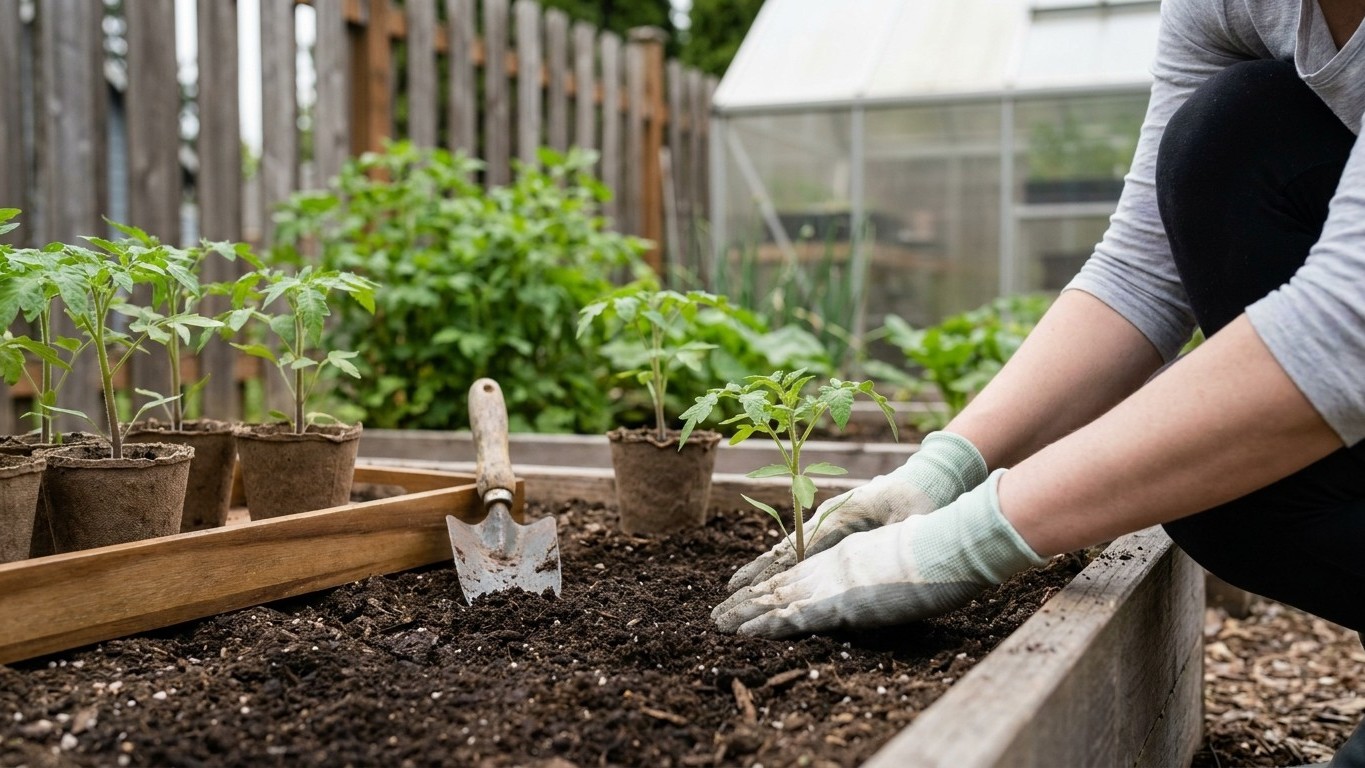

Oregon’s tomato transplant date depends on when the last spring frost clears, and NOAA’s NCEI 1991-2020 climate normals put that date at Portland between March 6 and March 21. Everything else, from hardening off seedlings to setting plants in the ground, counts forward or backward from that window. Check the closer NOAA station or your county extension office against this Portland figure before you move transplants outside, because a number measured at one city does not hold for the whole state.
What this comes down to in Oregon

Portland’s last-frost window runs March 6 to March 22, and that date alone is the reason so many tomato transplants end up stunted in cold soil. A frost date only marks when freezing becomes unlikely — it says nothing about when tomato roots actually start growing, which takes soil warmer than the ground usually is that early. Add the fall side, a first freeze landing sometime between November 11 and November 27, and the Willamette Valley’s real planting window sits somewhere in the eight months between, not on the date itself.
Growers working from this window generally hold transplants until mid-March to early April, a stretch that starts after the freeze probability has already dropped and gives soil another week or two to warm past the point where tomato roots actually grow. The last-frost date is not a planting date. It is the point after which frost becomes unlikely, not the point at which tomatoes want to go in the ground. Soil temperature and a run of mild nights matter as much as the calendar here, and neither shows up in a frost normal.
The other half of the equation is the fall side. NOAA’s same 1991-2020 normals put Portland’s first fall freeze between November 11 and November 27. That gives the Willamette Valley a working season of roughly eight months between the two windows, which is generous by Oregon standards and is exactly why the catalog margins on most tomato varieties, worked out below, come in well over a hundred days. None of this applies once you leave the valley floor, which the section on regional variation below addresses directly. The dates below line up the basics of growing tomatoes in Oregon.
Working it out for your own garden
The arithmetic, step by step
Start from NOAA’s last-frost window for Portland, March 6 to March 21. Add the week or two most growers hold past that window for soil warmth and safety margin, and you land on mid-March to early April as a transplant range, still a range, never a single date. Catalog days-to-maturity are counted from that transplant date, not from seed, so add the variety’s number directly onto the transplant window to get a ripening window.
Take Sakura, a 55-day indeterminate cherry tomato. Transplanted mid-March to early April, 55 days lands the first ripe fruit in late May, which is where the catalog figure for this variety comes from. Measured against NOAA’s fall-frost window starting November 11, that leaves about 166 days of margin, an enormous cushion at Portland. Now take San Marzano II, a 78-day indeterminate paste tomato. Same transplant window, but 78 days pushes first ripe fruit to late June, leaving 143 days of margin before the earliest fall frost date. Both finish comfortably at Portland, but the gap between them shows how fast margin shrinks as days-to-maturity climbs, and that gap becomes the whole story once you leave the Willamette Valley.
| Variety | Days to maturity | Transplant window | First ripe fruit | Margin before Portland’s earliest fall frost |
|---|---|---|---|---|
| Sakura | 55 | mid-March to early April | late May | 166 days |
| Juliet | 60 | mid-March to early April | early June | 161 days |
| San Marzano II | 78 | mid-March to early April | late June | 143 days |
A 143-day margin at Portland is not a rule for the rest of the state. In a shorter season, the same 78-day San Marzano II can run out of room before it sets fruit reliably, and picking a shorter-season cultivar becomes the fix rather than pushing the transplant date earlier. For a full lineup of what finishes reliably in this state’s various seasons, Tomato Varieties That Ripen in Time in Oregon works through the whole catalog against these same frost numbers.
What changes across the state
The Portland figures above describe the Willamette Valley and nowhere else with the same precision. USDA’s 2023 Plant Hardiness Zone Map spans Oregon from 4a to 9b, a range wide enough to cover a coastal garden and a high desert plateau in the same state, and that spread alone tells you a single frost window cannot travel far from where it was measured.
Coast, valley, and high desert
The Oregon coast runs milder and more even than the valley, with the Pacific keeping both spring and fall temperature swings smaller, though fog and cool marine air can slow tomato ripening even where frost itself arrives late. The Willamette Valley, where the NOAA figures above were measured, sits in between: real frost risk in spring, but a long enough season that even the 78-day varieties finish with room to spare. Central and eastern Oregon are a different climate entirely. Higher elevation and distance from the Pacific’s moderating effect mean a later last frost, an earlier first frost, and a shorter frost-free season overall, sometimes dramatically so.
Elevation does the same thing on a smaller scale even within western Oregon. A garden a few hundred feet higher than the valley floor, or one that sits in a low spot where cold air pools on a still night, can run a week or more behind a nearby garden at a lower or more exposed elevation. South-facing slopes and gardens close to a large body of water tend to warm earlier and hold heat longer into fall than low-lying or north-facing ground nearby. None of these differences comes with a NOAA number attached the way Portland’s does, which is exactly why local judgment and a look at your own site matter more than the printed frost window once you’re outside the Willamette Valley.
The mistakes this state punishes

Oregon’s spring weather has a habit of throwing a stretch of genuinely warm days into February or early March, well before NOAA’s freeze-probability window for Portland has closed, and that warm spell is what gets transplants killed. A warm week does not mean frost risk is over. The freeze probability band from NOAA’s 1991-2020 normals runs through March 21, and a late cold night after an early warm spell is a normal pattern here, not a fluke.
- Setting transplants out during a warm spell before the frost window has closed, then losing them to a clear, cold night afterward.
- Choosing a long-season variety like San Marzano II or Granadero for a garden east of the Cascades or at real elevation, where the season measured at Portland does not apply.
- Planting into cold, wet soil that has not actually warmed, which stalls root growth even when the air temperature looks fine.
- Skipping row cover or another form of protection in the first few weeks, when a late frost is still statistically live even after the transplant date.
Early transplants sitting in cool soil are also more vulnerable to early-season pests than a plant that goes in once the ground has genuinely warmed, since a stressed seedling recovers more slowly from feeding damage than a vigorous one. Tomato Pests in Oregon: Which Ones Actually Show Up Here covers what to watch for once plants are in the ground.
Checking this against your county
The Portland numbers are a starting point, not a verdict for your address. Oregon State University’s Extension Service, at extension.oregonstate.edu, publishes county-level guidance that accounts for elevation, coastal influence, and the high-desert climate east of the Cascades in a way a single statewide page cannot. Call or check the site for your own county office before locking in a transplant date, especially if you garden outside the Willamette Valley where these NOAA figures were measured.
Common questions
Can I just plant on the average last frost date and skip the range?
No, because the range itself is the useful information. NOAA’s 1991-2020 normals for Portland give a freeze-probability band from March 6 to March 21, not a single day, and picking one date out of that range throws away the margin the range was built to show you.
What if my last frost date locally is different from Portland’s?
Use your own, if you know it. The Portland figures come from a specific NOAA station and should not be applied to a garden in a different part of the state without checking a closer source or your county extension office.
Does starting seeds indoors earlier get me a head start on this window?
It gets your seedlings bigger before the transplant window opens, not an earlier safe transplant date. The frost risk on the ground does not move because your seedlings are ready sooner, and an oversized, rootbound seedling often transplants worse than one started on a normal schedule.
Is it worth pushing the transplant date earlier with row cover or wall-o-water protection?
Some growers do it and it can work, but it shifts risk rather than removing it. Protection can get a plant through a light frost, but the freeze-probability window from NOAA reflects real cold snaps that can beat covers still low on the plant, so treat an early transplant under cover as a calculated risk rather than a way to ignore the window entirely.
Some gardeners also time this by the Moon: when to plant tomatoes by the moon, as almanac tradition rather than fact.