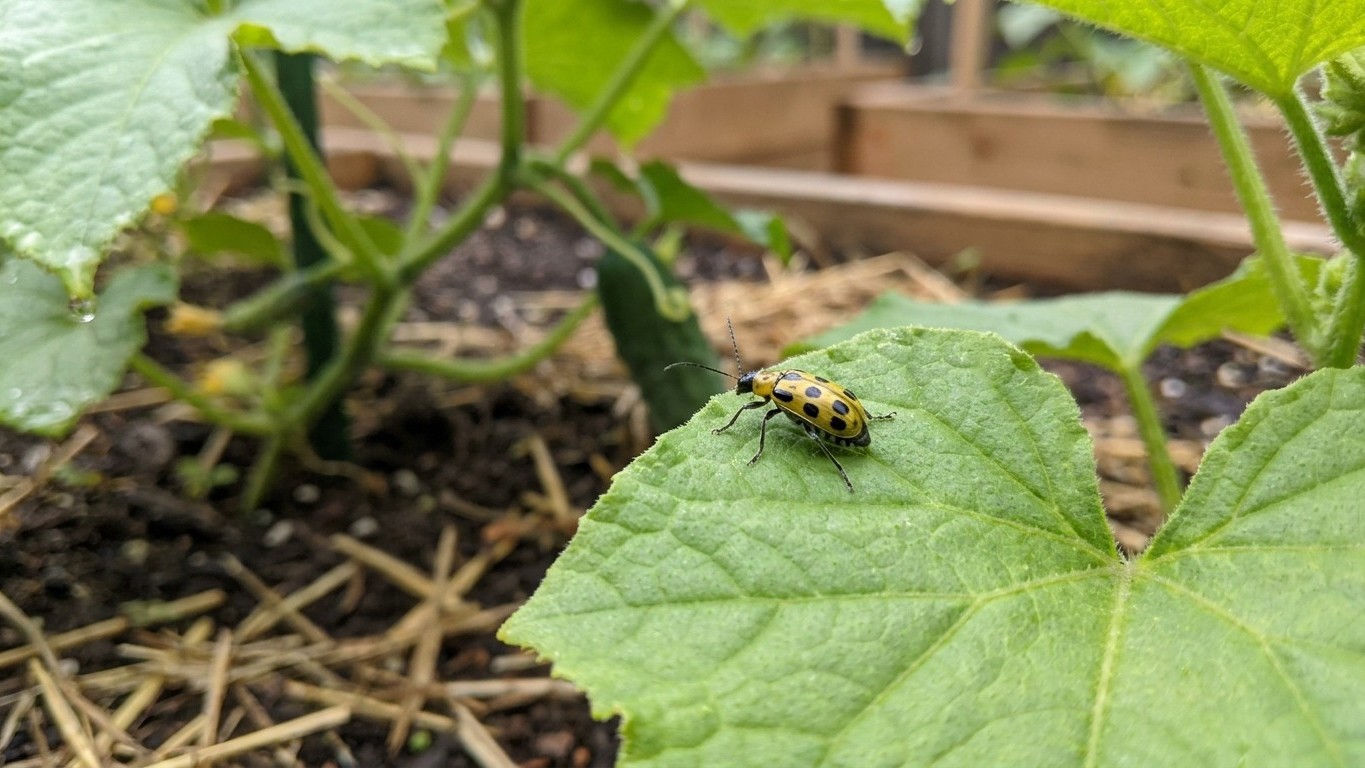

Cucumber beetles typically show up in Oregon gardens from mid-May through June, once soil temperatures climb past 55°F and cucurbit seedlings break ground. The western spotted cucumber beetle (Diabrotica undecimpunctata) is the species most Oregon gardeners actually deal with, not the striped cucumber beetle that dominates headlines in Midwest gardening guides. Row covers removed before flowering, yellow sticky traps set at transplant time, and a two-week delay in planting cucurbits are the three moves that make the biggest dent in populations here.
When Cucumber Beetles Actually Arrive in Oregon

Oregon’s climate splits the state into two very different beetle timelines. In the Willamette Valley, where spring soil warms slowly under marine-layer clouds, adult beetles usually don’t become active until late May. East of the Cascades, in places like the Treasure Valley or the Columbia Basin, faster soil warming and irrigated cropland can push emergence into early May, sometimes a full three weeks earlier than in Portland-area gardens.
These beetles overwinter as adults, tucked under leaf litter, garden debris, or bark mulch. They don’t fly in from somewhere else each spring. The same adults that fed on your squash last September are the ones waking up nearby this year, which is why cleaning up plant debris in fall does more good than most gardeners assume. A beetle that has nowhere to overwinter close to your cucurbit bed has to travel farther to find one, and every extra yard of bare ground or turf lawn between its hiding spot and your plants cuts survival odds.
Peak activity in western Oregon runs from June through early August, tapering as squash and cucumber plants mature and their leaves get tougher. A second, smaller population bump can appear in late August as a new generation of adults emerges from the soil, right around the time zucchini plants are still producing and gardeners are least prepared to keep watching for pests.
Spotted vs. Striped: Which One You’re Actually Seeing
Most cucumber beetle identification guides online are written for the Midwest and Northeast, where the striped cucumber beetle (Acalymma vittatum) is the primary pest. Oregon is different. The western spotted cucumber beetle, with twelve black spots on a yellow-green back, is far more common statewide. It’s about a quarter-inch long, and at a glance it can be mistaken for a ladybug that lost its curves, since its body is more elongated and flattened.
The striped cucumber beetle does turn up in parts of Oregon, particularly in warmer valley locations, but it’s the exception rather than the rule. Confusing the two matters less for pest control decisions and more for predicting disease risk, covered below, since the striped species carries a bacterial pathogen far more efficiently than the spotted one.
What Damage Actually Looks Like
Adult beetles chew ragged holes in leaves and flowers, and they’ll scar the surface of young cucumbers, squash, and melons with shallow feeding marks. Seedlings take the worst hit. A cucumber plant with two true leaves can be stripped down to stems in a couple of days if a cluster of beetles finds it before it’s established. Established plants with six or more leaves tolerate feeding damage far better and rarely need aggressive intervention.
The larvae are the quieter threat. They live in the soil and feed on roots, which weakens the whole plant’s ability to take up water during Oregon’s dry summer stretch. A plant that looks droopy on a 90-degree July afternoon in the Rogue Valley might not be under-watered at all. It might be running on a root system that’s been chewed down by beetle larvae for weeks.
The disease risk gets more attention than the direct feeding damage, and for good reason. Cucumber beetles can transmit bacterial wilt (Erwinia tracheiphila), a pathogen that clogs a plant’s vascular tissue and causes sudden, irreversible wilting. The good news for Oregon growers: bacterial wilt is documented as far less prevalent in the Pacific Northwest than in the Midwest and Southeast, largely because the striped cucumber beetle, the more efficient vector, is less common here and the region’s cooler, drier summer air doesn’t favor the bacteria’s survival. Gardeners in eastern Oregon’s warmer microclimates should still watch for it, but it’s not the near-guarantee it is in states like Iowa or Ohio.
What Actually Stops Them
Timing beats chemistry for most home gardeners dealing with this pest. Cucumber beetles target young, tender seedlings almost exclusively for their most damaging feeding. Delaying cucurbit planting by two to three weeks past the usual last-frost date, so seedlings emerge with beetle populations already past their spring peak, sidesteps a large share of the problem without spending a dollar.
Floating row covers work well as a physical barrier, but only if used correctly. Cover the bed immediately after seeding or transplanting, seal the edges with soil or landscape staples so beetles can’t crawl underneath, and remove the cover the moment flowers open. Cucumbers, squash, and melons need pollinators to set fruit, and a row cover left on too long blocks bees along with beetles. That timing window, usually three to five weeks after planting depending on the variety, is the trickiest part of using covers well.
Yellow sticky traps, placed at plant height near the base of young seedlings, exploit the beetles’ strong attraction to yellow. They won’t eliminate a population, but they give a useful early warning. Checking traps twice a week during May and June tells you whether beetle pressure in your specific yard is heavy enough to justify further action, or light enough to ignore.
Kaolin clay, sold under various garden product names as a spray-on particle film, coats leaves in a fine white powder that beetles find irritating to walk and feed on. It needs reapplication after rain or heavy overhead watering, which makes it a better fit for drier eastern Oregon gardens than for the wetter Willamette Valley spring.
For anyone dealing with a heavy infestation, a short list of additional tactics tends to cover most situations:
- Hand-picking beetles into a jar of soapy water during the cooler morning hours, when they’re slower to fly off
- Planting a trap crop like blue hubbard squash a few feet away, since beetles strongly prefer it over other cucurbits and can be concentrated there and removed
- Applying beneficial nematodes to the soil in spring to target beetle larvae before they mature
- Rotating cucurbit planting locations each year so emerging adults don’t wake up next to a ready food source
- Using neem oil or pyrethrin sprays only as a last resort, applied in the evening after bees have finished foraging for the day
Regional Differences Worth Planning Around
Oregon’s growing regions don’t share one beetle calendar, and gardeners moving between them, or advising neighbors, should account for that. In the Willamette Valley, cooler soil and later planting dates push most beetle activity into a tighter June-through-July window, which makes row covers and delayed planting especially effective since there’s a shorter period to protect. In the Columbia Basin and other irrigated high-desert areas, warmer soil brings beetles out earlier and keeps them active longer into September, so gardeners there benefit more from season-long trap monitoring rather than a short defensive window.
Southern Oregon’s Rogue and Umpqua valleys sit somewhere in between, with warm summer days that speed up beetle reproduction. A single female cucumber beetle can lay several hundred eggs over her lifetime, and warmer soil accelerates larval development, meaning southern Oregon gardens can see two overlapping generations in one season where the Willamette Valley typically sees closer to one and a half.
Coastal Oregon gardens, by contrast, deal with the lightest cucumber beetle pressure in the state. The consistently cool, damp climate slows both beetle activity and the cucurbits themselves, which shrinks the window during which either overlaps in a damaging way. Gardeners along the coast growing cucumbers or squash in unheated soil often find beetle damage is a minor nuisance rather than a season-defining problem.
None of this means coastal or valley gardeners can skip monitoring altogether. A mild winter followed by an early warm spring, something Oregon has seen more of in recent years, can shift emergence dates earlier across every region at once, catching gardeners off guard if they’re planning around a calendar date rather than watching actual soil temperature and beetle trap counts.