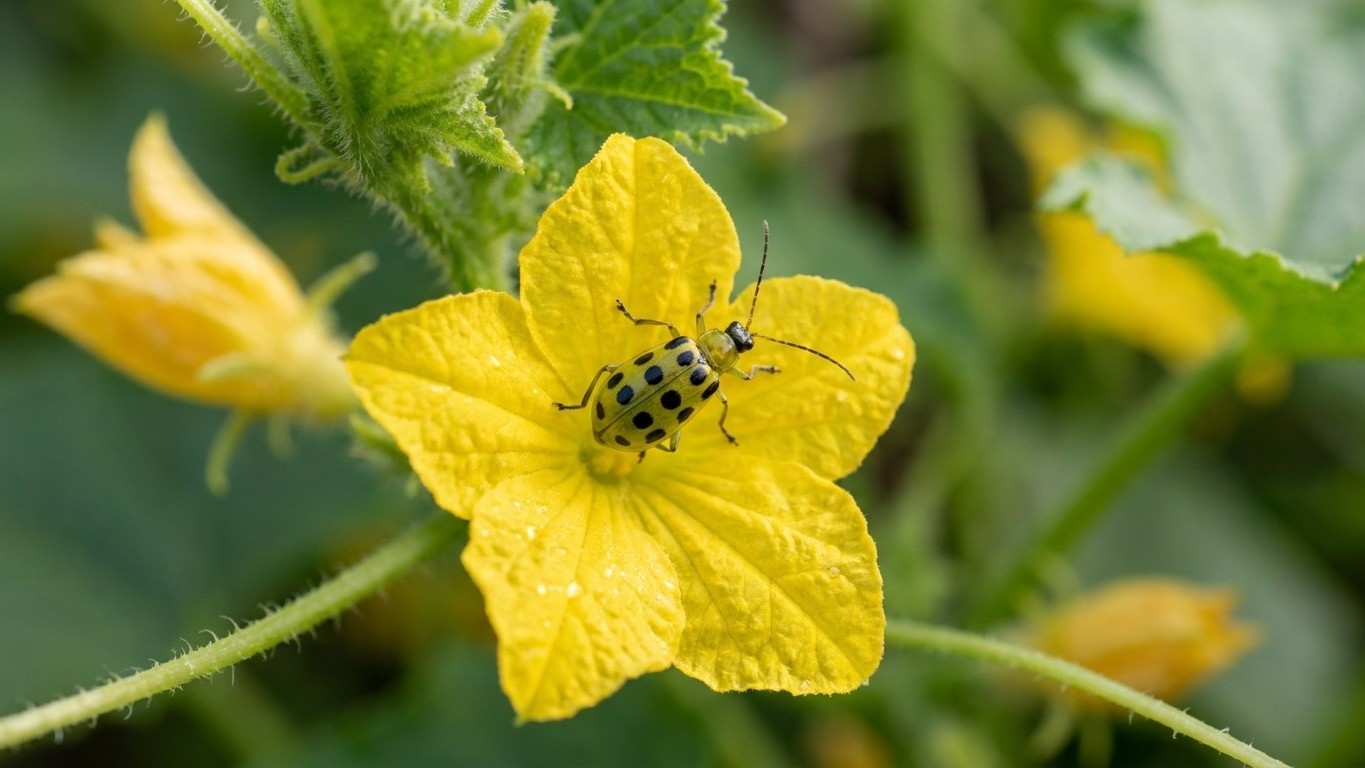

Spotted cucumber beetles start showing up in South Carolina gardens as early as March along the coast and by mid-April in the Upstate, feeding on cucurbit blossoms and seedlings before most gardeners have even hardened off their transplants. The beetle sticks around through late fall, cycling through two or three generations in a single season thanks to the state’s long, warm growing window. Stopping it means combining early scouting, row covers, and targeted spot treatments rather than relying on a single spray.
What the Spotted Cucumber Beetle Looks Like

Adults measure about a quarter inch long, with a greenish-yellow body and twelve black spots arranged across the wing covers, six on each side. That spot pattern is the giveaway. Its close relative, the Striped cucumber beetle, wears three black longitudinal stripes instead, and the two species get lumped together constantly by home gardeners scanning squash leaves for damage.
The spotted version is also less picky about food. Where striped cucumber beetles stick mostly to cucurbits (squash, cucumbers, melons, pumpkins), the spotted species feeds on more than 200 plant types. In South Carolina fields and backyard plots, that list stretches from beans and corn to sweet potatoes, peanuts, soybeans, and even ornamental flowers. Entomologists sometimes call the larval stage the “southern corn rootworm,” a name that hints at how much broader its appetite really is once you look underground.
Eggs are laid in soil cracks near the base of host plants, and the larvae that hatch are thin, white, worm-like grubs that tunnel into roots and lower stems. Unlike the adults, which do their damage in plain sight on leaves and flowers, larvae work invisibly below the surface, which is part of why infestations often go unnoticed until plants wilt for no obvious reason.
When Spotted Cucumber Beetles Show Up in South Carolina
Timing tracks closely with the state’s temperature gradient. Overwintering adults tuck into leaf litter, brush piles, and grassy field edges, then emerge once soil temperatures climb into the 60s. That happens sooner near Charleston and the Lowcountry than it does around Greenville or Spartanburg.
Coastal Plain vs. Upstate emergence
In the Coastal Plain and Midlands, adults are typically active by late March, right as early cucurbit and bean plantings go into the ground. Upstate gardeners usually don’t see meaningful numbers until mid-to-late April. First-generation adults lay eggs through May and June, and by July a second generation of beetles is chewing on ripening fruit and blossoms across most of the state. A third, smaller generation can appear in September in the warmer southern counties before the population settles in for winter.
That overlap of generations matters for anyone trying to time a single treatment window. Spraying once in early May might knock back the first wave, but it does nothing for the eggs already laid near plant bases, which hatch into root-feeding larvae weeks later.
The Damage: More Than Chewed Leaves
Adult beetles chew ragged holes in leaves and skeletonize young seedlings fast enough to kill a newly transplanted squash or cucumber plant in a matter of days. They’re especially drawn to flowers, where they eat pollen and petals, which can reduce fruit set on cucurbits that depend on healthy blossoms for pollination.
Underground, the larvae tunnel into corn roots, peanut pods, and sweet potato tubers. Peanut growers in the Coastal Plain sometimes see cosmetic scarring on pods that drops a crop’s grade at buying stations, even when the plant above ground looks fine. Sweet potato growers deal with similar surface tunneling that shows up at harvest, not before.
There’s also a disease angle worth flagging. Spotted cucumber beetles can carry the bacterium that causes bacterial wilt in cucurbits, though they’re a much weaker vector than striped cucumber beetles, which feed more aggressively on cucurbit tissue and spread the pathogen more efficiently. Still, on a farm or garden where both species are present, a spotted beetle can pick up and move the same wilt-causing bacteria between plants during a heavy feeding season.
What Actually Stops Spotted Cucumber Beetles
No single tactic handles this pest on its own, mostly because the adult and larval stages live in different places and eat different things. Growers who get results usually stack a few methods together and time them to what’s actually happening in the field, not to a fixed calendar date.
Cultural and physical controls
Floating row covers over young transplants block adult beetles from reaching seedlings during the most vulnerable two to three weeks after planting. Covers need to come off once flowers open, since cucurbits require pollinator access, but by then plants are usually sturdy enough to tolerate some feeding without collapsing.
Crop rotation matters more for the larval stage than most gardeners realize. Moving cucurbits, corn, and peanuts to a different bed each year interrupts the cycle where larvae emerge near the same roots their parents fed on the previous season. Clearing garden debris and mowing field edges close to a plot in late fall also removes the leaf litter where adults spend winter.
Delaying planting by even one to two weeks past the earliest recommended date can let the first beetle wave pass through before seedlings are in the ground, particularly in the Coastal Plain where that first generation is heaviest.
Monitoring and biological options
Yellow sticky traps placed at plant height catch adults early enough to gauge whether a spray is even necessary. Scouting the soil line at the base of squash and cucumber plants for small, oval eggs gives another few days of warning before larvae start tunneling.
Beneficial nematodes applied to soil around cucurbit and peanut roots target the larval stage directly, offering a non-chemical option for gardeners who’d rather not spray. Ground beetles, soldier beetles, and certain parasitic wasps also prey on cucumber beetle eggs and larvae, which is one more reason to avoid broad-spectrum insecticides that wipe out those predators along with the pest.
When a treatment is warranted
For heavy adult infestations on flowering plants, an insecticide labeled for cucumber beetles applied in the early evening, after bees have finished foraging for the day, limits harm to pollinators while still hitting active beetles. Kaolin clay sprays act as a physical deterrent, coating leaves so beetles have a harder time feeding and laying eggs, and they wash off before harvest without leaving lasting residue concerns for home gardeners.
Perimeter trap cropping, planting a highly attractive squash variety like Blue Hubbard around the border of a cucurbit patch, pulls beetles toward the edge rows where a grower can treat or hand-pick them without spraying the entire main crop. It’s a technique more common on small farms and market gardens than backyard plots, but scaled-down versions work on a large home garden too.
South Carolina’s Coastal Plain sees consistently higher spotted cucumber beetle pressure than the Upstate simply because the growing season runs longer and gives the beetle time for that extra generation. Gardeners in Aiken, Orangeburg, or Beaufort counties who plant a fall crop of squash or beans should expect beetle activity picking back up in September, right as spring-planted crops are winding down, which is often the point where a second round of row covers or trap crops pays off more than any late-season spray.