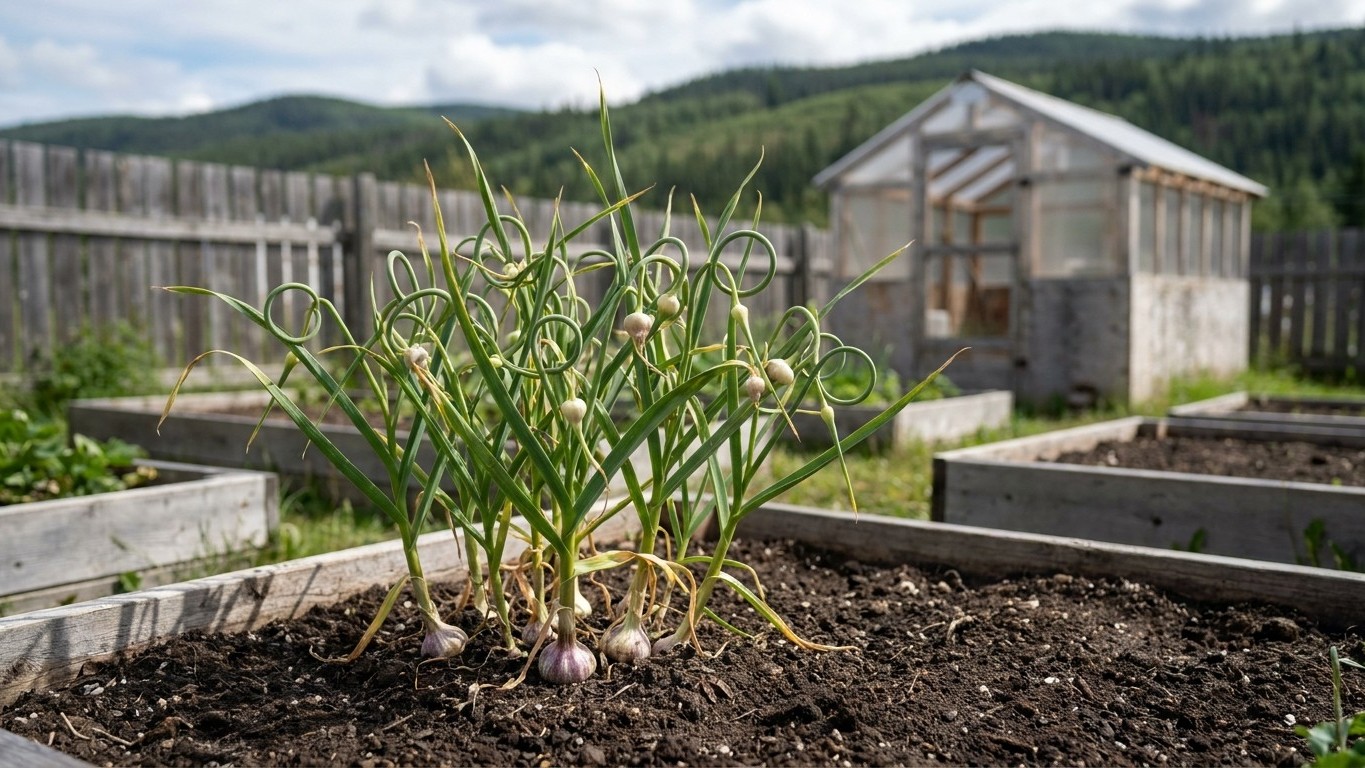

Plant Garlic in Yukon in early August, about three weeks before the territory’s average first fall frost of August 25, the mean given by Environment and Climate Change Canada’s 1981-2010 climate normals for the Whitehorse A station. That gap lets cloves root into cooling soil before the ground locks up for winter, without pushing tender green growth into a hard freeze. Order seed garlic now and mark early August on the calendar, since suppliers of northern-hardy stock tend to sell out before that window opens.
The short answer for Yukon

The planting date
Set garlic cloves in the ground in early August for the whole practical list of cultivars, from softnecks like Early Red Italian and Italian Late to hardnecks like Chesnok Red and German White. That date isn’t built around the frost itself. It’s built around the six to eight weeks University of Georgia Extension bulletin C854 says a clove needs, once planted, to split apart into the individual cloves you dig the following summer. Yukon’s winters supply that chilling with room to spare: air temperature at the reference station sits below 40°F for 39.1 weeks of the year, several times over what the clove actually needs.
Why the frost date isn’t a safe date
The frost date matters less for timing the planting and more for understanding the margin you’re working with. Environment and Climate Change Canada’s 1981-2010 climate normals put the average first fall frost at Whitehorse A at August 25. That figure is a mean, not a guarantee. In one year out of two, the real frost lands later than August 25, and in the other half it lands earlier. Treat it as the midpoint of a window that swings in either direction, never as a date you can plant right up against.
Because the frost date is unreliable within any given year, early August planting isn’t about beating a specific frost. It’s about giving the clove its rooting weeks while the soil is still workable, regardless of exactly when the first frost happens to land that particular season.
Working it out for your own garden
The three-week head start
Run the arithmetic yourself rather than trusting a single date. Environment and Climate Change Canada’s 1981-2010 normals put Whitehorse’s average first fall frost at August 25. Early August planting puts roughly three weeks of soil-warm growing time between clove-in-ground and that average frost date. That gap matters because garlic is not killed by a light frost. Only the leaves take damage, and the clove itself, sitting below the surface, keeps growing roots as the soil slowly cools, right up until the ground actually freezes solid, which comes later than the first frost in the air above it. The six-to-eight-week rooting period University of Georgia Extension’s bulletin C854 describes spans both sides of that first frost, not just the weeks before it.
Adjusting for your own site
This is also where you adjust for local conditions. A territory is never one climate. Elevation, a large lake nearby, or a stretch of open river valley can shift the local frost window by a week or two in either direction from the Whitehorse figure. A garden tucked into a south-facing slope above a river holds evening warmth longer than a low, flat clearing where cold air pools overnight. If your garden sits noticeably higher, colder, or more exposed than downtown Whitehorse, move your planting a few days earlier than early August. If it sits in a sheltered, south-facing spot with good drainage, you likely have a little more room to wait.
Set-out dates by variety
The table below shows the calculated planting window for each cultivar sold as suited to short, cold-summer climates. All of them share the same early August set-out point, since none of the catalogue figures for these varieties are day-length or heat sensitive at planting time. Days to maturity vary instead the following summer, at harvest.
| Variety | Type | Set out |
|---|---|---|
| Early Red Italian | Softneck | Early August |
| Inchelium Red | Softneck | Early August |
| Italian Late | Softneck | Early August |
| Lorz Italian | Softneck | Early August |
| Bavarian Purple | Hardneck | Early August |
| Blue Music | Hardneck | Early August |
| Chesnok Red | Hardneck | Early August |
| Duganski | Hardneck | Early August |
| Fall Festival | Hardneck | Early August |
| Georgian Crystal | Hardneck | Early August |
| Georgian Fire | Hardneck | Early August |
| German Red | Hardneck | Early August |
| German White | Hardneck | Early August |
| Ivan | Hardneck | Early August |
For a fuller rundown of how these differ in flavor, storage life, and clove size, see Garlic Varieties That Suit Yukon Winters before you order seed stock.
What changes across Yukon
North versus south
The August 25 frost figure comes from one station, Whitehorse A, sitting in a river valley in the territory’s south. Move away from that valley and the picture changes fast. Dawson City, several hundred kilometres north along the Yukon River, sits at a higher latitude with less moderating water nearby, and growers there typically work with a shorter, colder season than Whitehorse sees. Old Crow, north of the Arctic Circle, is colder again, and the workable window for any fall-planted crop compresses further the farther north you garden.
South and east of Whitehorse, around Watson Lake, the climate softens slightly. Lower elevation and a more southerly latitude tend to push the first frost a little later than at Whitehorse, though not far enough to justify waiting past early August for any of the cultivars on this list. Haines Junction, west of Whitehorse and closer to the coastal mountains, sees more precipitation and a climate shaped by proximity to the St. Elias range, which can mean cooler, wetter falls even at a similar latitude.
Local topography
Topography inside a single community matters just as much as which town you’re in. A garden at the bottom of a valley collects cold air overnight and frosts earlier than a garden on a mid-slope bench a few hundred meters up the same hillside. Anyone gardening along the Yukon River or one of its tributaries should also watch the river’s moderating effect, since water holds heat longer than open ground and plots close to a bank can stay frost-free a few days longer than a garden set back on flat, exposed ground. None of these adjustments change which cultivars work, since Growing Garlic in Yukon already narrows the list to hardy stock, but they do shift the calendar week by week from one yard to the next.
The mistakes this climate punishes
Planting stock that carries disease
The biggest risk in a Yukon garlic bed usually arrives in the seed bag, not the weather. White rot, caused by the fungus Sclerotium cepivorum, survives in soil for years once introduced, and UC IPM’s Pest Management Guidelines for onion and garlic (UC ANR Publication 3453) put its published temperature range for activity at 50 to 75°F, a range the mean air temperature at the reference station falls inside during two months of the growing season, June and July. That’s a count of overlapping months, not a forecast, and a monthly average hides plenty of days both above and below that range. Cold Yukon winters do nothing to remove the risk once white rot is established, since infected planting stock carries the pathogen regardless of climate. Buy seed garlic from a source that tests or certifies it, and never replant cloves from a bulb that showed soft, watery rot or white fungal growth at the base.
Choosing the wrong type for a cold snap
Hardneck cultivars such as Duganski, German Red, and Chesnok Red generally tolerate hard cold better than softnecks like Italian Late or Early Red Italian, whose looser wrapper leaves offer less protection to the clove through a severe winter. In a winter that runs colder than usual, an under-mulched softneck bed is the one most likely to show gaps in spring where cloves failed to survive. Mulch depth is not optional insurance here, it’s a working part of the planting, applied heavily enough to buffer the clove from the deep, sustained cold this territory carries for months on end.
Planting too shallow or too late
The other failure mode shows up in years when a grower waits past early August hoping for a longer window, or plants cloves at a shallow depth to save time. Either mistake cuts into the rooting weeks a clove needs before growth slows for the season. A clove that goes in late, or sits too near the surface, enters winter with a weak root system, and a weak root system heading into a Yukon winter this long and this cold is a bulb that either dies before spring or comes up undersized the following summer.
Checking this against your county
Whitehorse A is one weather station serving one part of a large territory, and the figures in this piece should be treated as a starting point rather than a fixed rule for wherever you garden. Yukon’s own agriculture office is the right place to ask about conditions specific to your community, but its site currently blocks the kind of automated check this article relies on for verification. For general planting guidance and contacts, Agriculture and Agri-Food Canada‘s site is the reliable federal resource, and it can point you toward territorial contacts as well. If you garden well north of Whitehorse, or at a markedly different elevation, ask specifically about local frost records rather than relying on the Whitehorse normals alone.
Common questions
Can I Plant Garlic in spring instead of fall in Yukon?
You can, but expect smaller bulbs. Garlic needs a sustained cold period to divide into cloves, and a spring-planted crop misses most of the fall and winter chilling a fall-planted clove gets for free. Yukon’s long, cold winters make fall planting the far more reliable route to full-sized heads.
What if I miss the early August window?
Plant as soon as you can rather than waiting for the following year. A clove planted a couple of weeks late still gets some root development in before the ground cools hard, even if it falls short of the full six to eight weeks University of Georgia Extension’s bulletin describes. A late but well-mulched planting generally beats no planting at all.
Does the first frost kill my garlic if I planted early?
No. A light frost damages exposed leaf tips at most, and the clove itself, sitting below the soil surface, keeps developing roots afterward as the ground gradually cools. The real threat is the ground freezing solid, not that first touch of frost in the air.
Do I need to mulch garlic in Yukon over winter?
Yes, and more heavily than guides written for milder states suggest. A thick layer of straw or leaf mulch insulates the clove against the deep, sustained cold this territory holds for months, and it matters more for softneck varieties like Inchelium Red or Lorz Italian than for hardier hardneck types.
If you follow the almanac, here is when to plant garlic by the moon. It is a tradition, not a proven method.