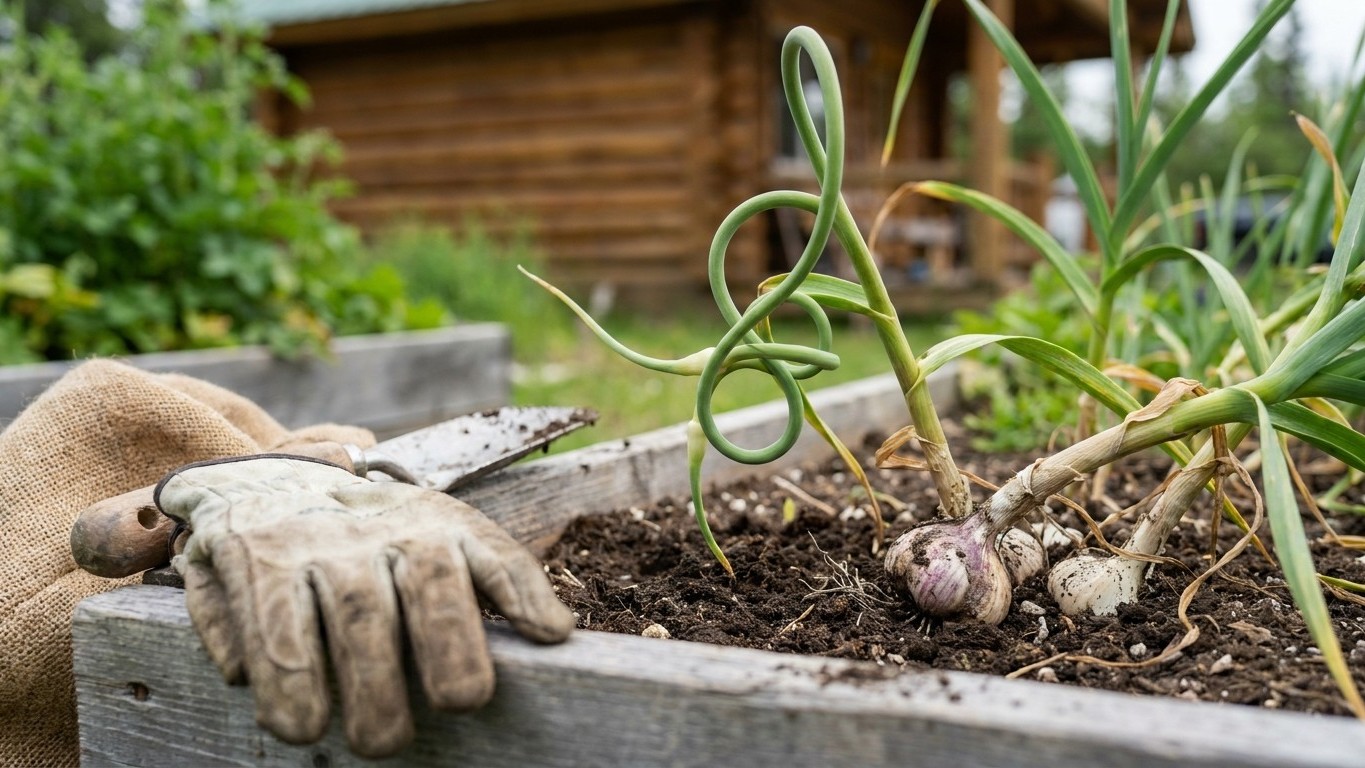

Yukon’s winters are long and cold enough that dormant chilling is never the problem for garlic. The real question is timing: Environment and Climate Change Canada’s 1981-2010 climate normals put the average first fall frost at Whitehorse A at August 25, and every variety worth planting here goes into the ground in early August to root ahead of it. Set your own planting date by counting back roughly three weeks from your local frost risk, not from this one territory-wide figure.
The short answer for Yukon

Every hardneck and softneck garlic worth growing in Yukon goes into the ground in early August, about three weeks ahead of the mean first fall frost that Environment and Climate Change Canada’s 1981-2010 climate normals record at the Whitehorse A station: August 25. That lead time is what lets cloves grow roots in still-warm soil before top growth shuts down for winter.
August 25 is an average, not a promise. In roughly half of all years on record, the actual first frost at that station falls later than August 25, and in the other half it falls earlier. Treat it as the midpoint of a window, never as a safe planting deadline. If you haven’t chosen a bed yet, it’s worth backing up to Growing Garlic in Yukon for site and soil basics before you settle on a variety here.
What makes this workable at all is winter length, not summer heat. Whitehorse spends an average of 39.1 weeks a year with air temperatures below 40°F, well past the six to eight weeks garlic needs after planting to split into cloves, a threshold set out by University of Georgia Extension publication C854. Cold is not the limiting factor in this climate. Getting cloves rooted before the ground locks up is.
Varieties that fit the window
Every cultivar below is planted in early August regardless of neck type. The difference between hardneck and softneck matters more for flavor, storage and scape production than for whether the variety survives here, since both groups clear Yukon’s winter cold with room to spare.
| Variety | Neck type | Set out |
|---|---|---|
| Early Red Italian | Softneck | Early August |
| Inchelium Red | Softneck | Early August |
| Italian Late | Softneck | Early August |
| Lorz Italian | Softneck | Early August |
| Bavarian Purple | Hardneck | Early August |
| Blue Music | Hardneck | Early August |
| Chesnok Red | Hardneck | Early August |
| Duganski | Hardneck | Early August |
| Fall Festival | Hardneck | Early August |
| Georgian Crystal | Hardneck | Early August |
| Georgian Fire | Hardneck | Early August |
| German Red | Hardneck | Early August |
| German White | Hardneck | Early August |
| Ivan | Hardneck | Early August |
Working it out for your own garden
Start from the same number these varieties are timed against: Environment and Climate Change Canada’s Whitehorse A normals put the mean first fall frost at August 25. Early August planting gives roughly three weeks of soil above rooting temperature before that midpoint. That three-week margin is what you’re protecting when you pick a planting date, not the calendar date itself.
Elevation, a large body of water nearby, and open exposed ground can shift that math by roughly two weeks in either direction. A garden sitting low in a valley pools cold air on clear nights and can see frost days before higher ground close by. A plot near a large lake or river holds warmth longer into fall and can push the safe window later than the station average suggests. None of that local variation shows up in the Whitehorse A record, which comes from one station on open, flat ground at the airport.
For the fuller week-by-week breakdown of counting back from frost to a planting date, see When to Plant Garlic in Yukon: Counting Back From the First Frost.
Reading your own site
Walk the plot on a clear fall evening and note where frost forms first. That’s usually low ground, next to metal, or anywhere fully open to the sky with no tree cover overhead. If your garden runs cooler than the territory-wide baseline, plant in the earliest days of early August rather than the last, so cloves still get the full three weeks of rooting time even if your own first frost arrives ahead of the mean. If your site is a warm pocket, sheltered from wind and holding heat from rock or a south-facing slope, you have a little more flexibility, but garlic planted too late to root before real cold sets in sits in loose, cold soil without anchorage, and frost heave over winter becomes a far bigger risk than losing a week of fall growth. Two or three years of your own recorded frost dates beat one distant station every time.
What changes across Yukon
Latitude, elevation and water
Whitehorse sits in a relatively broad valley in southern Yukon, and the Whitehorse A figures describe that specific location, not the territory as a whole. Dawson City, further north and more continental in its weather pattern, tends to run into fall cold sooner, which argues for planting on the early side of the early-August window rather than the late side if you garden that far north.
The Southern Lakes region, around Marsh Lake and Atlin, sits near large bodies of water that hold summer heat and release it slowly into fall. Gardens close to that kind of water often see their first frost arrive later than gardens the same distance inland, simply because the lake keeps the surrounding air a few degrees warmer on clear, calm nights when frost is most likely to form.
Higher, more exposed ground, the kind found around Haines Junction and through the foothills toward the Alaska border, runs colder and windier than the valley floor at Whitehorse. Cold air also drains downhill and pools in low spots on calm nights, so a garden at the bottom of a slope can frost before one partway up the same hillside. None of these effects change which varieties will survive a Yukon winter. All of them change how much lead time you should give the planting date.
The mistakes this climate punishes
Most garlic mistakes are the same everywhere. A few of them cost more in this particular climate than elsewhere.
- Planting after early August, leaving cloves too little time to root before top growth halts for winter.
- Setting cloves too shallow, which raises the odds of frost heave across the territory’s long stretch of weeks below freezing.
- Skipping mulch on the assumption that a hardy cultivar doesn’t need it, when mulch is what keeps a shallow-rooted clove from being pushed out of loosened soil by repeated freeze and thaw.
- Assuming a cold climate rules out disease in stored or planted garlic.
Disease doesn’t care about the cold
Yukon’s cold does not cancel out garlic disease risk. UC IPM’s Pest Management Guidelines for onion and garlic, UC ANR Publication 3453, put white rot‘s active range at 50 to 75°F, and Whitehorse’s mean air temperature falls inside that band for two months of the growing season, June and July. That’s an air reading rather than the soil temperature the pathogen, Sclerotium cepivorum, actually responds to, and a monthly average hides plenty of cooler and warmer days within it, so the two-month figure describes possibility, not certainty. A clean start matters more than a cold winter. Fusarium basal rot and the other soil-borne diseases in the same guidelines show no growing-season month with a Whitehorse mean inside their published range, but that is not the same as immunity. Infected planting stock carries these fungi wherever it’s planted, regardless of how cold the following winter runs.
Checking this against your county
Yukon isn’t divided into counties, but the same principle applies at whatever scale your local office uses: the Whitehorse A figures describe one station, and every other part of the territory should be checked against it rather than assumed to match. Agriculture and Agri-Food Canada maintains grower information for the whole country, and its website is a reasonable starting point if you want data closer to your own district than the territory-wide average used here.
If you garden well north of Whitehorse, at higher elevation, or close to a large lake, treat every date as a starting estimate and adjust it against whatever local frost record you can find, even a neighbor’s own planting notes.
Common questions
Can I plant garlic in spring instead of fall in Yukon?
You can, but expect smaller bulbs. Garlic planted in fall gets a long, cold dormant period that spring-planted cloves miss entirely, and that dormant chilling is part of what triggers strong bulb division the following summer.
Do I need to pick a hardneck for a cold climate like this?
No. Whitehorse’s winter cold, at an average of 39.1 weeks below 40°F according to University of Georgia Extension’s benchmark, comfortably covers the chilling requirement of both hardneck and softneck types on this list. Choose based on flavor, storage life and whether you want scapes, not on winter survival.
What happens if I miss the early August planting window?
Planting later isn’t automatically fatal, but cloves get less time to root in warm soil before growth stalls for winter, and that usually shows up as smaller bulbs or a higher rate of winterkill from frost heave. If you’re going to be late, plant a little deeper and mulch heavier to compensate.
Does a cold winter mean I don’t have to worry about garlic diseases?
No. Cold winters slow some soil pathogens but don’t eliminate the risk, and diseases like white rot and basal rot travel in infected cloves regardless of local climate. Buying certified, disease-tested seed garlic matters in Yukon as much as it does anywhere else.