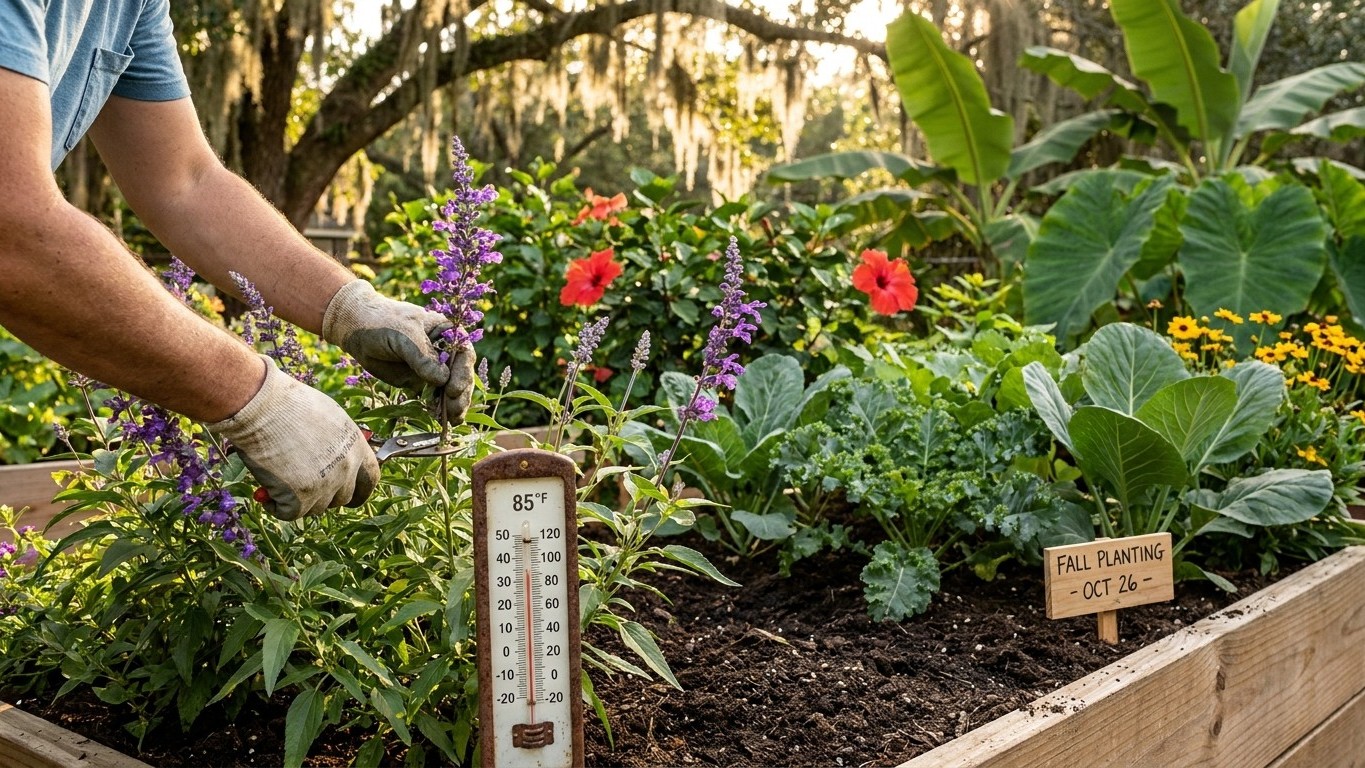

Louisiana gardens sit inside a USDA hardiness range of zone 8a to 10a, with an average last spring frost falling somewhere between January 18 and February 8, and an average first fall frost between December 17 and January 8. Do the subtraction and the truth is startling: this state’s frost-free window runs nearly eleven months. But that number hides more than it reveals, and heat, not cold, is what actually shapes what you can grow.
How long your season really is

Start with the three figures that matter. The USDA Plant Hardiness Zone Map, built entirely on average annual extreme minimum temperature, places Louisiana between zones 8a and 10a. NOAA’s 1991-2020 climate normals put the average last spring freeze between January 18 and February 8, and the average first fall freeze between December 17 and January 8. Stack those dates against each other and the frost-free window stretches to something like ten or eleven months in most of the state.
That’s an unusual problem to have. In most of the country, the frost-free window is the thing gardeners fight to lengthen with row cover and cold frames. Here, frost barely shows up at all. At the reference coastal station, a 32F freeze occurs in only 86.8 percent of years, which means roughly one winter in seven skips a hard freeze entirely. When frost does arrive, the fall window straddles the New Year, so “last frost” and “first frost” aren’t tidy bookends on a calendar the way they are farther north.
Here’s the part worth saying plainly: those dates are averages, not guarantees. By definition, half of all years run colder or later than average. A freeze can still show up in early February in a year that leans unlucky, and a gardener who plants tender crops on the assumption that the average always holds is gambling, not planning. North Louisiana, sitting closer to zone 8a, freezes more reliably and more often than the Gulf Coast parishes near zone 10a. Treat the state-level numbers as a starting orientation, not a personal forecast for your own backyard.
What this rules out is simple: the idea that Louisiana gardening runs on a single, predictable frost calendar like a Northeast or Midwest garden. It doesn’t. Cold isn’t your limiting factor. Something else is, and it shows up as soon as the calendar turns to June.
What the summer does to a garden here
The reference station near New Orleans averages 70.7 days a year at or above 90F. That’s not a footnote, it’s the defining fact of gardening in this state. Heat above roughly 90F isn’t simply “warm weather that helps things grow.” It’s a threshold where tomatoes stop setting fruit because their flowers drop before pollination can finish, lettuce and other cool-season greens like those grown while Growing Spinach in Louisiana bolt straight to seed, and root crops such as those discussed in Growing Potatoes in Louisiana face their own timing challenges from the heat, along with those covered in Growing Parsnips in Louisiana suffer too, which is why Growing Carrots in Louisiana means working around this same heat threshold, peppers face the same fruit-set struggles as detailed in this guide to Growing Peppers in Louisiana, and anything that prefers mild conditions effectively shuts down for the season.
Add the winter side of the equation: the coldest month’s average daily minimum sits at 46.1F, mild enough that cold-hardy crops rarely face a real test. So you end up with a state where winter is gentle and summer is punishing, which flips the usual gardening rhythm on its head. Instead of one long growing season with a dangerous cold snap at each end, Louisiana effectively runs on two shoulder seasons, a spring push and a fall push, with a stretch of summer in the middle where many food crops simply stop producing regardless of how much you water or fertilize.
That’s the practical consequence to plan around: timing crops to dodge the 90-degree stretch matters more than timing them around frost. A tomato planted to mature in July is fighting the exact conditions that shut down fruit set. The same crop timed to finish by late May, or replanted for a fall run once temperatures ease, has a real shot. Water demand climbs hard through those 70-plus hot days too, since evaporation and plant stress both scale with heat load, not just air temperature. Gardeners moving here from cooler states often bring the wrong instinct: they fear the cold and get caught off guard by the heat instead.
What tends to go wrong in Louisiana
The LSU AgCenter’s home garden and vegetable insect management guides point to a consistent short list of pests that actually show up in Louisiana gardens, and it’s worth naming them instead of drowning the reader in every possible bug. Squash vine borer and squash bug both target cucurbits, typically as vines fill out through late spring and early summer, and both can collapse a healthy squash or pumpkin plant within days once damage is advanced. Pickleworm follows a similar path later in the season, tunneling into fruit on squash and cucumber as summer wears on.
Tomato growers deal with tomato pinworm and leaf-footed bug, the latter piercing fruit and leaving discolored, pitted spots that ruin otherwise healthy tomatoes right as they ripen. Pepper weevil causes comparable damage on peppers. Cowpea curculio and vegetable weevil round out the pressure on legumes and root crops respectively, while fall armyworm tends to show up later in the year, chewing through leafy greens and grasses alike. Crape myrtle bark scale is the outlier on this list, an ornamental pest rather than a vegetable one, but it’s common enough across the state that the AgCenter tracks it separately.
None of this is a full inventory of every insect in Louisiana, and pressure shifts by region and by year. It’s the short list a gardener here will genuinely run into, which is more useful than a long list of pests that never actually show up in a home garden. If you spot damage you can’t identify, that’s a job for your local extension office, not a guess based on a name from a list.
Where to check before you plant
Everything above is a state-level average, and Louisiana spans enough latitude to cross from zone 8a in the north to zone 10a near the coast. A planting date that works in Baton Rouge can be three weeks off at either edge of the state, too early for the cooler north parishes and too late for the mild coastal ones. That gap is exactly why this page stops at orientation rather than trying to hand you a planting calendar.
The LSU AgCenter, the state’s land-grant extension service, publishes region-specific guidance. Its vegetable and ornamental insect management publications are the same source behind the pest list above, and its county-level agents can tell you what a state-wide average can’t: your actual local frost risk, your actual local pest pressure, and the planting windows that hold up in your specific parish. That’s the next real step, not another set of state averages dressed up as personal advice.
What to Plant Next, Now That You Know the Climate
Once the freeze dates and heat stretches make sense, the same numbers explain why certain crops behave the way they do here. Take garlic: the state’s near-total absence of real cold means the usual advice about chilling cloves doesn’t hold, and growing garlic in Louisiana walks through the planting dates and varieties that work around 0.0 weeks of sub-40°F weather instead of fighting it. The lawn tells the same story from a different angle — with over seventy days a year hitting 90°F or higher, cool-season grass never had a chance, and Louisiana lawn care lays out which warm-season grass to plant and when to feed it. Tomatoes sit right on the edge of that freeze window: New Orleans’ last 32°F freeze smears across three weeks in January and February, with no single day a sure bet either way, and growing tomatoes in Louisiana covers the planting dates, varieties, and pests that come with timing a crop against odds like that instead of a fixed date.