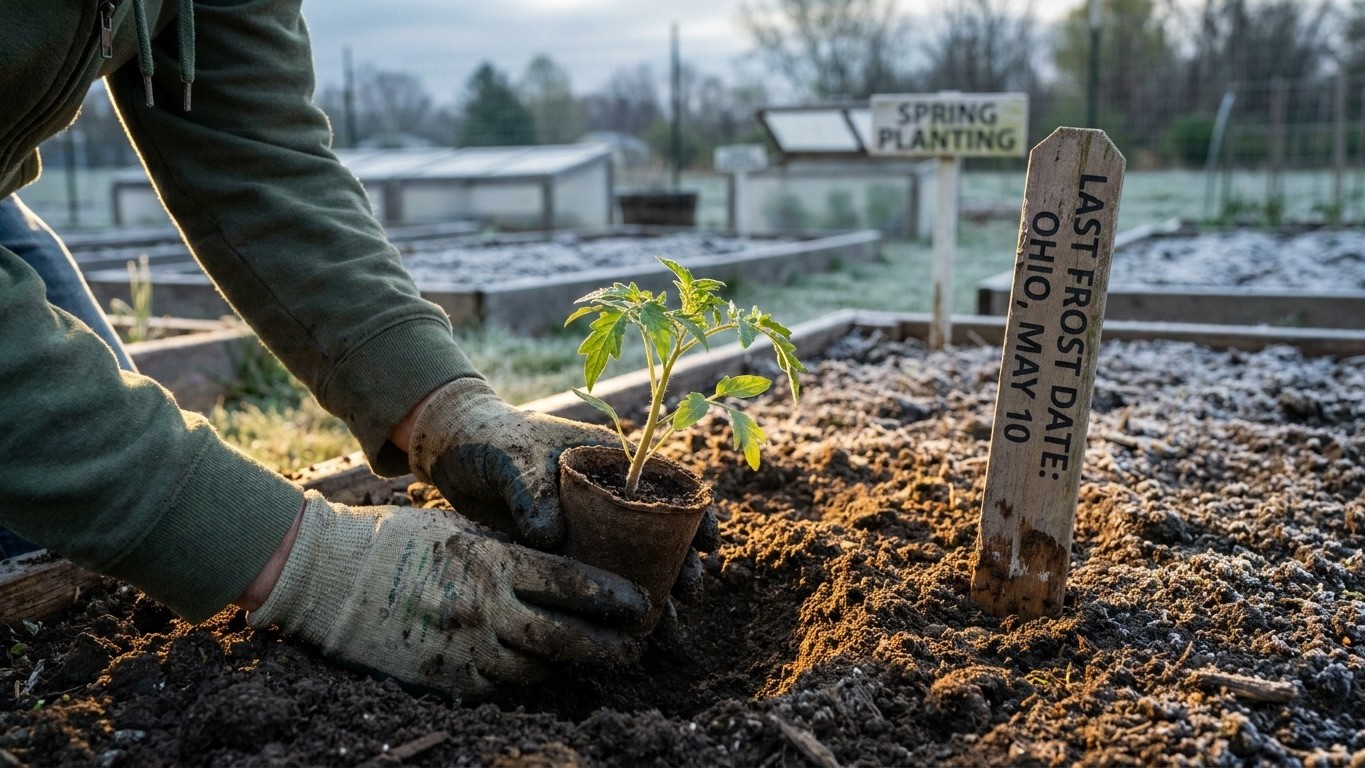

Zone 5b to 6b, frost by mid-October, a window of roughly five months to grow anything at all. That’s the arithmetic behind gardening in Ohio, and it decides more about what you can plant here than soil type, sun exposure, or how good your intentions are come April.
How long your season really is

Three numbers set the boundaries for every garden in this state. The USDA Plant Hardiness Zone Map, built on the average annual extreme minimum temperature, places Ohio across zones 5b to 6b. Ohio State University Extension pegs the average last spring frost at May 5 to May 15 for zone 6a, and the average first fall frost at October 5 to October 15.
| Metric | Value |
|---|---|
| USDA Hardiness Zone | 5b to 6b |
| Average last spring frost (zone 6a) | May 5 to May 15 |
| Average first fall frost (zone 6a) | October 5 to October 15 |
Put those two dates together and you get the frost-free window, the single figure that actually governs a garden here. Depending on where you fall within that range, it runs somewhere between 143 and 163 days. That’s the entire growing season for anything tender: tomatoes, peppers, melons, basil, all of it, and the timing questions around Growing Peppers in Ohio come down to this same window, much as the planting dates behind Growing Potatoes in Ohio hinge on it too, and the same is true for cool-season crops like those covered in Growing Beets in Ohio, in Growing Parsnips in Ohio, or in Growing Carrots in Ohio. A 90-day sweet corn variety fits comfortably inside that window. A 120-day pumpkin, planted late because of a wet spring, does not have much room for error, which is also why knowing When to Carve a Pumpkin in Ohio matters just as much as when you planted it.
Averages are not promises
Those frost dates are exactly what they sound like: averages. Half of all years, by definition, run colder or later than that. Plant tomato starts on May 10 expecting the season to behave, and some years you’ll lose them to a frost on May 20. The safer habit is to treat the stated dates as the center of a range, not a start whistle, and to watch the actual forecast rather than the calendar in the weeks right around planting.
What this window rules out matters as much as what it allows. Long-season crops that need 150-plus frost-free days to mature, tropical transplants, a second round of a slow-growing variety after a summer crop fails: all of that is a gamble in Ohio, not a plan. Gardeners here tend to build around one solid main season rather than stacking multiple long-season crops back to back, and the frost-free window is the reason why.
What the summer does to a garden here
Heat isn’t automatically good news for a garden, and Ohio’s summer makes that plain. NOAA’s 1991-2020 climate normals put the Columbus area at 15.3 days a year above 90F. That’s not a brutal number by national standards, but it lands at exactly the wrong time, in the thick of the growing season, and it’s enough to disrupt crops that were doing fine in June.
Tomatoes stop setting fruit once temperatures climb much past 90F: the flowers drop, and the plant simply pauses reproduction until conditions ease. Lettuce and spinach bolt, turning bitter and running to seed, and most cool-season crops become impossible to start from midsummer through the hottest stretch. The result is a garden that doesn’t run as one uninterrupted season so much as two productive shoulders, spring into early summer and then again from late summer into fall, with a real dead zone in between for anything that isn’t heat-tolerant.
Winter sets the other boundary. The coldest month’s average daily minimum in the Columbus area runs 22.0F, the figure that actually decides whether a perennial, a shrub, or an overwintering crop survives here at all. That’s a different question from the hardiness zone rating, which is based on the extreme minimum rather than a typical cold night, but the two work together: the zone tells you the worst-case cold snap, the coldest-month minimum tells you what a normal January night actually looks like for anything left in the ground.
Together, the heat days and the winter minimum explain why Ohio gardens tend to be planned in two acts rather than one long push, with heat-loving crops timed to dodge the worst of midsummer and cold-hardy plantings timed around that October frost.
What tends to go wrong in Ohio
Ohio State University Extension’s entomology fact sheets flag a consistent short list of pests that home gardeners in this state actually run into, rather than every insect that theoretically exists. Four are worth knowing on sight:
- Slugs and snails: show up early in spring, right as seedlings emerge, favoring the cool, damp conditions of April and May and chewing ragged holes in tender leaves overnight.
- Aphids: build up through late spring and into early summer, clustering on new growth and stems where they’re easy to miss until a plant is already stunted.
- Japanese beetle: arrives in force by midsummer, typically late June into July, skeletonizing leaves on everything from roses to beans in broad daylight.
- Squash vine borer: active from early to midsummer, when adult moths lay eggs at the base of squash and pumpkin plants, with the real damage showing up weeks later as vines wilt seemingly overnight.
This isn’t the full roster the extension service tracks, and pressure from any one of these varies across the state. No treatment schedule belongs in a general overview like this one; what’s worth knowing is simply that these four are common enough to expect, and that catching a problem early, before a slug has eaten a whole seedling row or a vine borer has hollowed out a stem, makes the difference between a setback and a lost crop.
Where to check before you plant
Everything above is a state-level average, and Ohio spans enough latitude that conditions at one edge of the state can look meaningfully different from the other. A hardiness zone range of 5b to 6b isn’t a rounding error, it’s a real gap in winter survival odds depending on where you garden. The same goes for frost dates: a planting calendar built around the state capital can run a few weeks off for a county near Lake Erie or one tucked into the state’s southern hills.
That’s exactly the gap Ohio State University Extension is built to close. Their gardening calendar and pest fact sheets are drawn from research done specifically for this state’s conditions, and their county offices adjust the general guidance to what actually happens locally, from microclimates near the lake to the different frost timing in the Appalachian foothills to the south.
Before committing to a planting date or writing off a crop as too risky, it’s worth checking Ohio State University Extension and, more specifically, the office for your own county. The state-level figures here are a starting point for understanding what the season allows in general terms, not a substitute for guidance tuned to the particular patch of ground you’re actually planting in.
Where to Go Next for Specific Crops
Ohio’s climate math plays out differently depending on what you’re trying to grow, and the details are worth chasing down before you commit a bed to anything. If you’re thinking about growing garlic in Ohio, the state’s zone 6a winters already clear the cold-hours bar that University of Georgia Extension sets as the minimum, so the planting question is less about survival and more about timing. Lawns run into the opposite problem: Ohio lawn care comes down to the fact that Columbus only spends about fifteen days a year at or above 90°F, which rules out warm-season grasses that need long punishing heat to hold together. And if tomatoes are the goal, growing tomatoes in Ohio walks through the transplant window most central Ohio gardeners use — May 5 to May 15 — with the reminder that anywhere closer to Lake Erie or up in the southeastern hills, that window slides later. Each page works from the same kind of local, season-specific numbers as this one, just applied to a single crop.