
Six to seven months, at best. That’s the realistic gardening window in New Jersey once you strip away the marketing language and look at what the frost dates and hardiness zone actually say. The state spans two full USDA zones, and even the “average” frost-free stretch comes with a warning label: half the years fall short of it.
How long your season really is

Three numbers set the boundaries for everything you plant here. Together they’re the closest thing to a rulebook New Jersey gardening has.
| Measure | Value |
|---|---|
| USDA Hardiness Zone | 6a-7b |
| Average last spring frost | March 29 to April 6 |
| Average first fall frost | November 4 to November 16 |
Do the math on those two frost dates and you get a frost-free window somewhere between roughly 210 and 230 days, depending on which end of each range your particular yard lands on. That’s the entire growing season, start to finish, for anything that dies at 32F. It sounds generous next to states with a four-month window. It is not generous enough to treat every long-season crop as a sure thing, especially melons, sweet potatoes, and some pepper varieties that want 90 to 100 warm days just to mature after transplant, on top of weeks of indoor start time (see this guide on Growing Peppers in New Jersey for variety-specific timing, this one on Growing Potatoes in New Jersey for a crop that fits comfortably within the shorter end of the window, this one on Growing Carrots in New Jersey for a quicker-maturing root crop that leaves room for succession planting, this one on Growing Spinach in New Jersey for a cold-hardy crop that can stretch beyond either end of that frost-free window, or this one on Growing Parsnips in New Jersey for a root crop that actually benefits from a hard frost before harvest).
The USDA Plant Hardiness Zone Map, built from 1991-2020 normals, is measuring one thing only: the average annual extreme minimum temperature. A 6a-7b range means a plant rated hardy to zone 7 might sail through a mild winter near the coast and die outright thirty miles inland or up at elevation. That’s not a flaw in the data. It’s the reason a statewide zone number is a starting point, not a guarantee for your specific plot.
Averages aren’t safe dates
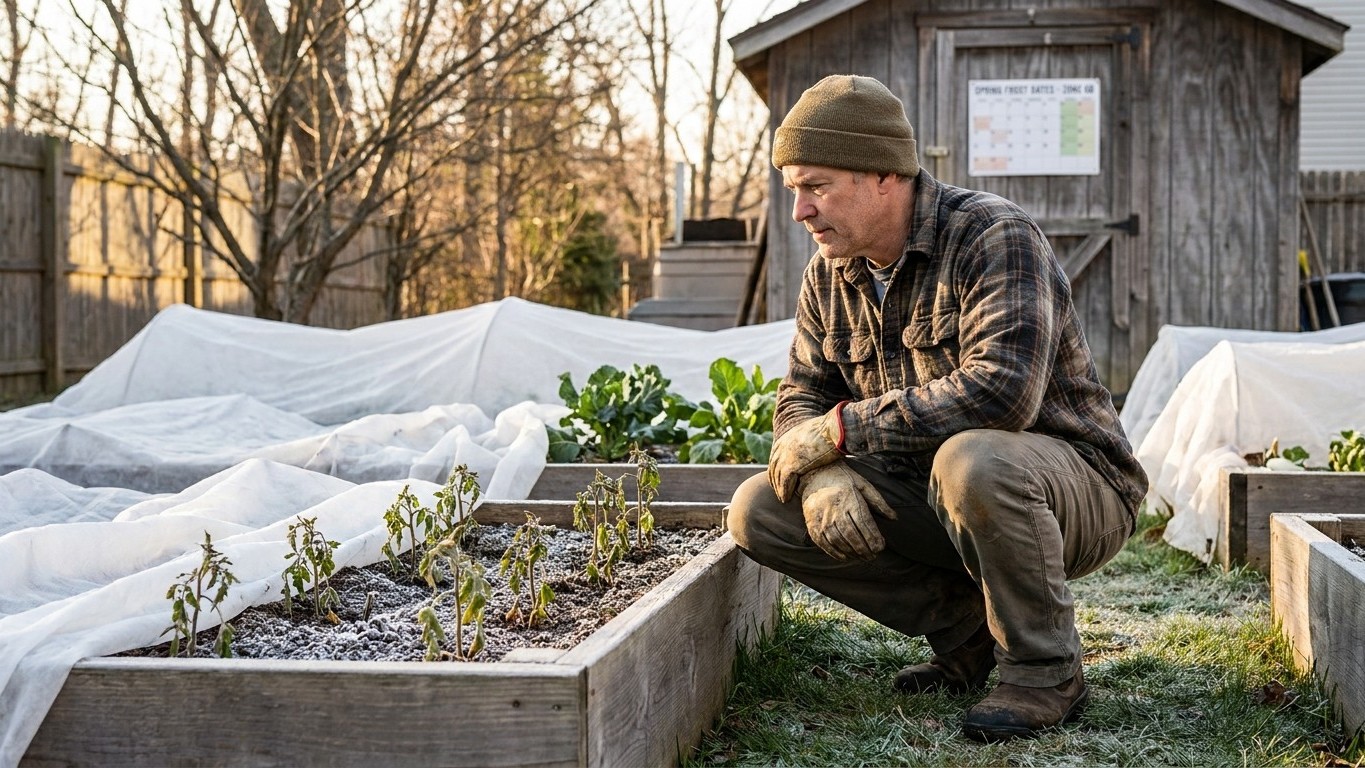
Here’s the part most planting calendars skip: “average last frost” is a statistical midpoint, not a promise. NOAA builds these dates from a 30 to 70 percent freeze-probability band at one reference weather station. By definition, roughly half of all years bring a frost later than that average date, and half bring one earlier. Plant tomatoes on April 6 because a calendar told you to, and in plenty of years you’ll lose them to a frost that arrived right on schedule for an “off” year. Gardeners who push the edges of the season routinely keep row cover or old sheets on hand for exactly this reason, not as an afterthought but as standard equipment for the first two and last two weeks of the frost-free window.
What the summer does to a garden here
New Jersey averages 20.8 days a year at or above 90F, based on the Newark reference station. That’s not a headline number, but it’s concentrated: those days cluster in July and August, exactly when a lot of first-year gardeners expect steady production.
Heat past roughly 90F does specific, predictable damage. Tomato flowers drop and fail to set fruit when nighttime temperatures stay too warm and daytime highs climb into that range, which is why plants that looked loaded with blossoms in June sometimes produce almost nothing in late July. Lettuce, spinach, and other cool-season greens bolt, going straight to seed and turning bitter, once soil and air temperatures push past their comfort zone. The practical result is a garden that behaves less like one long season and more like two productive shoulders, spring into early summer and then again from late summer into fall, with a dip in the middle where cool-season crops simply cannot survive and some warm-season ones stall out.
The coldest month here averages a daily minimum of 25.5F at the Newark reference station. That figure, not the record low, is what decides whether a perennial planted at the edge of its hardiness rating actually survives the winter or slowly declines over a few seasons. A plant that tolerates a quick dip to 10F can still struggle if 25F is the routine overnight low for six or eight weeks straight, because sustained cold does different damage than a single sharp snap.
What tends to go wrong in New Jersey
Rutgers Cooperative Extension, the state’s land-grant service, tracks a specific set of insects that home gardeners here run into most often. This isn’t every pest that exists in the state. It’s the short list worth learning to recognize on sight, because these are the ones an extension agent actually gets calls about.
- Colorado potato beetle: shows up as soon as potato and eggplant foliage emerges in late spring, stripping leaves down to the stem if the population builds unchecked.
- Tomato hornworm and tobacco hornworm: appear in midsummer, often not noticed until half a tomato plant’s leaves are already gone, since the caterpillars blend into the foliage.
- Striped and spotted cucumber beetles: arrive early on cucumber, squash, and melon seedlings and can also spread bacterial wilt as they feed.
- Mexican bean beetle: turns up on bean plants from early to midsummer, skeletonizing leaves in a lacy pattern that’s easy to mistake for something else at first glance.
- Spotted lanternfly: a newer arrival that Rutgers now tracks closely, most visible from midsummer through fall on a wide range of woody plants and vines.
Pressure from any one of these varies by county and even by neighborhood, and none of them is guaranteed to skip your garden just because it hasn’t shown up before. Identification is the first job. A county extension office can confirm what you’re looking at faster than guesswork, and getting the ID right matters more than reaching for a treatment before you know what you’re treating.
Where to check before you plant
Everything above describes New Jersey at the state level, and a state stretching across two hardiness zones has plenty of room for local exceptions. A planting calendar tuned to conditions near the coast can run two to three weeks ahead of one written for the northwestern highlands, and the reference-station frost dates cited here come from an airport weather station, not your backyard. Suburban and rural gardens typically see the last spring frost arrive later and the first fall frost arrive earlier than those figures, sometimes by a week or two, more at higher elevation.
Rutgers Cooperative Extension publishes county-level guidance built specifically to close that gap, and every county in the state has its own extension office that can confirm local frost timing, current pest pressure, and soil conditions particular to your area. That’s the resource worth checking before locking in a planting date, not a generic calendar aimed at the middle of the state.