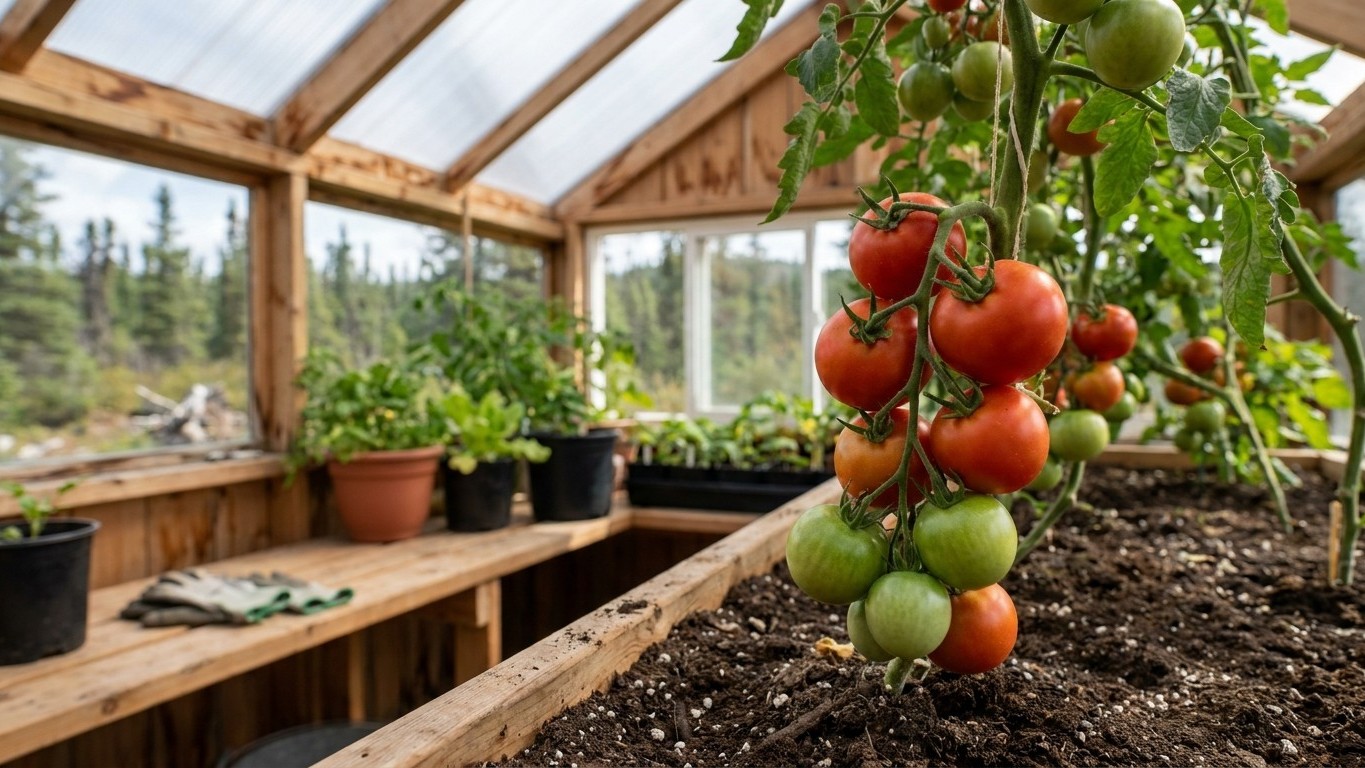

Only the shortest-season tomato varieties reliably finish before frost in Northwest Territories. Environment and Climate Change Canada’s 1981-2010 Canadian Climate Normals for the Yellowknife A station put the mean growing season at roughly 116 days, running from a last spring frost around May 25 to a first fall frost around September 18. Check a variety’s days-to-maturity against that window before you buy seed, not after you have already started it indoors.
What this comes down to in Northwest Territories

At Yellowknife A, Environment and Climate Change Canada’s 1981-2010 climate normals put the mean last spring frost at May 25 and the mean first fall frost at September 18, a window of about 116 days. That figure is a mean, not a guarantee: in one year out of two, frost arrives later in spring or earlier in fall than these dates, so the safe planting season runs narrower than the average implies. The margin a variety carries before frost, not its raw days-to-maturity number, is what actually decides whether it ripens here.
Every variety below is set out in early June, once the mean frost date has passed and the soil has had a chance to warm, and the margin listed is the buffer between its calculated first-ripe date and the mean September 18 frost. A wider margin is insurance against a colder-than-average year. The table gives the quick comparison, and the entries below it go into what each variety actually is.
| Variety | Days from transplant | Habit | Margin before mean frost |
|---|---|---|---|
| Sakura | 55 | Indeterminate | 47 days |
| Edox | 55 | Indeterminate | 47 days |
| Valentine | 55 | Indeterminate | 47 days |
| Glacier | 55 | Determinate | 47 days |
| Sun Gold | 57 | Indeterminate | 45 days |
| Supersweet 100 | 60 | Indeterminate | 42 days |
| Juliet | 60 | Indeterminate | 42 days |
| Amalfi | 68 | Determinate | 34 days |
| Cherokee Purple | 72 | Indeterminate | 30 days |
| Big Beef Plus | 72 | Indeterminate | 30 days |
| Tiren | 75 | Indeterminate | 27 days |
| Granadero | 75 | Indeterminate | 27 days |
| San Marzano II | 78 | Indeterminate | 24 days |
| Celebrity Plus | 78 | Determinate | 24 days |
Sakura

Sakura is a 55-day indeterminate cherry tomato, producing small round red fruit good for snacking and salads. Set out in early June, it ripens by early August and carries 47 days of margin before the mean September 18 frost, the widest buffer on this list. Its resistance to nematodes, tomato mosaic virus, and fusarium wilt races 1 and 2 helps in a garden that has grown tomatoes in the same soil before.
Edox

Edox matches Sakura almost exactly: a 55-day indeterminate cherry tomato with the same resistance package against nematodes, tomato mosaic virus, and fusarium wilt races 1 and 2. It ripens by early August with 47 days of margin, making it a safe pick where a short, cool season is the main obstacle rather than disease.
Valentine

Valentine is a 55-day indeterminate grape tomato bred for elongated fruit with a crack-resistant skin, useful where a wet spell late in the season would otherwise split ripening fruit. It carries intermediate resistance to early blight and, like the other 55-day varieties here, ripens by early August with 47 days of margin.
Glacier

Glacier is a determinate variety at 55 days from transplant, bred for small, early fruit on a compact plant. Because it is determinate, most of the crop ripens over a shorter window rather than trickling in through the season, which suits a gardener planning to preserve a harvest all at once. It shares the 47-day margin of the other 55-day cultivars on this list.
Sun Gold

Sun Gold is a 57-day indeterminate cherry tomato known for small, sweet fruit produced in long trusses. It ripens by early August with 45 days of margin, and its resistance to tobacco mosaic virus and fusarium wilt race 1 makes it a dependable choice in a bed that has had disease pressure before.
Supersweet 100

Supersweet 100 is a 60-day indeterminate cherry tomato producing clusters of small fruit in long trusses. It ripens by early August with 42 days of margin, and its resistance to verticillium wilt and fusarium wilt race 1 is useful where tomatoes have occupied the same ground for several seasons running.
Juliet
Juliet is a 60-day indeterminate grape tomato with oblong fruit suited to sauces as well as fresh eating. It ripens by early August, carries 42 days of margin, and its intermediate resistance to late blight and early blight matters most in a wet or humid season.
Amalfi
Amalfi is a 68-day determinate plum tomato bred for sauce and canning. It ripens by mid August with 34 days of margin and resists nematodes, late blight, and early blight at an intermediate level, a combination worth having where foliar disease has cut a season short before.
Cherokee Purple
Cherokee Purple is a 72-day indeterminate heirloom slicer, grown for flavor rather than disease resistance since it carries none of the resistance codes on this list. It ripens by mid August with 30 days of margin, tight enough that it belongs in a warm, sheltered spot rather than an exposed row.
Big Beef Plus
Big Beef Plus is a 72-day indeterminate slicer bred with resistance to nematodes, gray leaf spot, and tomato mosaic virus. It ripens by mid August with 30 days of margin, the same buffer as Cherokee Purple, but with a disease-resistance package that variety does not have.
Tiren
Tiren is a 75-day indeterminate slicer with resistance to verticillium wilt, tomato mosaic virus, and fusarium wilt race 1. It ripens by late August with 27 days of margin, narrow enough that it only makes sense in a warm microclimate or with some form of season extension in place.
Granadero
Granadero is a 75-day indeterminate plum tomato bred for sauce and paste, with resistance to nematodes, verticillium wilt, and tomato mosaic virus. It ripens by late August with the same 27-day margin as Tiren, so it carries the same risk in a cold year.
San Marzano II
San Marzano II is a 78-day indeterminate paste tomato, producing the long, narrow fruit classic to sauce making. It ripens by late August with only 24 days of margin before the mean frost, the narrowest buffer of any variety on this list, and it carries none of the resistance codes here.
Celebrity Plus
Celebrity Plus is a 78-day determinate slicer bred with resistance to nematodes, gray leaf spot, and tomato mosaic virus. It ripens by late August with 24 days of margin, matching San Marzano II for risk, though its disease resistance is considerably stronger.
Working it out for your own garden
Start from the two mean dates Environment and Climate Change Canada records at Yellowknife A: a last spring frost around May 25 and a first fall frost around September 18. Because these are averages rather than promises, treat late May transplanting as the center of a window that can slide into June in a colder year, and treat September 18 as a date frost could beat by a week or two rather than a floor you can count on. Subtracting a variety’s days-to-maturity from that window, instead of from a single date, is what keeps the estimate honest.
Take Sun Gold as a worked example. It needs 57 days from transplant to first ripe fruit, a figure printed on the seed packet and counted under typical conditions, so treat it as a range of a week or so either side rather than a fixed count. Set the transplant out in early June, once the mean frost date has passed and the soil has had time to warm, and 57 days lands the first ripe fruit in early August. That leaves roughly 45 days by the packet’s own count before the mean September 18 frost. Even a fall frost arriving two or three weeks early still leaves Sun Gold with fruit already on the vine.
Now run the same arithmetic on San Marzano II, which needs 78 days from transplant. The same early-June transplant date puts first ripe fruit in late August, only 24 days ahead of the mean frost. A fall that turns cold early, which happens in roughly half of years by the nature of a mean, can erase that margin entirely and leave the last flush of fruit green on the vine. That is the line: a variety with a wide margin tolerates a bad year, one with a narrow margin does not.
For the exact transplant window this territory allows, work from Tomato Planting Dates in Northwest Territories: Counting Back From Your Frost Window rather than guessing a single date from the frost normals alone.
The mistakes this state punishes

The most common mistake in Northwest Territories is transplanting to the calendar instead of the soil. A run of warm days in mid-May can make it tempting to set tomatoes out ahead of the mean May 25 frost date recorded at Yellowknife A, but a late frost that year kills the crop outright, and even a close call stunts a tomato badly enough that it never fully recovers the lost growth. Treat the mean date as the earliest sensible point, not the target.
The second mistake is choosing a variety for its flavor or its reputation rather than its season. Cherokee Purple carries only 30 days of margin and none of the resistance codes on this list, which is a reasonable trade for flavor in a warm, sheltered spot, but a poor choice for an exposed bed or a cold summer. A long-season heirloom belongs under cover here, not in an open row. If the goal is a reliable harvest rather than a specific flavor, the 55 to 60-day cultivars on this list carry far more insurance.
The third is skipping the hardening-off step that growing tomatoes in Northwest Territories generally requires before transplant. A seedling moved straight from a warm windowsill or greenhouse into an open garden bed can be checked by cold, wind, or intense light badly enough to lose a week or more of growth, which matters far more here than in a longer-season garden where a lost week is easily absorbed.
Checking this against your county
The May 25 and September 18 frost dates above come from Environment and Climate Change Canada’s 1981-2010 climate normals at the Yellowknife A station, and they describe conditions around Yellowknife specifically, not the whole territory. Communities further north, at higher elevation, or further from the moderating effect of Great Slave Lake can run weeks behind that window, while a sheltered river valley might run slightly ahead of it. Check your own community’s frost record, where one exists, before locking in a transplant date built on the Yellowknife normals. The Government of Northwest Territories’ Department of Industry, Tourism and Investment maintains an agriculture services page with more localized guidance, worth a call before committing a season’s worth of seedlings to a single date.
Common questions
What’s the shortest-season tomato I can grow this far north?
The shortest catalogue figures on this list are the 55-day varieties: Sakura, Edox, Valentine, and Glacier. All four are calculated to ripen by early August against the mean frost dates at Yellowknife A, leaving the widest buffer of any variety here, roughly 47 days by the packet count.
Can I still grow a big slicing tomato like Cherokee Purple or Celebrity Plus?
Yes, but with less room for error. Cherokee Purple needs 72 days and Celebrity Plus needs 78, leaving 30 and 24 days of margin respectively against the mean September 18 frost, so both do better in a warm, sheltered spot or under some form of cover than in an open row.
Does disease resistance mean a variety ripens faster?
No. Resistance codes like the ones listed for Celebrity Plus or Big Beef Plus describe how the plant handles specific diseases, not how quickly it fruits. A resistant variety with a long days-to-maturity figure, such as San Marzano II with no resistance codes at all and a full 78 days, can still run out of season before it ripens.
Should I start seeds indoors earlier than usual to make up for the short season?
Starting seed indoors earlier helps more than picking a slightly shorter variety, since transplant size at set-out matters almost as much as the days-to-maturity count on the packet. The indoor-sowing window that works backward from the local frost dates is a separate calculation from variety choice, and it changes the answer more than swapping one 55-day cultivar for another.