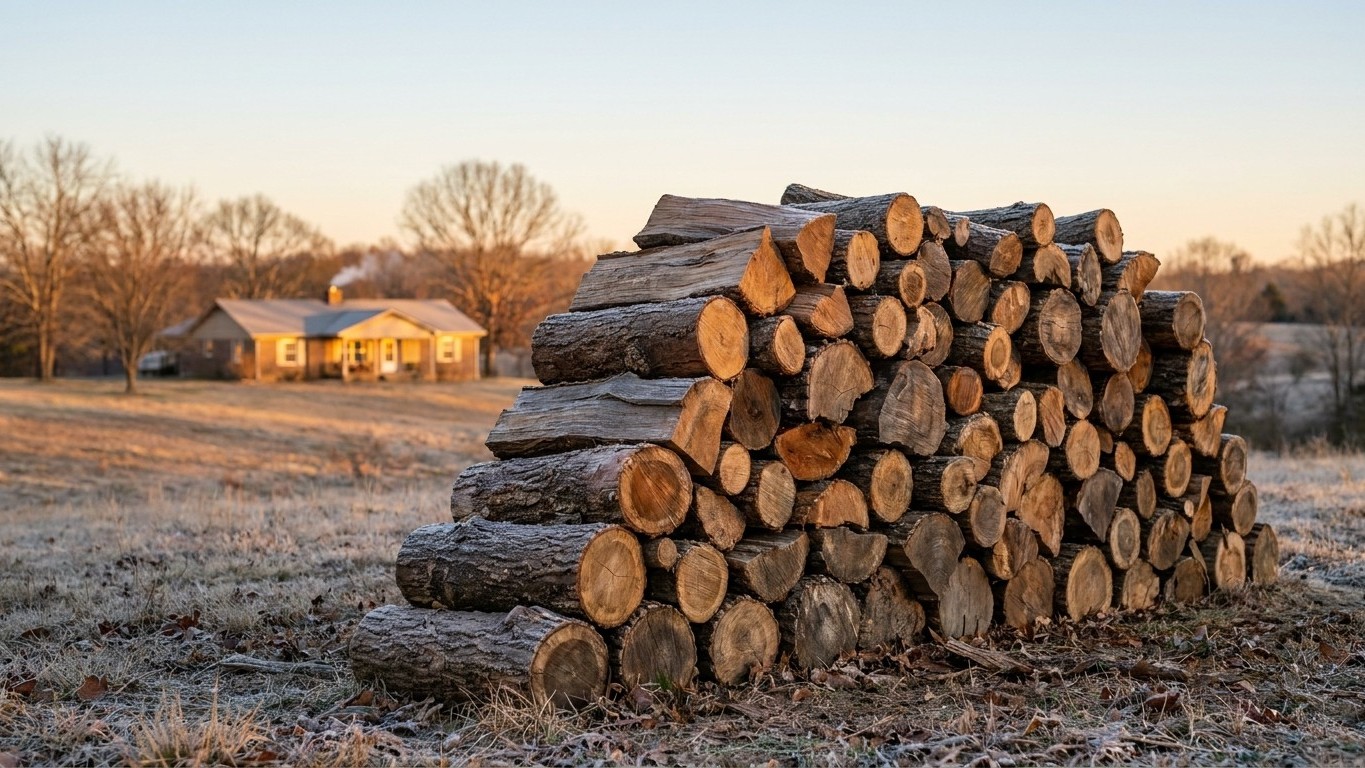

Arkansas winters don’t ask for the same woodpile as Minnesota, but they’re not mild enough to ignore, either. The average low in the coldest month at Little Rock sits at 30.9°F, cold enough for real heating demand, not cold enough to force you into buying the densest hardwood you can find. That number, more than any species chart, should decide how you stock a woodpile here.
How cold it actually gets here

The figure that matters is 30.9°F, the average daily low for the coldest month at Little Rock, based on NOAA’s 1991-2020 Climate Normals. That’s not a record low and not a monthly average temperature. It’s the mean minimum, the number that tells you what a typical cold night looks like, night after night, for weeks at a stretch.
Thirty degrees is a specific kind of cold. It’s below freezing, enough to keep a house calling for heat all night, but it’s nowhere near the sub-zero lows that force a Northern Plains or Upper Midwest household to plan around survival. A wood stove running through an Arkansas January is working, but it’s not fighting for its life. Pipes can freeze, a stove that goes cold overnight will let a house drop uncomfortably, but nobody in central Arkansas is choosing between firewood and frostbite the way someone in Montana might.
What that means in practice: heating through an Arkansas winter is a matter of comfort, cost, and consistency, not raw survival math. You don’t need the single densest wood species available just to make it to March. You need enough well-seasoned wood, reasonably dense, to keep a stove or fireplace producing steady heat through nights that dip into the low 30s and occasionally colder, especially in the Ozark and Ouachita highlands where cold air pools in valleys and elevation shaves a few extra degrees off that average.
That last point matters more than people expect. The 30.9°F figure is a statewide reference tied to Little Rock, but Arkansas isn’t flat in temperature the way it looks on a map. Northwest Arkansas and the higher elevations of the Ozarks run colder on average than the Delta or the southern part of the state. If you’re burning wood in Fayetteville or up in the hills, treat that 30.9°F as a floor, not a ceiling, and plan your woodpile a little heavier than someone burning the same stove in Pine Bluff or El Dorado.
None of this means firewood in Arkansas is decorative. A stove that’s actually carrying part of the heating load through December, January, and February needs a real supply, seasoned properly, in enough volume to get through the season without a midwinter scramble for dry wood. The difference between Arkansas and a harder climate isn’t whether you need a woodpile. It’s how much margin for error you have if that woodpile runs short.
Which woods are worth the effort here
Density is what turns a cord of firewood into hours of heat, and it matters more as the cold figure drops. Arkansas’s 30.9°F average low doesn’t demand the absolute densest hardwood on the continent, but it does reward wood that’s genuinely dense over wood that’s light and quick-burning, especially for anything you expect to hold overnight.
Here’s the mechanism. A cord is a fixed volume, 4 feet by 4 feet by 8 feet, or 128 cubic feet of stacked wood. That volume doesn’t change based on species. What changes is how much actual wood mass is packed into it, and how much water has to boil off before that mass gives up its heat. A cord of well-seasoned hardwood carries roughly 20 million BTU, according to Michigan State University Extension, which is about the heat equivalent of 145 gallons of #2 fuel oil or 215 gallons of LP gas. That figure is an average across seasoned hardwood generally. Species, and especially moisture content, move it substantially in either direction, so treat it as a benchmark for what a decent cord should deliver, not a guarantee for any specific load someone sells you.
Denser hardwoods are the ones worth prioritizing for the coldest nights and for an overnight burn you want still glowing at 6 a.m. Lighter, less dense woods still have a place: they’re good for getting a fire started quickly, for shoulder-season burning in October or April when you just need to take the chill off, and for mixing into a load so a stove doesn’t run too hot too fast. The mistake is building an entire winter supply around light, fast-burning wood and expecting it to carry you through a cold snap the way a dense load would.
One caution worth flagging by name: red oak, common across much of Arkansas, dries more slowly than most other hardwoods because of its cell structure. It’s a solid, dense firewood once it’s actually seasoned, but “once it’s actually seasoned” takes longer with red oak than with faster-drying species, and burning it too green wastes a lot of that density on boiling off water instead of producing heat.
Beyond the density question, local availability decides as much as any chart does. A species with excellent heat output that you can only buy green, or can’t find seasoned and stacked anywhere near you, is a worse choice than a more modest wood you can actually get properly dried. Ask any seller directly how long a load has been split and stacked, not just what species it is. For a closer look at how specific species stack up on density and heat output, see our full firewood species and BTU comparison guide.
How much wood a winter takes
There’s no honest single number for “how many cords does an Arkansas winter take,” and anyone who gives you one without asking follow-up questions is guessing. The real answer depends on three things: how cold your specific location actually runs, how well your house holds onto heat once it’s made, and whether wood is doing all the heating work or just supplementing a furnace or heat pump.
Start with the cold figure. A household in the Ozark highlands, running consistently colder than the 30.9°F Little Rock average, is going to burn through more wood over a season than one in the warmer southern part of the state, even with an identical stove and an identical house. That’s before insulation or usage pattern enters the picture at all.
Insulation is where the real swing happens, and it’s bigger than most people expect. A poorly insulated house, drafty windows, minimal attic insulation, an old uninsulated crawlspace, can burn through close to double the wood that a tight, well-insulated house uses in the exact same winter, in the exact same climate. That’s not a small variance. It means two neighbors on the same street, both burning the same stove through the same January, can have completely different woodpile needs simply because one house leaks heat and the other doesn’t. If you’re trying to estimate your own need, an honest look at your home’s insulation and air sealing tells you more than any regional average.
The third variable is how wood fits into your heating setup. A household using a wood stove as the primary heat source, running it daily through the coldest months, needs a fundamentally different volume than one burning wood a few evenings a week to take the edge off while a furnace or heat pump carries the rest of the load. Primary heat users in Arkansas typically need several cords across a full winter; supplemental burners often get by on a fraction of that. There’s no way to know which category you’re in from a published statewide number, because the number was never built to account for your house or your habits.
The practical move is to track your own use for one season, note how many cords you actually burn through, and adjust from there rather than trusting a generic figure that was never calculated for your climate zone, your insulation, or your stove.
Drying wood in this climate
Seasoning matters more than species almost everywhere firewood gets burned, and Arkansas’s climate makes the seasoning question a little trickier than people expect. Green wood can hold over 60 percent moisture, and none of that water turns into heat. It has to boil off first, and that boiling consumes energy that should have gone into warming your house. The target, regardless of species or region, is 20 percent moisture or less by the time wood hits the firebox.
What gets wood there is air moving through it and time, not sunlight. Split wood, stacked loosely enough that air can pass between the pieces, dries far faster than wood left in rounds or stacked tight against a wall with no airflow. Arkansas’s humid summers slow that process compared to a dry Western climate, where the same wood might season noticeably faster. That doesn’t mean Arkansas wood can’t get to 20 percent moisture in a normal season; it means the humid stretch from June through August does less of the drying work than dry air would, so the total time needed tends to run longer than a quick rule of thumb suggests.
Red oak deserves a second mention here specifically because of how it dries. Its cell structure holds moisture longer than most other hardwoods common in Arkansas, so a red oak round split in spring is less likely to be ready by the following winter than a faster-drying species split at the same time. Giving it extra months, or planning to burn it a full year later than other wood in the pile, avoids the disappointment of a “seasoned” red oak load that still hisses and smokes on the fire.
Tie this back to the cold figure and the most common mistake in the state becomes obvious: wood split and stacked in spring for that same coming winter is usually not ready by the time the first 30-degree nights show up. One full summer stacked, split, with air moving through the pile, is the realistic minimum for most species here, and longer for red oak. Wood cut this spring is wood for next winter’s stove, not this one, and planning a season ahead is the difference between a fire that throws real heat and one that mostly smolders and smokes while the water inside it slowly boils away.