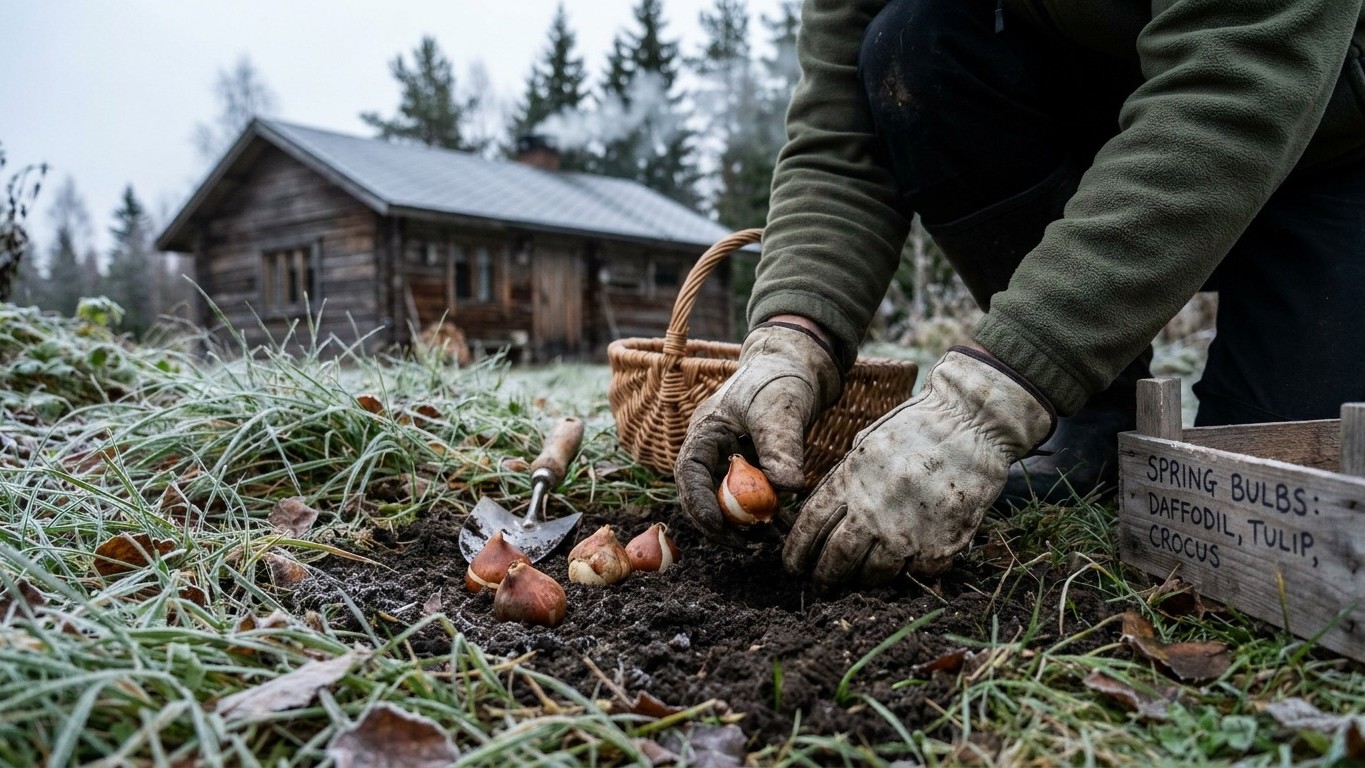

The short answer: plant in early September, and don’t worry about whether Yukon gets cold enough for spring bulbs to bloom. It does, several times over. The real question here isn’t chill, it’s which bulbs survive the winter at all, and that answer is narrower than most seed catalogs let on.
When to plant bulbs in Yukon

The average first fall frost at Whitehorse A lands on August 25, and that date anchors the whole planting calendar. Spring bulbs want to go into the ground roughly six weeks before the soil locks up for good, which in practice means most Yukon gardeners are working with a window that opens in late August and closes by mid-to-late September, depending on how the season runs.
Miss either edge of that window and the bulb pays for it. Plant too early, while the soil is still holding summer warmth, and a bulb like a daffodil or tulip can push up a shoot before winter arrives. That shoot gets killed by the first hard freeze, and the bulb spends its stored energy recovering instead of building next year’s flower. Plant too late, once the ground is already stiffening, and the bulb never develops the root system it needs before freeze-up. It may still flower the following spring, but weakly, and it often skips a year afterward while it rebuilds. Gardeners who miss the outdoor window entirely still have options: Forcing Spring Bulbs Indoors in Yukon lets you enjoy blooms without waiting on the ground to cooperate, while Growing Spring Bulbs in Containers in Yukon gives you more control over timing and soil conditions than an in-ground bed ever will.
Treat the frost date as a midpoint, not a guarantee
August 25 is a mean date pulled from thirty years of Environment and Climate Change Canada records at the Whitehorse A station. A mean means exactly what it sounds like: in roughly half of all years, frost arrives later than that, sometimes by a couple of weeks. Planning a planting date off the average without building in slack is how bulbs end up going into ground that’s colder or warmer than expected. The safer approach is to start watching soil temperature in late August rather than circling a single calendar day, and to have bulbs in hand and ready before the month turns.
Gardeners in outlying districts, especially at higher elevation or further from the Whitehorse valley, should push that window earlier rather than later. Cold settles into upland and northern ground faster than it does around a river valley, and a planting date calculated for the capital can run weeks behind what a colder district actually needs.
Whether your winter is cold enough
Every spring bulb needs a stretch of real cold before it will flower. Below about 45°F, sustained for somewhere between twelve and fourteen weeks depending on the species, a tulip or daffodil bulb runs through the internal changes that let it push up a flower stalk instead of just leaves. Skip that cold requirement, or cut it short, and the bulb typically still grows, it just doesn’t bloom, or it blooms on a stunted stalk too short to clear the foliage. This is the number every bulb guide should give you, because without it you have no way to judge whether a variety someone hands you, or a bag on a garden center shelf, has any chance in your ground.
Yukon clears that bar without effort. The coldest month at Whitehorse runs a mean daily minimum of -2.6°F, and the cold season that produces that number stretches across many months, not just the twelve or fourteen weeks any bulb requires. In practical terms, this means every spring bulb sold for cold climates gets more chill here than it knows what to do with. Nobody in Yukon needs to pre-chill a bulb in the refrigerator before planting, and nobody needs to worry about a warm winter cheating a tulip out of its bloom. That’s not a small thing. In much of the continental United States, gardeners in mild-winter regions have to fake this cold artificially, storing bulbs in a fridge for twelve weeks, kept well away from apples and other ripening fruit because the ethylene gas they give off can kill the flower bud inside the bulb before it ever reaches soil. Yukon skips that step entirely.
The margin here is wide enough that chill stops being the limiting factor. What decides success in Yukon is a different question entirely: whether the bulb itself survives the depth of cold that produces that chill, not whether it gets enough of it. That distinction matters, and the next section deals with it directly.
| Bulb | Cold needed to flower (weeks below 45°F) | What Yukon’s winter delivers | Verdict on chill |
|---|---|---|---|
| Tulips | 12–16 weeks | Months of subfreezing soil, no pre-chill needed | Cleared, with room to spare |
| Daffodils | 12–14 weeks | Same | Cleared |
| Crocus | 8–15 weeks | Same | Cleared |
| Hyacinths | 12–14 weeks | Same | Cleared |
| Muscari (grape hyacinth) | 13–15 weeks | Same | Cleared |
| Alliums | 8–10 weeks | Same | Cleared |
Chill is a solved problem here in every case. Whether the bulb makes it through the winter alive is not, and that’s where the real filtering happens.
Which bulbs suit Yukon
Because Yukon’s cold season is severe rather than merely long, the bulbs that do well are the ones bred or selected for the coldest end of the hardiness spectrum, not the general-purpose spring bulbs sold across most of the country. Species tulips and the toughest small bulbs tend to outperform the big Dutch hybrids that fill most garden center bins.
- Siberian squill (Scilla siberica), hardy USDA zones 2 to 8, about as tough as spring bulbs get
- Species tulips such as Tulipa tarda and Tulipa turkestanica — hardy zones 3 to 8
- Snow crocus (Crocus chrysanthus), hardy zones 3 to 8
- Glory-of-the-snow (Chionodoxa), hardy zones 3 to 8
- Daffodils, hardier cultivars — hardy zones 3 to 9
- Muscari (grape hyacinth), hardy zones 3 to 8
None of these ranges are a hard wall. A daffodil rated to zone 3 will often do fine in a sheltered spot against a south-facing foundation with reliable snow cover, and struggle in an exposed, wind-scoured bed even a few feet away. Snow cover in particular acts as insulation, and a bulb bed that loses its snow to wind in January is colder than the zone rating assumes.
Some popular bulbs disappoint here in predictable ways. Large hybrid tulips, the kind sold as mixed collections, often put up leaves the first spring and then thin out or vanish within two or three years as the cold and short growing season wear them down. Hyacinths frequently survive one winter, bloom well, and then fail to return, especially in heavier or poorly drained soil, where standing meltwater around the bulb in early spring causes rot before the ground has even fully thawed. Dutch iris and most fritillaria varieties are a poor bet outright, they’re rated for milder zones and rarely make it through a single Yukon winter.
What digs them up here
Squirrels and voles are selective, and the pattern isn’t random. It comes down to chemistry inside the bulb itself. Daffodils and anything in the onion family contain compounds that make them bitter or mildly toxic to rodents, so they get left alone almost every time. Tulips and crocus have no such defense, and a freshly planted bed of either is an open invitation.
- Bulbs rodents typically avoid: daffodils, alliums, snowdrops, scilla
- Bulbs rodents typically dig up and eat: tulips, crocus, hyacinths
Of the bulbs recommended above for Yukon’s winters, the daffodils, alliums, scilla, and snowdrops are already safe on this front, which makes them a doubly practical choice here. For the tulips and crocus, the one measure that consistently works is a physical barrier: lay wire mesh flat over the planting bed and pin it down, then leave it in place until the ground freezes solid, at which point digging becomes impractical for the animals anyway. Repellent sprays and granules get pitched hard in garden centers, but they wash off with the first rain and need constant reapplication, which makes them unreliable compared to a $10 roll of hardware cloth.
Where to check for your own county
Every figure in this article, the frost date, the coldest month minimum, the hardiness zone, comes from the Whitehorse A weather station and the reference city tied to it. Yukon spans a wide range of terrain, from river valleys to alpine districts, and a planting calendar built around Whitehorse can run two or three weeks off in a colder or higher district. That gap is large enough to matter when a bulb needs to be in the ground before the soil hardens.
For local confirmation, Agriculture and Agri-Food Canada maintains resources at agriculture.canada.ca, and it’s worth checking there or with a territorial agricultural office before locking in a planting date for a district far from Whitehorse. A gardener in a cold pocket a couple of valleys over is better served by a date adjusted for their own ground than by one calculated for the capital.