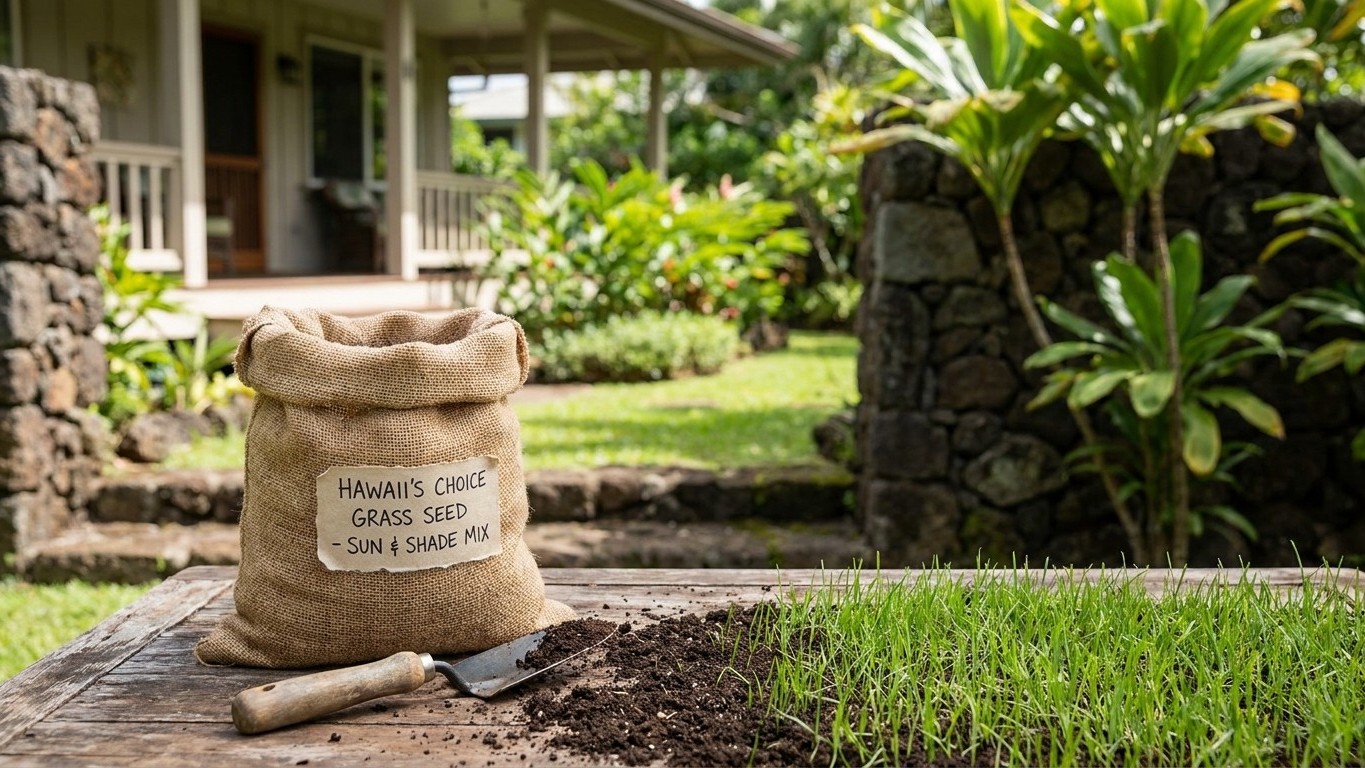

Salt spray drifting off the reef is what separates a lawn that survives here from one that doesn’t. There’s no fall seeding deadline in Hawaii, no freeze to plan around — Honolulu’s climate record doesn’t even register one. So the choice among the seven warm-season grasses actually sold here comes down to three things: how much salt reaches the yard, how much shade the canopy throws, and how often the lawn gets walked on. Seashore paspalum wins near the water; st. augustinegrass wins under kukui trees; bermudagrass wins where kids play.
The short answer for Hawaii
For most Hawaii yards, the short list narrows to three species: seashore paspalum, bermudagrass and zoysiagrass, with st. augustinegrass and centipedegrass as options where shade or low mowing frequency matter more than density. Clemson Cooperative Extension’s HGIC 1214 places all seven of these grasses in the warm-season group, and NOAA’s National Centers for Environmental Information could not even compute a freeze percentile for Honolulu in the 1991-2020 normals, because the value never occurs there. There is no fall seeding deadline here the way there is on the mainland.
What actually decides the winner on your property is salt exposure, shade, rainfall and how the lawn gets used. A yard within reach of ocean spray does better with seashore paspalum, which tolerates salt better than the other six species named by HGIC 1214. A yard under kukui or monkeypod trees needs the shade tolerance of st. augustinegrass, since bermudagrass and zoysiagrass thin out fast once direct sun drops below a few hours a day. A steep, rarely mowed slope favors centipedegrass or carpetgrass, both of which need less nitrogen and less frequent cutting than bermudagrass. None of the seven is free of a trade-off: the density and wear tolerance that make bermudagrass the choice for a play lawn are also what make it invasive into flower beds, and the shade tolerance that makes st. augustinegrass work under trees comes with a coarser leaf and higher water demand.
Seed availability narrows the list further. St. augustinegrass has no reliable seeded cultivar in the trade, it is planted from sod, plugs or sprigs, so a real grass-seed shopping list for Hawaii means bermudagrass, centipedegrass, carpetgrass, bahiagrass and a handful of seeded zoysiagrass cultivars. Seashore paspalum is almost always established from sprigs or sod too, for the same reason. Before you tear out an existing lawn to switch species, it’s worth reviewing Hawaii Lawn Care basics like mowing height and irrigation, since a species swap only pays off once those fundamentals are already right.
Working through the year

Every one of these seven grasses grows year-round in Hawaii’s lowlands, since there is no winter dormancy to pause them. What changes month to month is rainfall, not temperature, so a Hawaii lawn is really worked to a rainfall calendar layered over the mowing height, nitrogen rate and irrigation figures published for each species. Clemson’s species-specific maintenance calendars, HGIC 1216 for bermudagrass, HGIC 1217 for zoysiagrass, HGIC 1215 for centipedegrass and HGIC 1218 for st. augustinegrass, were written for a climate with a real winter, so their calendar dates don’t transfer here. Their mowing heights and nitrogen rates per 1,000 square feet do, since those figures describe the plant, not the Carolina frost line. For the month-by-month version of that rainfall-driven routine, see the Hawaii Lawn Care Calendar, Month by Month.
| Species | Shade tolerance | Salt tolerance | Seeded cultivars available |
|---|---|---|---|
| Bahiagrass | Low | Low | Yes |
| Bermudagrass | Low | Medium | Yes |
| Carpetgrass | Medium | Low | Yes |
| Centipedegrass | Medium | Low | Yes |
| Seashore Paspalum | Medium | High | Rare, usually sprigged |
| St. Augustinegrass | High | Medium | No, sod or plugs only |
| Zoysiagrass | Medium to high | Medium | Yes, but slow to establish |
Seashore Paspalum

Best where salt spray or brackish irrigation water rules out the others. It forms a dense, dark green, fine to medium-textured turf that spreads by stolons and fills in fast once sprigged. The trade-off is a shorter mowing interval, since it keeps growing whenever moisture is available.
Bermudagrass

The most wear-tolerant choice for a play lawn or a yard with dogs. Clemson’s HGIC 1216 calendar sets it at a lower mowing height and a higher nitrogen rate than centipedegrass, and skipping a feeding cycle shows up fast as thinning in full Hawaii sun. It also spreads into beds and needs regular edging.
Zoysiagrass

Dense and slow-growing, so it needs fewer mowings but recovers slowly from bare patches. Clemson’s HGIC 1217 calendar sets its mowing height between bermudagrass and st. augustinegrass. It tolerates more shade than bermudagrass, less than st. augustinegrass.
St. Augustinegrass

The shade-tolerant pick, and the one most likely to hold turf under trees. Clemson’s HGIC 1218 calendar calls for a taller mowing height than the other six species, matching its coarse, broad blade. It’s planted from sod or plugs, not seed, and drinks more water than centipedegrass.
Centipedegrass

The low-input option. Clemson’s HGIC 1215 calendar sets its nitrogen rate well below bermudagrass, and overfeeding is one of the fastest ways to kill it. It stays a light apple-green even when healthy, a color some owners mistake for hunger and then fertilize into decline.
Carpetgrass

Suited to a low, damp corner where nothing else holds. It tolerates wet, poorly drained soil better than the other six but won’t take heavy traffic or a close mowing height.
Bahiagrass
The coarsest-textured of the seven, prone to sending up seed heads between mowings. It holds on poor, sandy soil with little care, better suited to an unirrigated slope than a front lawn.
What changes across Hawaii
The warm-season label above comes from NOAA and NCEI data measured at Honolulu, and the rest of the state does not match it evenly. Windward coasts, Hilo on the Big Island and the windward side of Oahu and Kauai, get far more rainfall than Honolulu, which favors species that tolerate wet feet, like carpetgrass and st. augustinegrass, and works against centipedegrass, which struggles in constantly saturated soil. Leeward coasts, Kona on the Big Island and the dry side of Maui, run drier, and a lawn there depends on irrigation or a drought-tolerant species like bahiagrass or bermudagrass to hold color through a dry stretch.
Elevation is the other big variable. Upcountry areas like Kula on Maui or Waimea on the Big Island sit high enough that growth slows, and the same grass takes longer to fill in after planting than it would at sea level in Honolulu. None of this pushes any part of inhabited Hawaii into a real frost risk. NOAA’s 1991-2020 climate normals could not compute a freeze percentile for Honolulu because the event never happens there, and frost in this state is confined to the summits of Mauna Kea, Mauna Loa and Haleakala, elevations no lawn reaches.
Coastal exposure works on top of both. A yard a few dozen feet from the shoreline gets salt in the irrigation water and in wind-driven spray, and that is the strongest single argument for seashore paspalum over bermudagrass or zoysiagrass, regardless of which island or which side of it the yard sits on.
The mistakes this climate punishes
Feeding on a mainland calendar
The maintenance calendars in HGIC 1216, 1215 and 1218 space nitrogen applications around a spring green-up and a fall shutdown that assumes a real winter. Hawaii’s warm-season grasses never go fully dormant, so feeding heavily in what would be “fall” on the mainland just pushes soft new growth into whatever rainy stretch follows, and that growth is what fungal diseases attack first. Split the same total nitrogen into more, smaller feedings spread across the year rather than following a spring and fall pair of large ones.
Mowing too short in a wet stretch
Scalping a lawn during a rainy month opens bare soil to weed seed and to the same fungal pressure mentioned above, and it shows up as thin, yellowing patches within a couple of weeks rather than the slow decline a mainland lawn shows after a hard winter. Raise the mower a notch during the wettest months rather than holding one height all year.
Sowing a cool-season species
Tall fescue, Kentucky bluegrass and perennial ryegrass are the species Penn State Extension lists for a genuinely cold climate, and none of them holds up in lowland Hawaii’s year-round heat. A cool-season lawn seeded here doesn’t wait for a frost to fail, since there isn’t one. It simply thins and dies through the first hot, humid stretch, usually within a season, because the plant has no dormancy strategy that works without a real cold period to trigger it.
Planting bermudagrass or zoysiagrass on a salt-exposed lot
Both grow well inland but decline steadily within reach of ocean spray, showing tip burn and thinning along the exposed edge first. The damage builds slowly, over a season or two, rather than all at once, which makes it easy to blame drought or pests before checking the more obvious cause.
Checking this against your county
Every figure above comes from Honolulu data, and the islands span enough rainfall and elevation difference that a county-specific check is worth the time it takes. The University of Hawaii’s College of Tropical Agriculture and Human Resources extension service is the state’s land-grant office and the right first call for a soil test, a disease diagnosis or a planting recommendation specific to your island and elevation. Before buying seed or sod, confirm your yard’s rainfall pattern and salt exposure against what CTAHR’s local office reports, rather than assuming the Honolulu figures above apply exactly where you live.
Common questions
Can I grow fescue or another cool-season grass in Hawaii if I water it enough?
No. Water doesn’t fix the underlying problem, which is heat and humidity, not moisture. Penn State Extension lists tall fescue, Kentucky bluegrass and perennial ryegrass as cool-season species built for a cold-winter climate, and none of them has a way to cope with a lowland Hawaii summer no matter how well it’s irrigated.
Which recovers faster from foot traffic, bermudagrass or zoysiagrass?
Bermudagrass, generally. Its stolons and rhizomes spread faster than zoysiagrass, so worn or bare patches fill back in sooner. Zoysiagrass forms a denser, more cushioned mat once mature, but that same slow growth habit means it takes longer to recover from damage in the meantime.
Why does my centipedegrass look yellow if there’s no frost to cause it?
The most common cause on Hawaii’s lava-derived soils is iron chlorosis from high soil pH, not cold and not nitrogen shortage. Centipedegrass is naturally a lighter green than bermudagrass or zoysiagrass even when perfectly healthy, so a soil test is worth doing before adding any fertilizer.
Do I need to overseed or dethatch in winter like a mainland lawn?
No, because none of these seven species goes dormant here the way a mainland lawn does. Dethatching and any renovation work should follow the rainfall pattern instead, done during a drier stretch so the lawn can recover quickly rather than sitting torn up through a wet one.