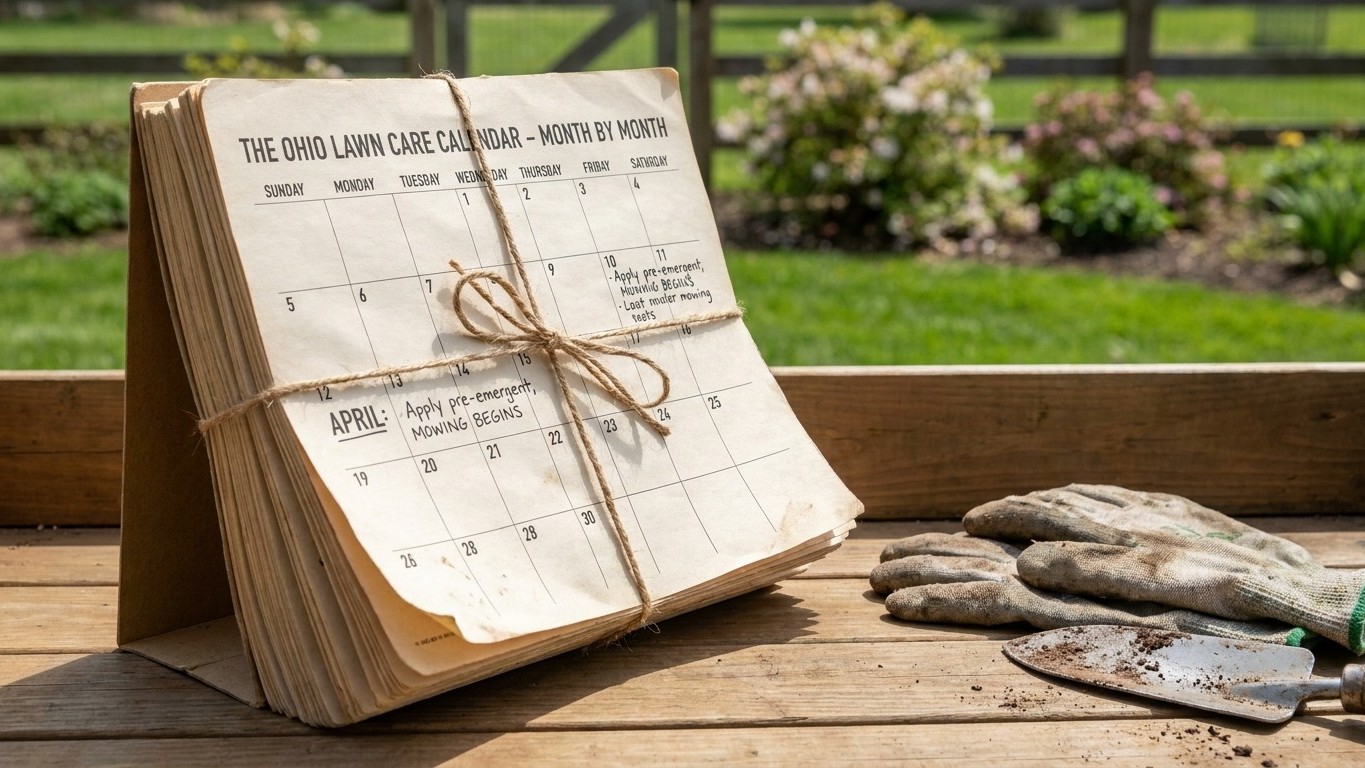

Bermuda grass promises showing up in seed catalogs every spring make Ohio lawns look like candidates for a low-maintenance warm-season switch. They aren’t. Ohio’s winters end that conversation before it starts, which is why the calendar that actually works here runs on Kentucky bluegrass, tall fescue, ryegrass and the fescue cousins instead. Each keeps its own rhythm, so a date that suits one can miss another by weeks — which is the real reason “just tell me when” never has one clean answer.
The short answer for Ohio
Ohio sits in the cool-season turf zone, a classification The Homestead Post assigns based on how many days a reference city spends at or above 90°F and how cold its coldest month runs, read against the season tolerances published by Clemson Cooperative Extension in HGIC 1214. That means the grasses that actually hold up here are Kentucky bluegrass, tall fescue, perennial ryegrass, fine fescues and rough bluegrass, the species Clemson’s HGIC 1214 and Penn State Extension both list as cool-season turf. A warm-season grass like Bermuda or zoysia will not thrive through an Ohio winter, no matter how well it’s marketed for low maintenance.
The answer to “when do I do X” always depends on which of those five grasses you planted, because their calendars are close but not identical. Tall fescue tolerates heat and drought better than Kentucky bluegrass, so it can carry a slightly later spring feeding without stress. Fine fescues want less nitrogen across the board. The frost date matters most for fall seeding: work backward from the October 5 to October 15 window near Columbus so new seedlings get roots down before the ground closes for the season. If you haven’t settled on a species yet, The Best Grass Seed for Ohio Lawns walks through which of the five fits which yard.
Everything below assumes you’ve already got turf in the ground, whether that’s an existing lawn or one seeded last fall. If you’re starting from bare dirt, work through Ohio Lawn Care first, then come back to this calendar for the maintenance rhythm.
Working through the year

Clemson Cooperative Extension’s HGIC 1219, the Tall Fescue Maintenance Calendar, lays out the sequence most cool-season lawns in Ohio actually follow, since tall fescue is one of the five species recommended here. It’s worth saying up front that HGIC 1219 is written for South Carolina’s transition-zone climate, so the calendar months shift earlier in fall and later in spring for Ohio. The rates and the order of operations carry over. The dates need to be re-anchored to Columbus’s frost window from OSU Extension.
Spring
Mow as soon as growth starts, keeping tall fescue at roughly 2.5 to 3 inches for the first few cuts. Hold off on nitrogen or apply only a light dose. Heavy spring feeding pushes leaf growth at the expense of roots right before summer stress arrives. This is also the window for a pre-emergent herbicide against crabgrass, applied before soil temperatures warm enough for seeds to germinate.
Summer
Raise the mower to 3 to 4 inches once daytime heat sets in. A taller blade shades the soil, slows moisture loss and keeps roots cooler. Water deeply and infrequently rather than a little every day, aiming for roughly an inch a week when rain doesn’t provide it, split across one or two sessions rather than a daily sprinkle that only wets the surface. Skip fertilizer entirely during the hottest stretch.
Fall
This is the main event for cool-season turf. Aerate compacted soil and overseed thin spots in early fall, giving new grass enough runway to root before the Columbus-area frost date of October 5 to 15. Fall carries the bulk of the year’s nitrogen, following the HGIC 1219 pattern of loading feeding into the cooler months rather than spring. Keep mowing until growth stops, gradually lowering the height for the last cut or two of the season.
Winter
There’s little to do once growth stops beyond keeping leaves off the lawn and staying off frozen or waterlogged turf, which compacts easily when it can’t spring back.
What changes across Ohio
The figures above are measured at or near Columbus, and Ohio is a large enough state that other regions run on a different clock. Along Lake Erie, the lake itself moderates temperature swings: spring green-up tends to lag behind inland areas because the lake keeps the air cool longer into the season, while fall stays milder later, pushing the safe seeding window a bit past what a Columbus calendar suggests.
Southern Ohio, along the Ohio River valley, runs warmer than the Columbus reference point in both directions. Spring mowing and feeding can start earlier, and the growing season stretches later into fall before frost shuts things down. Northeast Ohio’s higher ground and the hillier counties toward the Appalachian foothills in the southeast trend colder, with frost arriving on the early side of any statewide range and lingering longer in spring.
None of this changes which grasses work. Cool-season turf is the right call across the entire state, since Ohio doesn’t have a region warm enough to carry Bermuda or zoysia through winter reliably. What shifts is timing: treat the Columbus dates as a starting point and nudge earlier if you’re near the Ohio River, later if you’re near Lake Erie or up in higher, colder ground.
The mistakes this climate punishes
Seeding cool-season grass in the heat of summer
Tall fescue and Kentucky bluegrass seed germinates poorly once soil temperatures climb into summer range, and any seedlings that do sprout struggle against heat and drought stress before they’ve built a root system. The damage shows up as bare, thin patches by late summer that look like a failed lawn rather than a failed planting date. Fall, anchored to the frost window discussed above, is the fix.
Cutting too short before summer stress
Scalping a cool-season lawn down to 1.5 or 2 inches right as heat arrives removes the leaf area the plant needs to shade its own roots and hold soil moisture. The lawn browns within weeks, and people often assume it’s dead. It’s usually just dormant and stressed, and it can recover once cooler weather and consistent watering return, but a scalped lawn takes longer to bounce back than one mowed at a reasonable height all summer.
Trying a warm-season grass because it’s marketed as low-maintenance
Bermuda and zoysia genuinely need less water and fertilizer where they’re hardy, which is exactly the sales pitch that gets Ohio homeowners to try them. They go dormant and brown at the first real cold snap and, north of the true warm-season zone, they don’t reliably green back up the following spring. That’s a different failure than summer drought dormancy in a cool-season lawn: it’s a species planted outside the range it can survive.
Skipping the pre-emergent window
Missing the spring pre-emergent application means crabgrass gets a head start, and by the time it’s visible in June or July, no herbicide timed for prevention will touch it. The mistake is invisible in April and obvious by midsummer, which is exactly why it gets skipped year after year.
Checking this against your county
Columbus figures are a starting point, not a guarantee, for a county two hours away in any direction. Ohio State University Extension keeps county-level offices that track local frost trends, soil conditions and turf pest pressure specific to their area. Before locking in a seeding or feeding date, check the current guidance at OSU Extension for your county rather than assuming the Columbus dates translate exactly.
That’s especially worth doing in a year running unusually warm or cold, since a calendar built on long-term normals won’t reflect a single odd season.
Common questions
When should I put down grass seed in Ohio?
Early fall, timed to finish well before the Columbus-area frost window of October 5 to 15 from OSU Extension, gives seedlings the best shot at rooting before winter. Spring seeding is possible but riskier, since summer heat arrives before young grass has built a deep root system.
My lawn turned brown in July, is it dead?
Probably not. Cool-season grasses like Kentucky bluegrass and tall fescue go dormant and brown under summer heat and drought stress as a survival strategy, and they typically green back up once temperatures drop and rain or irrigation returns. Check the crown of a few blades near the soil; if it’s still white or pale rather than brown and dry all the way down, the plant is dormant, not dead.
Can I grow Bermuda grass or zoysia in Ohio?
Not reliably. Both are warm-season grasses that go dormant at the first hard frost and, outside the true warm-season zone, often fail to green back up consistently the following spring. Ohio’s cool-season climate favors the tall fescue, Kentucky bluegrass, perennial ryegrass, fine fescue and rough bluegrass lineup instead.
Do I need to aerate every fall?
Not every single year unless your soil is heavily compacted or you’re overseeding. Clay-heavy soil, high foot traffic, or a lawn that pools water after rain are the signals that aeration is due. A lawn without those signs can often go every other year without a noticeable difference.