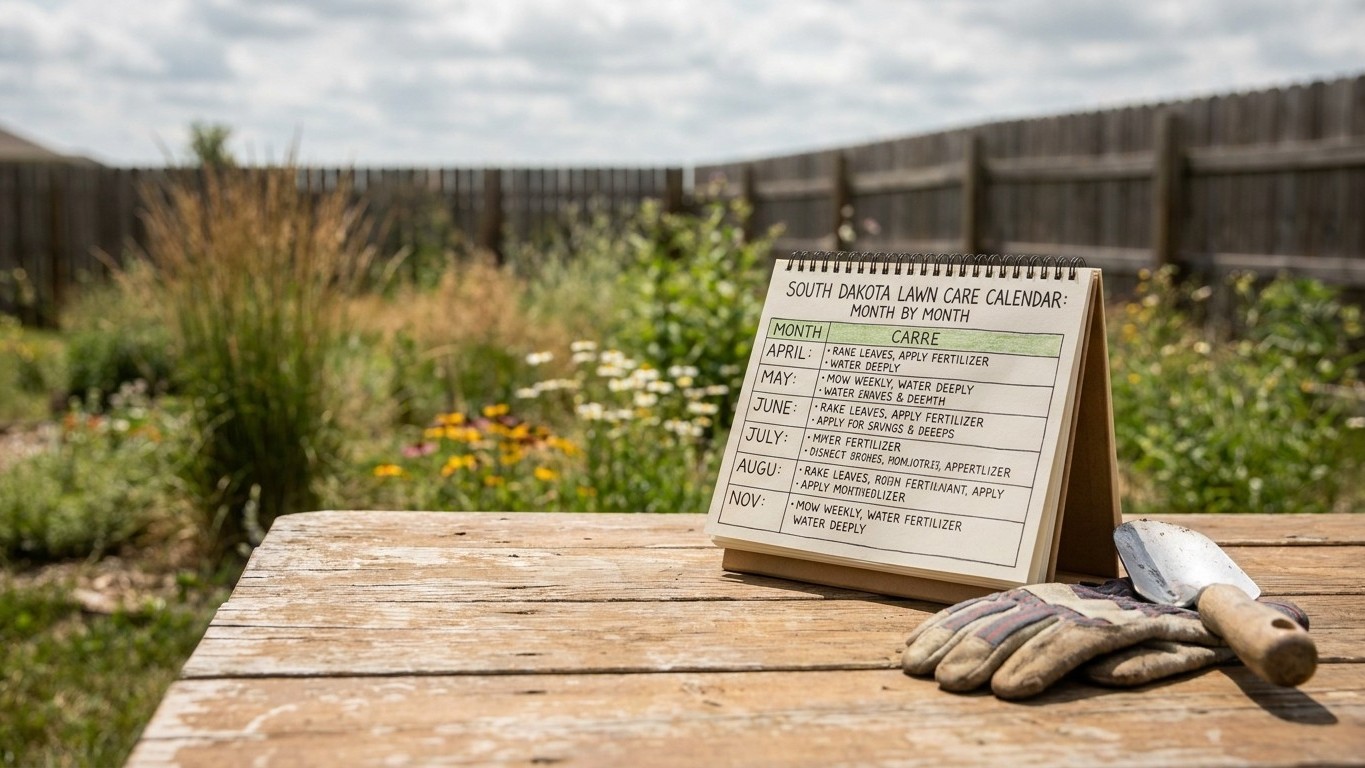

Five grasses survive a South Dakota winter, and none of them are the warm-season kind your cousin in Texas swears by. Kentucky bluegrass, tall fescue, perennial rye, fine fescue, rough bluegrass — that’s the whole list, and it’s why this state’s lawn care runs on a different clock, built around spring green-up and fall recovery instead of summer growth. This calendar picks up once that lawn is already in the ground, month by month.
The short answer for South Dakota
South Dakota lawns belong in the cool-season zone, a classification The Homestead Post assigns by reading Sioux Falls’ climate normals against the season tolerances published in Clemson Cooperative Extension’s HGIC 1214. That means the grasses that hold up here are built for cold winters and a growth pattern centered on spring and fall, not the heat-loving turf of the Sun Belt. This calendar assumes a lawn that is already established. If you’re starting from bare dirt, back up to South Dakota Lawn Care for soil testing and site prep before worrying about a mowing schedule.
The five grasses that hold up here
Per Clemson’s HGIC 1214 and Penn State Extension’s list of cool-season species, five grasses actually work across South Dakota:
- Kentucky Bluegrass – spreads by rhizome and fills in bare patches on its own
- Tall Fescue – deep-rooted, the most drought-tolerant of the cool-season group
- Perennial Ryegrass – germinates fast, often mixed in as a nurse grass
- Fine Fescues – shade-tolerant with low fertility needs
- Rough Bluegrass – suited to wet, shaded spots that drain poorly
Bermudagrass and zoysia, the warm-season staples of southern lawns, will not hold here: a hard freeze during a South Dakota winter kills the crown outright rather than just browning the top growth. Which of the five cool-season species suits your yard depends on sun exposure, foot traffic, and how much time you want to spend watering. For a full comparison, see The Best Grass Seed for South Dakota Lawns.
Working through the year

The closest published maintenance schedule for one of these species is Clemson’s HGIC 1219 Tall Fescue Maintenance Calendar. It was written for South Carolina’s climate, so the sequence of tasks holds but the timing shifts earlier in a colder state like South Dakota, especially around the fall frost window.
Spring: pre-emergent first, nitrogen light
Tall fescue greens up as soil warms, and HGIC 1219 calls for the first mowing at a height of 2.5 to 3.5 inches once growth resumes. A pre-emergent herbicide goes down ahead of crabgrass germination, timed to soil temperature rather than a fixed date. A light nitrogen feeding, around 1 pound per 1,000 square feet, follows once the lawn is mowing regularly. Heavier feeding waits for fall, when tall fescue stores nitrogen in the roots instead of pushing top growth a summer drought will just burn off.
Summer: height over feeding
Through the hot months, HGIC 1219 raises the mowing height to the top of that 2.5 to 3.5 inch range, since taller grass shades its own roots and slows moisture loss. Irrigation runs at roughly 1 to 1.5 inches per week, delivered as one or two deep soakings rather than daily sprinkling, and nitrogen more or less stops until temperatures ease. A tall fescue lawn browning in July is not dying. It is going semi-dormant, and a heavy feeding at this point does more harm than the drought itself.
Fall: the working season
Fall is when tall fescue does its real growing, and HGIC 1219 puts core aeration and overseeding in this window, timed to finish while soil is still warm enough for germination. At Sioux Falls, NOAA’s 1991-2020 climate normals put the first fall frost between September 24 and October 4, which means overseeding needs to finish well ahead of that date, not after it. Most of the year’s nitrogen, roughly two-thirds to three-quarters of a 3 to 4 pound annual total per 1,000 square feet, goes down in split applications through this period.
Winter: mostly waiting
Once growth stops, mowing and feeding stop with it. The lawn draws on its stored nitrogen through winter and spends it on the next spring’s growth, which is why a strong fall feeding matters more here than a spring one.
What changes across South Dakota
Every date and rate above is measured at Sioux Falls, and the rest of the state runs on its own schedule.
West and up in elevation
The Black Hills, in the far west, sit at much higher elevation than the Sioux Falls station. The same cold-air pooling that shortens the growing season at elevation there means frost tends to arrive earlier in fall and linger later into spring than the eastern figures suggest. A gardener in the Black Hills should treat the Sioux Falls frost window as a starting point and plan for an earlier cutoff.
Along the river and up north
The Missouri River corridor works the other direction. Moving water moderates temperature swings along its immediate banks, so lawns close to the river near cities like Pierre or Yankton tend to warm a little sooner in spring and hold color a little longer in fall than a lawn on the open plains nearby. Northern counties toward Aberdeen sit farther from any large body of water and see harder winter cold, so the safety margin before a fall feeding or an overseeding push should be planned generously rather than run to the exact Sioux Falls date.
The mistakes this climate punishes
Timing mistakes
Seeding cool-season grass in the heat of summer is the most common one. Kentucky bluegrass and tall fescue germinate poorly once soil temperatures climb through summer, and seed put down in June or July mostly fails, showing up as thin, patchy growth by August instead of the full stand a fall seeding gives.
Cutting the lawn too short heading into summer is the second. A tall fescue lawn scalped to under 2 inches in June loses the shade its own canopy provides the soil, and roots that would normally survive a dry stretch cook instead, showing up as brown, thinning turf by mid-July that a fall seeding then has to repair. Feeding heavily in spring instead of fall has the same root cause: it spends the plant’s energy on leaf blades it cannot use through summer dormancy, and the lawn shows poor drought recovery in August, right when it most needs stored reserves.
The mistake with no fix
Planting a warm-season species because it is cheaper or more drought-tolerant somewhere else is the one that cannot be corrected mid-season. Bermudagrass and zoysia will not survive a South Dakota winter; the first hard freeze kills the crown rather than just browning the leaf, and the lawn has to be reseeded from scratch the following spring.
Checking this against your county
Every figure above comes from the Sioux Falls weather station and a maintenance calendar written for tall fescue in South Carolina, adapted here to South Dakota’s colder frost window. Your own county’s soil, elevation, and microclimate can shift these dates by a week or two in either direction.
For a local read on frost dates, soil temperature, and seeding windows specific to your county, check South Dakota State University Extension, which publishes county-level guidance a statewide calendar like this one cannot. Confirm your planting and feeding dates there before committing seed or fertilizer to the ground, especially if you garden west of the Missouri River or at elevation in the Black Hills.
Common questions
Can I plant warm season grass in South Dakota?
Not successfully outdoors year-round. Bermudagrass and zoysia are built for climates that stay hot through summer and never see a freeze deep enough to kill the crown, and South Dakota’s winters do exactly that. Stick with the cool-season list: Kentucky bluegrass, tall fescue, perennial ryegrass, fine fescues, or rough bluegrass.
Why is my tall fescue lawn brown in july?
It is most likely dormant, not dead. Tall fescue slows growth and loses color once summer heat and dry soil set in, and it typically greens back up once temperatures cool and rain or irrigation returns. Check the crown at soil level: if it is still pale green and pliable, the plant is alive.
When should I stop mowing in the fall?
Keep mowing as long as the grass keeps growing, which in a cool-season lawn can run right up to the first hard freeze. Stopping too early lets grass grow long into winter and invites snow mold. Stopping too late risks scalping if a sudden freeze catches the lawn mid-growth. Watch growth rate rather than the calendar.
Is it too late to seed if I missed the fall window?
If you missed the window ahead of the first fall frost, wait rather than force it. Cool-season seed germinates poorly in cold soil, and grass that sprouts too close to freeze-up rarely survives winter with strong enough roots. Plan on early spring instead, or circle back the following fall and count backward from your county’s frost date that time.