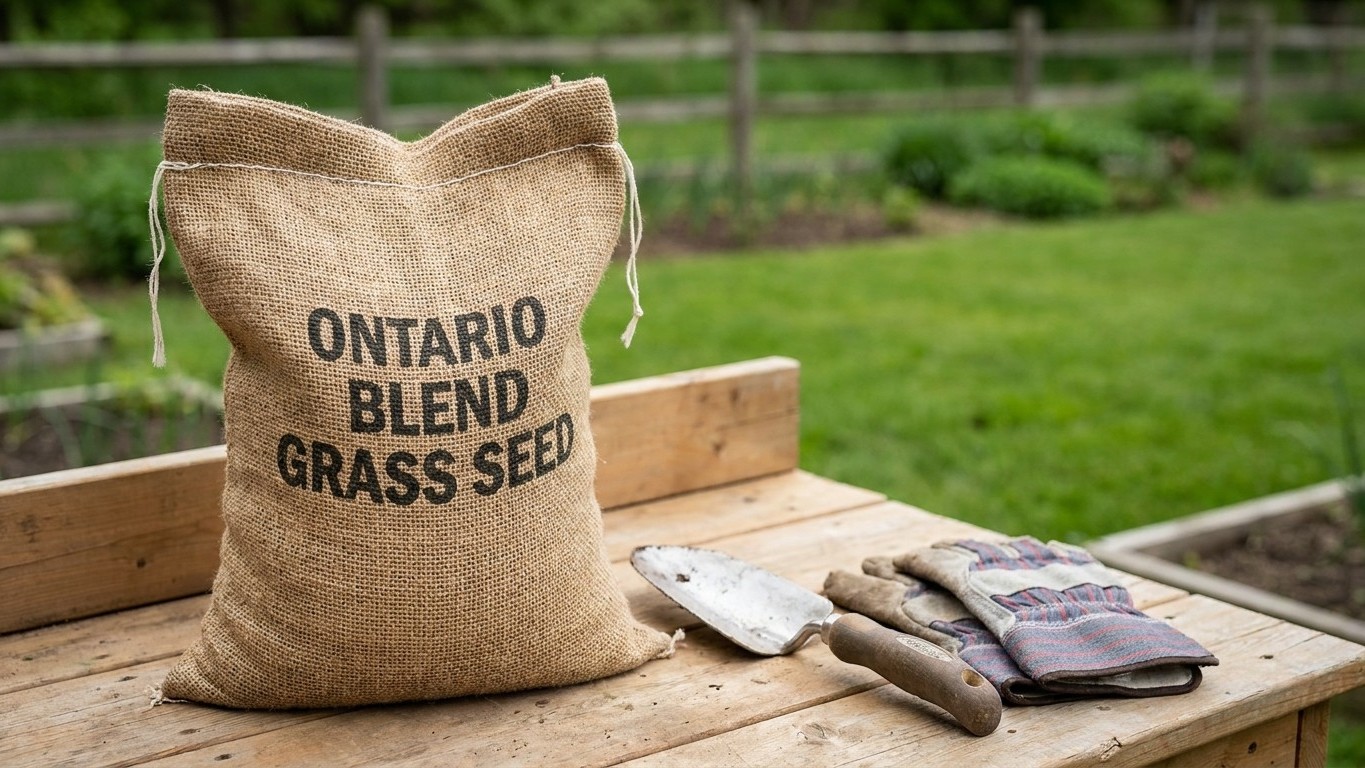

If you’re wondering what grass will actually make it through an Ontario winter and still look decent in July, the answer is a blend of Kentucky bluegrass and perennial ryegrass, with fine fescue mixed into any shaded spots. That combination works because bluegrass builds the thick, self-healing lawn most people want, ryegrass covers the ground fast while the bluegrass catches up, and fine fescue picks up the slack wherever trees block the light. Before you buy a bag of seed, walk your yard and sort it into sun, shade, and any low wet corners, since that’s what decides the exact mix, not the season.
The short answer for Ontario
The short answer: a blend of Kentucky bluegrass and perennial ryegrass, overseeded with fine fescue in shaded corners, is the safest all-around choice for a cool-season lawn in the Toronto area. Kentucky bluegrass forms the dense, self-repairing sod most people picture when they hear the word “lawn,” and named cultivars sold in Canadian and US catalogues alike, such as ‘Midnight’ and ‘Bewitched’, are bred and rated for cool-season regions. Left alone, though, Kentucky bluegrass is slow to establish from seed, which is why most retail mixes cut it with perennial ryegrass, a species that germinates within about a week and holds bare soil while the bluegrass fills in underneath.
What the “best” choice actually depends on is the site, not the calendar. A lawn in full sun with normal foot traffic does well on a bluegrass-ryegrass blend. A yard shaded by mature trees needs fine fescue worked into the mix, since bluegrass thins badly without direct light. A low, poorly drained corner that stays wet into June is one of the few spots where rough bluegrass earns its place, and a slope that dries out every August is better served by tall fescue‘s deeper root system. None of the five species named by Clemson’s HGIC 1214 is a warm-season grass, and none of them will hold through an Ontario winter if you substitute a warm-season type like bermudagrass or zoysia grown for Deep South lawns. Those grasses go dormant at the first real cold and simply do not green up again north of their range.
Working through the year

Clemson Cooperative Extension publishes its HGIC 1219 Tall Fescue Maintenance Calendar as a month-by-month schedule of mowing height, nitrogen rate, irrigation and pre-emergent timing, but it is written for tall fescue growing under South Carolina’s climate. If tall fescue is the species you seeded, that calendar is the right reference for the sequence of practices, since Clemson publishes one calendar per species rather than per region. Ontario’s later spring and earlier fall mean every date on that calendar needs to be shifted, so use it for the order of operations, in other words feed, mow, aerate, overseed, in that sequence, and set the actual dates against your own frost record rather than South Carolina’s.
For the other four species named by HGIC 1214, no single-page calendar exists in the FACTS available here, so the safest approach is seasonal logic rather than a fixed date. Spring growth resumes once the ground thaws and daytime temperatures hold above freezing consistently, and this is when the first mowing and any pre-emergent crabgrass control should happen, timed to your local soil warming rather than a fixed day on the calendar. Summer is a holding pattern for cool-season turf: growth slows in the heat, and the priority shifts to mowing high and watering deeply rather than feeding heavily. Fall is the working season. Cool-season roots grow fastest once daytime temperatures cool but the soil is still warm, which is exactly the six-to-eight-week window before Toronto’s average October 16 frost, a window that runs roughly through late August into early September for most seeding and overseeding jobs in that area.
Species at a glance
| Species | Establishes | Best for | Trade-off |
|---|---|---|---|
| Kentucky Bluegrass | Slow, spreads by rhizome | Full sun, self-repairing sod | Weeks to fill in from bare seed |
| Perennial Ryegrass | Fast, about a week | Quick cover, high foot traffic | Does not spread; bare spots need reseeding |
| Fine Fescue | Moderate | Shade, thin dry soil | Thins under heavy foot traffic |
| Tall Fescue | Moderate | Drought tolerance, deep roots | Coarser blade than the others |
| Rough Bluegrass | Slow | Wet, shaded ground | Struggles once soil dries in summer |
What changes across Ontario
The figures in this article come from a single weather station, Toronto Pearson, and Ontario is not one climate. The Great Lakes moderate temperature along the shoreline, which typically means frost arrives later near Lake Ontario and Lake Erie than it does a short distance inland, since the lake water holds summer heat into fall. Move north toward the Ottawa Valley, Muskoka or the districts along Georgian Bay and the growing season runs shorter on both ends, with frost arriving earlier in fall and lingering later in spring than the Toronto figure suggests. Elevation matters too: higher ground cools faster on clear nights, so a property on a ridge or in a low frost pocket can see frost weeks apart from a neighbor a few kilometers away at a different elevation.
None of this changes which grass species suit the province, since the entire cool-season zone described here holds across Ontario from the Windsor area to well north of Toronto. What it changes is timing. A seeding window that reads as “late August to early September” near Toronto needs to shift a week or two earlier the further north or the higher in elevation your lawn sits, because the growing season available before that region’s own first fall frost is shorter. There is no single correction factor to apply, since it depends on the specific station nearest your property, which is exactly why the Toronto Pearson figure should be treated as a starting point rather than a fixed answer for the whole province.
The mistakes this climate punishes
The most common mistake in this climate is seeding cool-season grass too late in fall, past the point where seedlings can root before the ground cools for good. Seed put down after the six-to-eight-week window ahead of the average frost date germinates weakly if at all, and what does come up rarely survives winter with roots that shallow. The damage doesn’t show until spring, when the seeded area looks bare or patchy while the rest of the lawn greens up normally.
A second mistake is treating a brown lawn in July or August as a dead one. Cool-season turf in Ontario goes semi-dormant and browns during summer heat and dry spells, which is a survival response, not death, and the grass typically recovers with cooler weather and rain in fall. Watering it back to green artificially through peak summer heat costs more than it’s worth and does not make the lawn healthier long-term, since the dormancy is the plant protecting its crown.
Mowing and feeding errors
Cutting cool-season grass too short during a hot stretch is another one that shows up fast, usually within a week or two as scorched, thin turf that struggles to recover until temperatures drop. Shorter grass has less leaf area to shade its own roots and loses water faster, which compounds any existing drought stress. On the feeding side, a heavy nitrogen application right before winter dormancy pushes soft, leafy growth at exactly the point the plant should be hardening off, and that growth is more vulnerable to winter injury and snow mold the following spring. Saving the larger feeding for the active fall growth window, well ahead of the ground freezing, avoids both problems at once.
- Seeding cool-season grass in late spring, when summer heat arrives before roots are established
- Skipping aeration on compacted clay soil, which chokes root growth regardless of species
- Overwatering lightly and often instead of deeply and less frequently, which grows shallow roots
Most of these mistakes are timing errors rather than product errors, which is why the calendar matters as much as the seed bag. For the fuller month-by-month version adapted to this climate rather than South Carolina’s, see The Ontario Lawn Care Calendar, Month by Month.
Checking this against your county
Every figure on this page comes from a single reference station near Toronto, and the province is large enough that a lawn in Windsor, Ottawa or Thunder Bay works to a different frost record entirely. Before you commit to a seeding date, check your own municipality’s climate data or contact the province’s agriculture office through the Ontario Ministry of Agriculture, Food and Rural Affairs page. If you’re setting up a lawn program from scratch rather than fixing one patch, the broader steps are covered in Ontario Lawn Care.
Common questions
Can I seed grass in spring instead of fall in Ontario?
You can, but fall is more forgiving. Spring-seeded cool-season grass has to compete with summer heat and weed pressure while its roots are still shallow, whereas fall-seeded grass gets cooling temperatures and less competition right when it needs to root.
Why is my lawn turning brown in July even though I planted the right grass?
Cool-season species like Kentucky bluegrass and fine fescue naturally go semi-dormant and brown under summer heat and dry conditions. It is a normal stress response rather than a sign the grass has died, and it typically greens back up once cooler, wetter fall weather arrives.
Is it too late to overseed if it’s already October?
It depends how close you are to your local first frost. Toronto’s average is October 16 per Environment and Climate Change Canada, and seed needs several weeks of active root growth before hard freeze, so overseeding right at or after that average date is a gamble rather than a plan.
Do I need a different grass for a shady backyard than a sunny front lawn?
Usually yes. Fine fescue tolerates shade far better than Kentucky bluegrass, which thins out without several hours of direct sun, so many Ontario lawns end up seeded with two different blends on the same property rather than one mix everywhere.