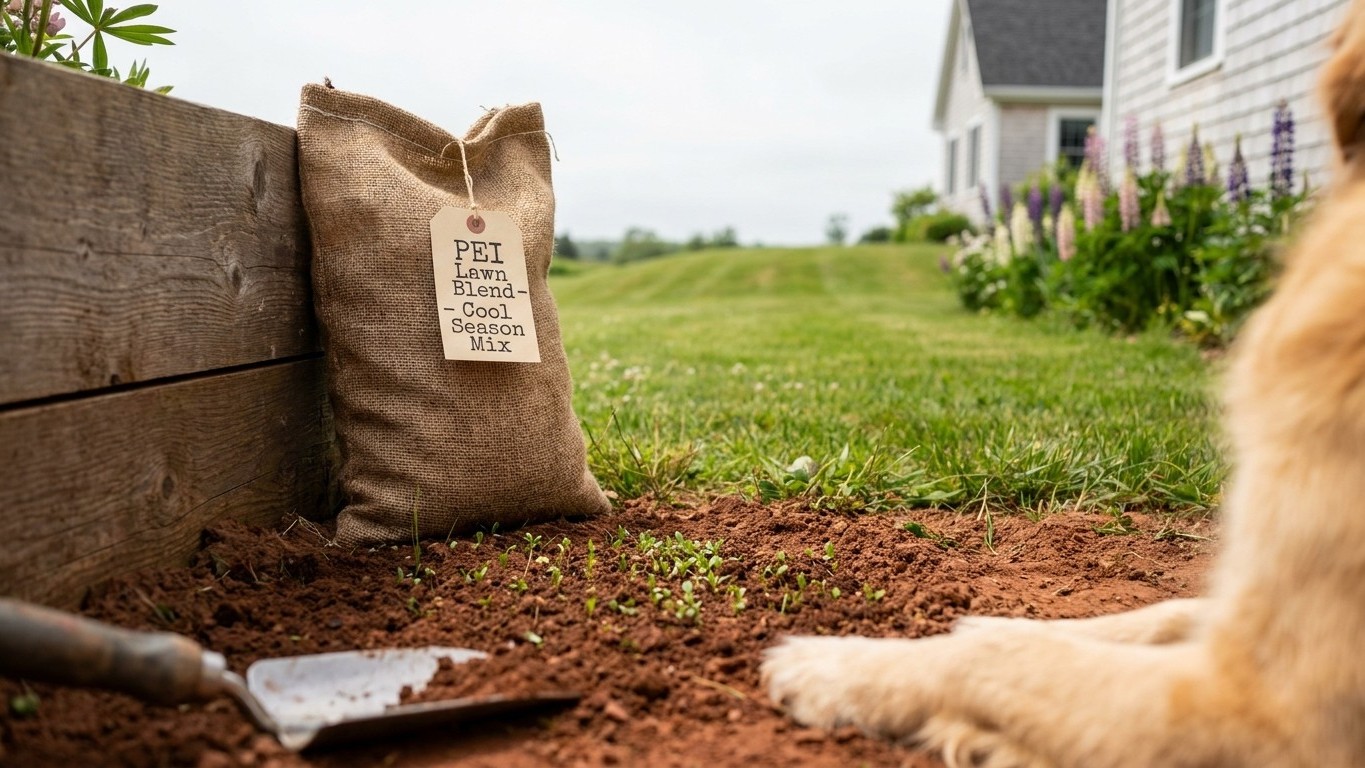

There is no single best grass for Prince Edward Island, but the choice is narrow: this is cool-season turf country, and the realistic options are fine fescue, Kentucky bluegrass, perennial ryegrass, rough bluegrass and tall fescue, all named by Clemson Cooperative Extension’s HGIC 1214 as the cool-season group. Start by matching the species to how the lawn gets used, since the fast-establishing ryegrass that recovers from a dog or a trampoline is not the same seed you’d pick for a shady side yard.
The short answer for Prince Edward Island

Prince Edward Island doesn’t have one best grass — it has five that actually survive here, and the right one depends on what your lawn has to put up with. Fine fescue, Kentucky bluegrass, perennial ryegrass, rough bluegrass, and tall fescue are the only cool-season options worth buying; anything sold as bermudagrass or zoysia will die over an Island winter. Walk your yard first and notice how it’s actually used — worn by kids and dogs, shaded under trees, or just meant to look tidy from the street. That answer tells you which of the five belongs in your bag.
Which of the five cool-season grasses is “best” depends on what the lawn has to do. A high-traffic yard with kids and a dog wants the quick germination of perennial ryegrass. A shaded side yard under mature trees wants fine fescue or rough bluegrass. A lawn that has to look uniform and dense from the street wants Kentucky bluegrass, at the cost of more patience while it fills in. None of the five is wrong for Prince Edward Island, but each one asks something different of the person mowing it, and the sections below lay out what that trade is.
Working through the year
Ranking the species by what they cost you
Cool-season grass seed goes down in one of two windows: spring, once the soil has warmed enough to germinate, or late summer into early fall, while soil is still warm but air temperatures are dropping. Fall is generally the stronger window for cool-season turf because weed pressure is lower and the young grass gets a full season of cool, moist growth before summer stress arrives. The catch on Prince Edward Island is the calendar itself: Environment and Climate Change Canada’s 1981-2010 climate normals put the average first fall frost at the Charlottetown A station at October 17, and because that figure is a mean, not a guarantee, frost arrives earlier than that in roughly half of all years. Seed put down in early fall needs time to root before growth stops for winter, so treat that October date as the far edge of the window, not a deadline to seed up against.
Among the five recommended species, perennial ryegrass germinates the fastest, often within a week or two under good conditions, which makes it the standard choice for patching bare spots or overseeding a thin lawn before winter closes the window. The cost is durability: ryegrass alone thins faster under heat and drought stress than the others on this list, which is why it is usually mixed with bluegrass rather than sown alone. Kentucky bluegrass spreads by rhizome and knits itself into a dense, self-repairing turf, but it germinates slowly and needs a longer runway, which argues for spring seeding as much as fall on the Island. Fine fescue tolerates shade and poor soil better than any grass on the list and needs less nitrogen to look decent, but it does not hold up to heavy foot traffic the way ryegrass or bluegrass does. Tall fescue has the deepest root system of the group and rides out short dry spells better than the others, at the cost of a coarser blade and a clumping growth habit that can look uneven in a fine-textured lawn. Rough bluegrass tolerates wet, shaded ground where almost nothing else will establish, but it thins out fast in full sun and summer heat, so it belongs in specific damp corners rather than across a whole yard.
| Species | Establishment speed | Best use | Main trade-off |
|---|---|---|---|
| Perennial ryegrass | Fast (days to two weeks) | Patching, overseeding, traffic areas | Thins under heat and drought stress |
| Kentucky bluegrass | Slow | Dense, uniform front lawns | Needs a long establishment window |
| Fine fescue | Moderate | Shade, low-maintenance areas | Wears thin under heavy foot traffic |
| Tall fescue | Moderate | Dry sites, drought resilience | Coarse texture, clumping habit |
| Rough bluegrass | Moderate | Wet, shaded low spots | Fails in full sun and summer heat |
If tall fescue is the species chosen, Clemson’s HGIC 1219 tall fescue maintenance calendar is the closest published seasonal guide, and it times fall overseeding by soil and air temperature rather than a fixed date. That principle, seed by temperature signals rather than the calendar page, carries over to the other cool-season species even though HGIC 1219 itself is written for tall fescue specifically. For a full month-by-month rundown of mowing, feeding and overseeding tasks once the seed is in the ground, the Prince Edward Island Lawn Care Calendar, Month by Month walks through the whole year in more detail than a seed-focused page can.
What changes across Prince Edward Island
The figures above are read from the Charlottetown A weather station, and Prince Edward Island is not one uniform climate. Coastal stretches of the Island, moderated by the surrounding water, tend to warm up slower in spring and hold their warmth later into fall than inland ground does, which shifts both the spring seeding window and the safe cutoff for fall seeding in either direction depending on which coast a lawn sits on. Inland and eastern parts of the province, away from that moderating effect, run through a sharper swing between summer heat and the first hard frost, which narrows the fall establishment window for cool-season seed compared with what the Charlottetown figures suggest.
Soil matters as much as coastline. The Island’s well-known red soil drains fast in places and holds water in low, clay-heavy pockets elsewhere, and rough bluegrass or fine fescue will behave very differently on a soggy corner of a yard than on a sandy, sun-baked slope thirty feet away. A single bag of mixed seed sown across a lawn with both conditions will show it within the first summer: thick in the damp spots, thin on the dry ones, regardless of which species dominates the blend.
None of this changes which five species belong on a Prince Edward Island lawn. It changes when to sow them and how much of each to put where. A grower on higher, inland ground should treat the Charlottetown frost date as arriving earlier for their own property, not later, and plan fall seeding accordingly rather than relying on the reference-station figure as if it applied everywhere on the Island equally.
The mistakes this climate punishes
Errors that show up months later
The costliest mistake on Prince Edward Island is buying a warm-season grass because a bag looked hardy or drought-tolerant on the shelf. Bermudagrass and zoysia need sustained heat to grow at all, and on the Island they either fail to establish in the first place or die back completely over winter rather than simply going dormant the way they would farther south. This shows up as bare, dead patches by the following spring, and by then the growing season for reseeding has already been lost.
Seeding too late in fall is the second common failure. Cool-season grass seed sown right up against, or after, the average frost date does not have time to develop the root system it needs before growth shuts down for winter, and a thin, weak stand that struggles through its first winter is often mistaken for a seed quality problem rather than a timing one. Since Environment and Climate Change Canada’s frost normal for Charlottetown is a mean rather than a guaranteed date, treating it as a safe cutoff rather than a midpoint is exactly the assumption that causes this.
Cutting the lawn too short during a dry summer stretch is the third mistake that punishes an otherwise well-chosen lawn. Cool-season grasses like Kentucky bluegrass and perennial ryegrass rely on enough leaf surface to keep roots fed during heat and drought stress, and a scalped lawn browns faster and recovers slower than one left a notch or two higher through the hottest weeks. That browning is not dead turf, it is the plant protecting its crown, and a lawn cut too short during that stretch often looks far worse than the underlying grass actually is, which leads some owners to reseed or resod a lawn that would have greened back up on its own with cooler weather and a taller mowing height.
- Planting bermudagrass or zoysia expecting it to overwinter like a cool-season lawn
- Seeding cool-season grass right up against the average first fall frost instead of well ahead of it
- Scalping the lawn short through a hot, dry summer stretch
- Treating one seed blend as right for both the sunny and shaded parts of the same yard
Checking this against your county
Before buying seed or timing a fall overseed, it is worth checking current guidance from Prince Edward Island’s own agriculture services, which can speak to local conditions. Anyone working through a full-season plan for an existing cool-season lawn should also start from Prince Edward Island Lawn Care, which covers the groundwork this seed-selection page assumes is already in place.
Common questions
Can I mix bluegrass, fescue and ryegrass in the same bag?
Yes, and most commercial cool-season blends already do this on purpose. A common approach pairs Kentucky bluegrass for density with a smaller share of perennial ryegrass for fast cover, since the ryegrass fills in quickly while the slower bluegrass spreads underneath it.
Will warm-season grass survive if I plant it in a sheltered spot?
No, not reliably. A sheltered microclimate can shave a little off the winter’s edge, but it does not change the fundamental heat requirement warm-season species need to grow and store energy, and they are not part of the recommended list for this climate for that reason.
Is it too late to seed if I missed the fall window?
Spring is the other viable window for all five cool-season species named here, once the soil has warmed enough for germination. It is generally the slower option because summer heat arrives before the new grass has fully rooted, but it is far better than forcing seed into the ground right before frost.
Why does my lawn look patchy even though I used the right seed?
Uneven sun, shade, or drainage across a single yard is the usual cause, not the seed itself. A blend that thrives in a damp, shaded corner can thin out on a sunny, sandy slope thirty feet away, which is why matching the species to each specific patch of ground matters more than picking one perfect bag for the whole lawn.