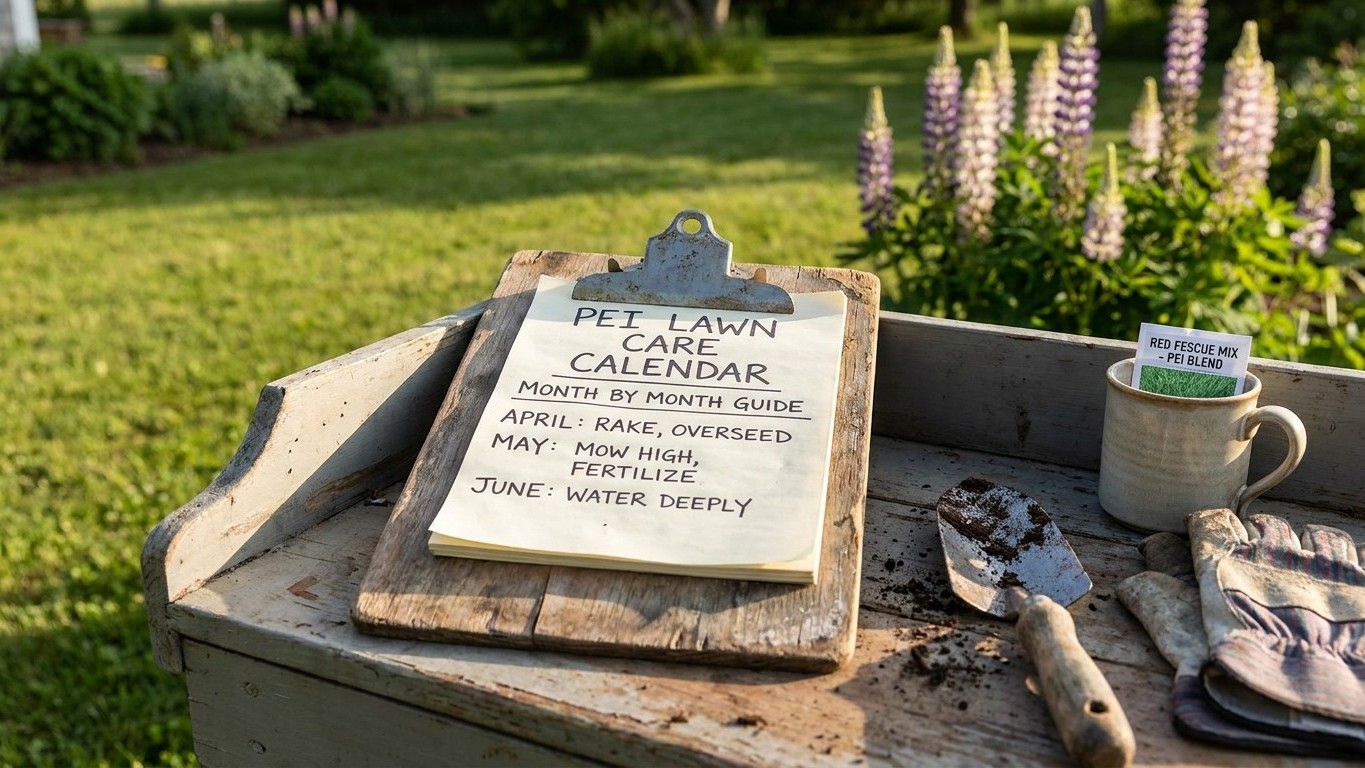

Prince Edward Island lawns run on a cool-season calendar: mow, feed and seed a grass built for cold winters and mild summers, not the warm-season turf grown across the southern states. Environment and Climate Change Canada’s 1981-2010 climate normals for station Charlottetown A put the average first fall frost at October 17, and that date anchors the most important work of the lawn year. Kentucky bluegrass, tall fescue, perennial ryegrass, fine fescue and rough bluegrass are the species built for this zone. Mark the six to eight weeks before October 17 on your own calendar now, because that window carries the year’s heaviest feeding and any fall seeding you plan to do.
The short answer for Prince Edward Island
The Homestead Post places Prince Edward Island, read from the Charlottetown reference station, in a cool-season lawn zone. That call comes from weighing the days at or above 90°F and the coldest month’s mean minimum against the season tolerances published by Clemson Cooperative Extension in HGIC 1214, the standard reference US turf extension offices use to sort grasses into cool, warm and transition categories. In a cool zone, the grasses that hold up are Kentucky bluegrass, tall fescue, perennial ryegrass, fine fescue and rough bluegrass, all named by Clemson HGIC 1214 and by Penn State Extension as cool-season species. Warm-season grasses such as bermudagrass or zoysia are bred to go dormant at temperatures far milder than what a PEI winter delivers, and planting one here means watching it die rather than brown.
The answer also depends on which of those five grasses is already in your lawn, since they green up, thin out and recover from stress on slightly different timelines. It depends on soil drainage, since a low, wet corner of a lawn stays workable later into fall than a sandy, south-facing slope. And it depends on how far your own property sits from Charlottetown, since the October 17 mean frost date is a single-station figure, not a province-wide guarantee. If you haven’t settled on a species yet, the comparison in The Best Grass Seed for Prince Edward Island Lawns is the place to start before you follow the calendar below.
Working through the year

Clemson Cooperative Extension’s HGIC 1219, the Tall Fescue Maintenance Calendar, structures a cool-season lawn year around three windows, and tall fescue is one of the five species named for Prince Edward Island, so its shape applies directly if that’s your grass. Kentucky bluegrass, perennial ryegrass, fine fescue and rough bluegrass follow the same broad rhythm, with small shifts in timing between species.
Spring
As soil warms and the lawn greens up, HGIC 1219 calls for a lighter feeding than the one that follows in fall, the idea being to support color without forcing a flush of soft shoot growth that then struggles once summer heat arrives. Spring is also when a pre-emergent herbicide goes down if crabgrass or other summer annual weeds have been a problem, applied before soil temperatures climb into their germination range rather than after weeds are already visible.
Summer
The calendar’s summer instruction is to ease off nitrogen and raise the mowing height, both aimed at protecting roots through the hottest, driest stretch of the year. A cool-season lawn that browns in a dry July or August is not dead, it has gone dormant to survive, and it typically recovers once rain and cooler air return. Mowing shorter to make a stressed lawn “look tidy” in summer heat does the opposite of what the plant needs.
Fall
Fall carries the heaviest feeding of the year under HGIC 1219, timed while the grass is still actively growing but ahead of dormancy, and it is also the best seeding and overseeding window for a cool-season lawn. Seed needs several weeks to establish before hard frost, so counting back from Environment and Climate Change Canada’s October 17 mean frost date at Charlottetown gives a rough window of late summer into very early fall for overseeding, not a fixed date, since a year that runs later or earlier than the mean shifts that window with it. If your lawn needs a fuller rebuild rather than overseeding into existing turf, the steps for building that from scratch are covered in Prince Edward Island Lawn Care.
| Season | Main task | Timing note |
|---|---|---|
| Spring | Light nitrogen feeding, pre-emergent if needed | As soil warms and green-up begins |
| Summer | Raise mowing height, reduce nitrogen | Through the hottest, driest stretch |
| Fall | Heaviest feeding of the year, seeding and overseeding | Several weeks ahead of October 17 mean frost, Charlottetown |
| Winter | No feeding or seeding, keep off frozen or snow-covered turf | Dormant season |
What changes across Prince Edward Island
The October 17 mean frost date and the cool-season zone call both come from the Charlottetown A station, sited on the island’s south coast where the Northumberland Strait moderates temperature swings in both directions. That coastal buffering means Charlottetown itself tends to warm up a little later in spring and hold heat a little longer into fall than inland ground does. A lawn set back from the coast, or on higher inland ground away from that moderating water, can see its first fall frost arrive earlier than the Charlottetown mean, which shortens the safe seeding window described above without changing the calculation itself.
Low-lying inland pockets carry their own risk in the opposite direction: cold air drains downhill and pools overnight, so a lawn sitting in a hollow can see frost on a night when a slope nearby stays clear. Soil type shifts the practical calendar too. The island’s characteristic red, sandy loam drains fast, which means a summer dry spell shows up as drought stress sooner than it would in a heavier clay soil that holds moisture longer. None of this changes which five grasses are the realistic choices, but it does mean a reader well outside Charlottetown should treat the October 17 figure as a starting point to adjust from, not a date to plan against exactly.
The mistakes this climate punishes
The costliest mistake on a cool-season PEI lawn is seeding too close to the average frost date and assuming there’s still time. Seed and seedlings need real weeks of root growth before hard frost locks the ground, and a planting done in the two or three weeks before October 17 often shows the damage the following spring as bare, thin patches where the grass never got established rather than as anything visible in fall itself.
Heavy fall nitrogen applied too late, after growth has already slowed for the season, is a related error. Instead of feeding root and crown development ahead of winter, it can leave excess soft, tender growth sitting under snow cover, which is exactly the condition that invites snow mold to show up as matted, grey-pink patches once the snow melts in spring.
Mowing too short in summer heat is the mistake that shows up fastest. Scalping a cool-season lawn to make it look neat over a dry, hot stretch removes the leaf area the plant needs to shade its own soil and roots, and the lawn typically responds within one to two mowing cycles by browning off harder and slower to recover than a lawn left a notch taller through the same stretch. A brown cool-season lawn in July is not a dead one, but a scalped one recovers more slowly and can lose ground permanently to weeds that move into the thinned turf.
Trying to grow a warm-season species here at all is the final, avoidable mistake. Bermudagrass and zoysia are bred for winter dormancy thresholds far above what a Charlottetown winter delivers, and a lawn seeded or sodded with either does not go dormant and recover the way a cool-season lawn browning in a dry summer does. It simply dies over the first winter, and the damage doesn’t show until the following spring when nothing greens up at all.
Checking this against your county
Every figure above comes from a single reference station and a single extension calendar, and county-level advice will always beat a province-wide estimate for the specific soil and microclimate of your property. The Prince Edward Island Department of Agriculture and Land is the place to check for anything more local than the Charlottetown A figures used here, including any current guidance on timing for your specific county. If your lawn sits well away from Charlottetown, inland or at higher elevation, treat the dates in this calendar as a starting point and watch your own ground for the actual signs of green-up and first frost each year rather than working strictly to the calendar date.
Common questions
Can I seed a cool-season lawn in spring instead of fall on PEI?
You can, but fall is the stronger window because cooler air and reliably damp soil favor seedling roots over top growth, while spring seeding has to compete with weed germination and the summer heat stress that follows soon after. If you must seed in spring, do it as early as soil can be worked, not after the ground has fully warmed.
Why is my lawn brown in August if it isn’t dead?
Cool-season grasses go dormant under drought and heat stress as a survival strategy, shutting down leaf growth while keeping the crown alive underground. It typically greens back up within a couple of weeks once rain returns and temperatures ease, unless the lawn was mowed too short or driven on repeatedly while dormant.
Is it too late to seed if I’m past the frost date already?
Once you’re past the average October 17 frost date at Charlottetown, new seed is unlikely to establish enough root before winter to survive it. Wait for the following fall’s window rather than seeding into cold soil, and use the intervening time to overseed thin spots as soon as the window reopens.
Do I need to feed my lawn in winter?
No. A dormant or frozen cool-season lawn isn’t taking up nutrients, and feeding right before or during dormancy risks the same soft-growth and snow mold problems that come from feeding too late in fall. Hold off until the calendar’s spring window instead.