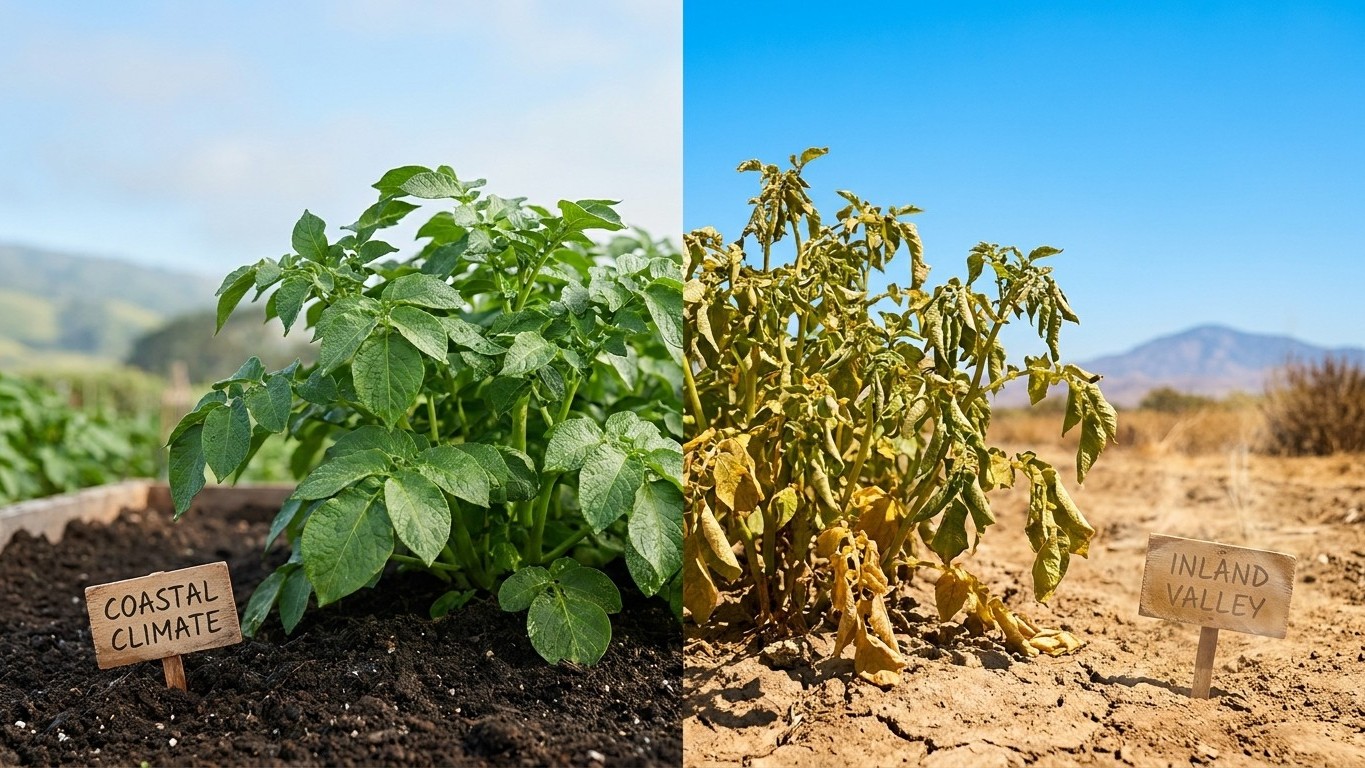

California splits into two potato climates. Along the coast and through the Los Angeles basin, frost basically never happens and Summer Heat rarely spikes past 90°F, so gardeners get a long, forgiving window. Inland and up in elevation, in the Central Valley and the Sierra foothills, freezes do happen and summers run far hotter. The short version: plant early, get tubers set before high soil heat shuts the plant down, and pick your dates by your own microclimate, not a state average — see this guide on When to Plant Potatoes in California for region-specific timing.
The short answer

Start with the number that actually runs this crop: at the Los Angeles reference station, NOAA’s 1991-2020 Climate Normals count an average of just 2.4 days a year reaching 90°F or higher. That’s the air-temperature heat load for the coastal and southern part of the state, and it’s low. Set that against frost, and the picture gets stranger: the same station’s 30-year record shows zero days at or below 32°F, and NOAA lists the frost-free season there as the full 365 days. In an average year, Los Angeles and much of coastal and southern California simply don’t freeze.
Put those two facts together and the answer for that part of the state is straightforward. Utah State University Extension’s fact sheet on garden potatoes sets the mechanism that matters everywhere the crop grows: tuber set and fill shut down once soil temperature climbs above 90°F. Where a place logs only 2.4 days a year of 90°F-plus air temperature, soil almost never gets there. A gardener in the LA basin or along the coast can run potatoes through a long season without racing the heat clock the way growers in hotter inland climates have to.
The other California
None of that holds inland or at elevation. The Central Valley and the Sierra foothills freeze in a normal winter, and their summers run considerably hotter than the coastal reference station used here. Those areas need their own frost dates and their own count of 90°F days, because a Los Angeles number tells you nothing about Fresno or Bakersfield. The mechanism from Utah State stays constant wherever you garden: once soil crosses 90°F, tuber set and fill stop, and no amount of watering reverses that. What changes by region is how many days a year soil actually gets there.
For varieties, Utah State University Extension and the University of Maine Cooperative Extension both publish season class rather than a fixed day count: early, mid-season, and late. An early variety is the one to lean on where local soil hits 90°F sooner in the year, since it sets and fills tubers before the ceiling closes in. Mid-season and late types suit growers with a longer cool window, the kind coastal and southern California mostly has, and this guide to Potato Varieties That Suit California breaks down which types fit which region. Once the tubers have matured, timing your dig and cure correctly matters just as much as planting date — see Harvesting and Storing Potatoes in California for how to handle that stage.
When to plant here
The planting date for potatoes is never really a calendar date. It’s a soil temperature, and the calendar date is just what falls out after counting backward from it. Utah State University Extension and the University of Maine Cooperative Extension both put the trigger at 50°F soil temperature, reached 14 to 21 days before the last frost date. Here’s how that arithmetic works, and how to redo it for your own county.
- Find your last frost date, if you have one. Coastal and southern California, using the Los Angeles reference station as an example, don’t have one in an average year: NOAA’s record shows zero days at or below 32°F over 30 years. Gardeners in the Central Valley or the Sierra foothills, which do freeze, need that local date first.
- Subtract 14 to 21 days. That’s the window before the last frost when soil should reach 50°F. In a frost-free area there’s no frost date to subtract from, so the soil reading becomes the trigger by itself: plant as soon as a thermometer at planting depth reads 50°F.
- Check soil temperature directly. A simple soil thermometer a few inches down gives the real number. Air can feel mild while soil is still cold and wet, and planting into that cold, wet ground is a common way seed potatoes rot before sprouting.
- Plant once soil holds 50°F for several days running. A single warm afternoon reading isn’t enough; wait for the temperature to hold so seed pieces don’t sit through a cold snap right after planting.
For a Los Angeles-area or coastal garden, that math plays out early: mild winters mean soil often crosses 50°F well ahead of summer heat, giving a wide planting window. For a Central Valley or Sierra foothill garden, the same four steps apply, but the reader needs their own local frost date and soil readings, since Los Angeles numbers don’t transfer that far inland.
What the heat does to the crop
The number that decides everything here is 90°F, measured in the soil, not the air. Utah State University Extension is explicit about the mechanism: once soil temperature climbs above that point, tuber set and fill are inhibited. The plant doesn’t just slow down, it stops building the crop underground. That fact should shape planting decisions in a hot climate more than any date on a calendar.
At the Los Angeles reference station, that ceiling is barely a factor: 2.4 days a year of 90°F-plus air temperature means soil rarely crosses that threshold for long. A gardener there can run a crop through spring into early summer without the plant stalling from heat. The bigger risk in that climate is running out of cool weather at the far end of the season, not hitting too much heat in the middle.
That changes inland. In climates logging far more 90°F days than the coastal reference station used here, whether the Central Valley or the Sierra foothills, the practical answer is to treat potatoes as a spring crop: get seed in as soon as soil hits 50°F, and plan to dig before the heat of summer arrives, rather than carrying a crop through the hottest stretch of the year. Once soil crosses 90°F, watering more does not restart tuber set. That’s worth saying plainly, because it’s the mistake gardeners make most in hot climates: they see wilting leaves and turn up the irrigation, when the actual problem is a soil temperature the plant can’t work around no matter how wet the ground is.
Where climate allows, the workaround is timing rather than irrigation: mulch heavily to keep soil temperature down, plant early enough that tubers finish sizing before the hottest weeks, and dig rather than leave a crop in hot ground hoping it recovers.
What goes wrong here
- Planting uncertified seed. Grocery-store potatoes and seed saved from a previous garden can carry viruses that stunt the plant and cut yield before a tuber even forms. Buying certified seed potatoes each season is the fix, and it matters more than variety choice.
- Planting into cold, wet soil. Getting seed pieces into the ground before soil actually reaches 50°F, just because a calendar date has arrived, invites rot rather than sprouting. Check soil with a thermometer, not the calendar.
- Skipping the hilling and ending up with green tubers. Tubers that push near the surface and catch sunlight turn green and develop solanine, which makes them unsafe to eat. Mounding soil or mulch over the row as plants grow keeps tubers covered, and needs doing more than once through the season.
- Digging too early. Pulling a crop before tubers have finished sizing trades yield for impatience, especially in a climate with a generous growing window, as coastal and southern California has. Let foliage die back before digging rather than guessing by how long plants have been in the ground.
Checking this against your own county
The Los Angeles reference station numbers above describe one part of one state, not all of California. Elevation changes everything: a garden a few thousand feet up in the Sierra foothills can freeze hard while the coast sixty miles away never sees frost in an average year. North versus south moves these same windows by weeks, and a Central Valley garden runs a very different heat load than the coastal reference station cited here.
A state-wide month is a starting point, not an instruction to follow blindly. Before locking in a planting date, check it against local data through the University of California Agriculture and Natural Resources (UC ANR) extension network, which maintains county-level guidance and can supply the actual frost dates and heat patterns for wherever the garden sits.
Common questions
Does Los Angeles get frost at all?
In an average year, no. NOAA’s 30-year record for the Los Angeles reference station shows zero days at or below 32°F, with the frost-free season listed as the full 365 days. That’s specific to the coastal and southern part of the state; the Central Valley and the Sierra foothills do freeze in a normal winter.
Can I grow potatoes all summer in California?
Along the coast and through the Los Angeles basin, where 90°F-plus days average only 2.4 a year, yes, the heat rarely climbs high enough to stop tuber set. Inland, where summers run hotter, the better approach is a spring crop dug before the hottest weeks rather than one carried through summer.
Why did my potato plants stop making tubers even though I kept watering?
Once soil temperature crosses 90°F, Utah State University Extension notes that tuber set and fill are inhibited, and watering doesn’t reverse that. The fix is timing, planting early and choosing an early-season variety, not more irrigation after soil has already gotten too hot.
What potato variety should I plant in a hot California climate?
Neither Utah State University Extension nor the University of Maine Cooperative Extension publishes a specific days-to-maturity number, but both classify varieties by season: early, mid-season, and late. In a climate with a high count of 90°F days, an early-season variety finishes tuber-building before the heat ceiling closes the window.