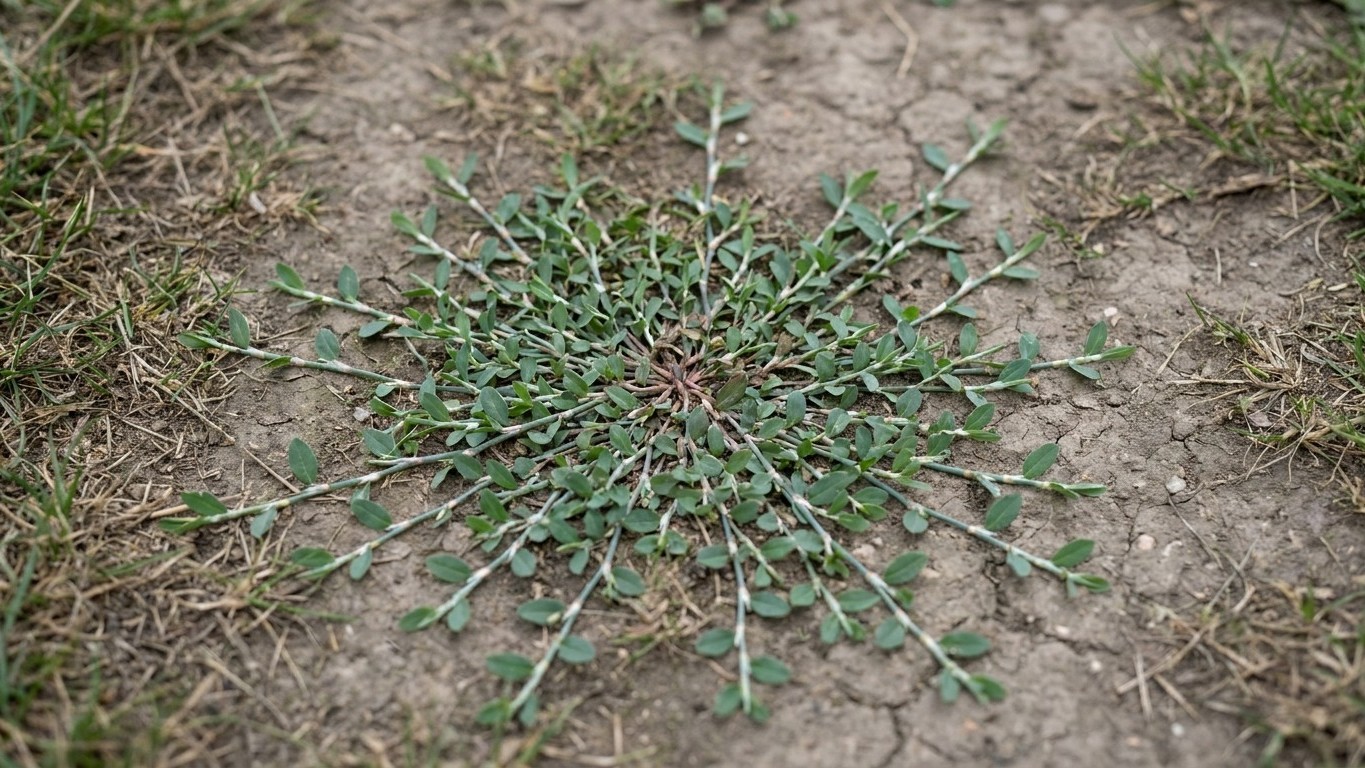

Prostrate knotweed is a low, wiry summer weed that thrives exactly where turfgrass struggles most: compacted soil along driveways, gates, and worn paths. Seeing it isn’t a lawn disease diagnosis. It’s a map. Every patch tells you where foot traffic, poor drainage, or hardpan soil has already beaten your grass before the weed ever showed up.
How to be sure that is what you have

Prostrate knotweed (Polygonum aviculare) grows flat against the ground, radiating out from a central taproot into a mat that can spread a foot or more across. Its stems are thin and wiry, almost blue-green, lined with small oval leaves set alternately along the stem. The single detail that confirms identification: at every point where a leaf meets the stem, there’s a thin, papery, silvery sheath wrapped around the joint. That sheath, called an ochrea, is a trademark of the knotweed family and doesn’t appear on the two weeds people mistake it for.
Germination happens earlier than almost any other lawn weed, often while soil is still cool in late winter. Small greenish-white or pinkish flowers appear in the leaf axils through summer, easy to miss unless you’re looking closely. The first hard frost kills the plant outright since it’s an annual, leaving behind a season’s worth of seed in the soil for next year.
The two lookalikes
Spotted spurge is the closest match in habit, also a low mat-former in compacted, sunny spots. The giveaway is sap: break a spurge stem and it bleeds a milky white latex. Knotweed stems run clear. Common purslane is the second mix-up, but its leaves are thick, fleshy, and paddle-shaped rather than thin and oval, and it lacks the papery ochrea entirely.
| Feature | Prostrate knotweed | Spotted spurge | Common purslane |
|---|---|---|---|
| Stem sap | Clear | Milky | Clear |
| Leaf texture | Thin, oval | Thin, oval | Thick, fleshy |
| Papery sheath at nodes | Yes | No | No |
Why it is in your lawn
A weed shows up where the grass already lost its footing. Prostrate knotweed is a compaction specialist. Wherever soil gets packed down by repeated foot traffic, driveway edges, gate swings, or a dog’s favorite path, oxygen and water can’t move through the top few inches the way turfgrass roots need. Most lawn grasses thin out or die back under that pressure. Knotweed’s shallow, tough taproot handles it without complaint, and its seeds are built to germinate in cold, hard soil weeks before turfgrass even wakes up for the season.
Mowing too short adds to the problem rather than solving it. Scalped turf lets more light reach the soil surface, and knotweed seed needs that light to germinate. A lawn already thinned by drought stress, shade, or poor drainage gives the weed even more open ground to work with, since there’s less living root competing for the same space.
None of this points to a disease or a failing lawn. It points to a structural soil problem in specific zones, usually the same zones every year. That’s actually useful information: if the knotweed keeps appearing along the same strip by the driveway, that’s exactly where compaction needs to be addressed, not the whole yard.
The window that decides everything
Because prostrate knotweed is an annual that regrows entirely from seed each year, pre-emergent control is the strategy that actually works long term. The trick is timing it before germination, not after the mat is already visible.
Clemson Cooperative Extension’s Home & Garden Information Center fact sheet HGIC 1219 times pre-emergent herbicide applications for lawn weeds like crabgrass to the bloom of forsythia and flowering dogwood, a soil-temperature signal that’s more reliable than a calendar date. Prostrate knotweed germinates even earlier than crabgrass, often while soil is still cold in very early spring, so a pre-emergent application timed to forsythia bloom can already be a step behind for this particular weed. The safer approach is applying slightly ahead of that bloom signal rather than waiting for it.
Post-emergent herbicides work once the plant is already up and growing, but they’re far less reliable against a mature, sprawling mat than against a seedling just breaking the surface. The bloom-based trigger arrives at very different calendar dates depending on where you live, sometimes weeks apart between northern and southern states, which is exactly why a fixed month on a bag label is less useful than watching the actual plants in your area. Checking a regional planting or bloom calendar for your specific territory gives a far more accurate window than guessing from a national average.
Getting rid of it
Hand-pulling works, especially on young plants and right after rain when the soil is soft enough to release the taproot cleanly. The catch: if the root snaps and a fragment stays in the ground, prostrate knotweed can resprout from that leftover piece, so slow, steady pulling beats yanking. For a handful of small patches along a walkway, this alone often solves the problem without any product at all.
For larger mats, post-emergent broadleaf herbicides are the common chemical route. Active ingredients like 2,4-D, dicamba, and triclopyr are widely sold for lawn use and target broadleaf weeds like knotweed while leaving most common turfgrasses unharmed, when applied according to label directions. That last part matters: some grass species, including St. Augustinegrass, are sensitive to certain broadleaf actives and can be injured by products that are perfectly safe on Kentucky bluegrass or tall fescue. Reading the label for grass-species restrictions before buying is not optional.
Several of these active ingredients face state-level restrictions or limits on residential use, particularly dicamba in certain states, so what’s sold over the counter varies by location. A local extension office can confirm what’s legal to buy and apply in a given state before a purchase is made. For prevention going forward, pre-emergent actives like dithiopyr or pendimethalin stop next year’s seed from germinating, but they won’t touch plants already growing this season. Chemical control is realistically a last resort for stubborn infestations, not the first move for a few scattered plants.
Keeping it out
Thick, healthy turf is the only control that holds up year after year, because it simply leaves knotweed seed no bare, sunlit soil to germinate in. The mowing height matters more than most people assume. Cool-season lawns, tall fescue and Kentucky bluegrass among them, do best kept around 3 to 3.5 inches, tall enough to shade out germinating weed seed at the soil surface. Warm-season lawns like bermudagrass and zoysia are mowed shorter by design, but scalping below the recommended height for the species opens the same door for weeds that cool-season scalping does.
Feeding timing follows the same seasonal split. Cool-season grasses build their strongest root reserves from a fall feeding program, which carries them through the following summer stress. Warm-season grasses do their heaviest growing and feeding through late spring and summer instead. Either way, a well-fed lawn simply out-competes a weed for light and root space.
Overseeding thin or bare patches each fall (cool-season) closes the gaps that knotweed seed would otherwise colonize the following spring. And since compaction is the root cause in the first place, core aeration on the same seasonal schedule (early fall for cool-season, late spring into summer for warm-season) breaks up the hardpan that gave the weed its opening. Fix the compaction, and the weed loses the advantage that let it show up there in the first place.
Common questions
Is prostrate knotweed the same as Japanese knotweed?
No. Japanese knotweed is a large, invasive perennial that grows several feet tall and spreads aggressively by rhizome. Prostrate knotweed is a low annual lawn weed, a completely different scale of plant despite the shared family name.
Will prostrate knotweed die on its own?
Yes, eventually. It’s a summer annual, and the first hard frost kills the mature plant outright. The seed it drops beforehand, though, stays in the soil and can germinate again the following spring.
Does seeing it mean my whole lawn has bad soil?
Usually not. Prostrate knotweed tends to follow the exact pattern of compaction, showing up along paths, driveway edges, and gates rather than spread evenly across the yard. Where it appears is a fairly accurate map of where the soil itself is the problem.
Can I fix compacted soil without using any chemicals?
Yes. Core aeration, topdressing with compost, and simply rerouting foot traffic away from the worst spots address the underlying compaction directly, which removes the condition the weed depends on in the first place.