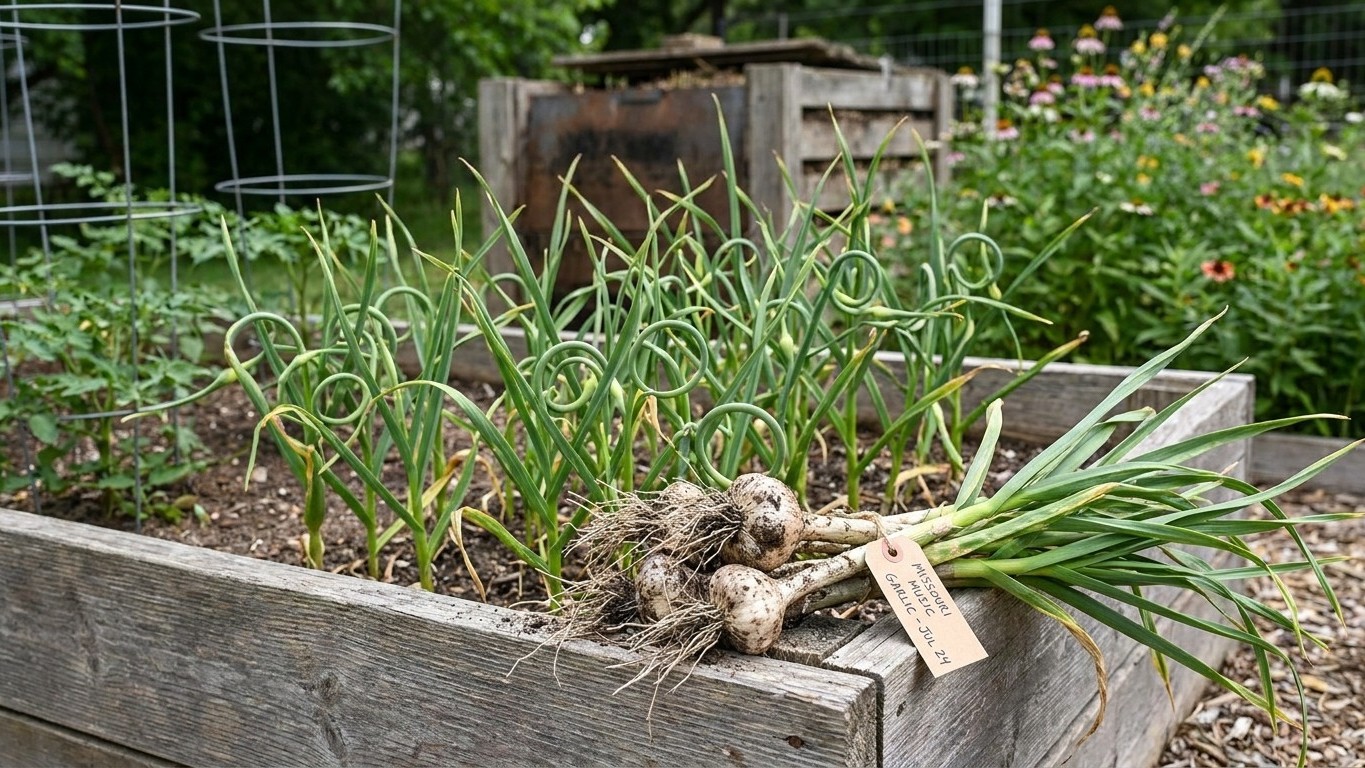

German Red and Inchelium Red cloves tucked into cold Missouri ground in November rarely get the three to four weeks of root contact they need before the soil locks up, and the payoff come July is a fistful of small, single-clove bulbs instead of the fat heads you were promised on the seed packet. That failure traces back to one bad habit: waiting for the first visible frost as your planting cue, when by then half of Missouri’s freeze years have already left you weeks too late.
The short answer for Missouri

Plant garlic cloves in Missouri between late September and early October. That is the window every named variety in the closed catalog list is bred and sold to hit, including softnecks like Inchelium Red and hardnecks like German Red. The date is not really about the calendar page. It is counted backward from the first fall frost, because garlic needs three to four weeks of soil contact before winter shuts root growth down.
What the date is anchored to
Near Kansas City, NOAA’s 1991-2020 Climate Normals put the first fall freeze at 32°F somewhere between October 18 and October 29. That is a fourteen-day range, not a single day, because freeze probability climbs gradually through the back half of October rather than arriving on a switch. Treat it as a midpoint. In roughly half the years on record, the first freeze at this station actually lands after October 29, and a gardener who waits for visible frost before planting is already behind schedule in those years.
Counting back three to four weeks from that range lands on late September through early October, which is why every cultivar on the list, from Bavarian Purple to Lorz Italian, carries the same planting window despite having different days to maturity the following summer. The frost date decides when to stop waiting. It does not decide when the crop is harvested, since that comes the following July, after a full winter and spring in the ground.
Working it out for your own garden
If the bed itself is not ready yet, the soil prep and site selection steps belong to an earlier stage. Growing Garlic in Missouri covers that groundwork.
The count-back math
Start from the Kansas City frost window, October 18 to October 29 per NOAA’s NCEI normals, and count back three to four weeks. October 18 minus three weeks lands on September 27. October 29 minus four weeks lands on October 1. That arithmetic is what produces the late-September-to-early-October window listed for every hardneck in the catalog, including Duganski, Georgian Crystal, and Chesnok Red. Redo the same subtraction with your own local frost figures, if your county has a published one, and you land on a window built for your own garden instead of one measured at an airport well outside it.
The precision matters less than it looks once the clove is in the ground. Missouri’s winters run cold enough, an average of 21.8 weeks with mean air temperatures below 40°F according to University of Georgia Extension bulletin C854, to comfortably clear the six to eight weeks of cold a garlic clove needs to split into the multiple cloves of a new bulb. A planting date off by a week in either direction still gets that full stretch of cold. What actually changes with a late or early date is how well the clove roots before the ground freezes solid, not whether the bulb divides at all.
Depth, spacing and mulch timing
Once the week is chosen, the details underneath it decide whether the crop rooted well or sat loose all winter.
- Set cloves root-end down, roughly two inches deep, pointed tip up
- Space cloves about four to six inches apart, rows a foot or more apart
- Water in at planting if the fall has been dry, so roots start moving right away
- Mulch with straw after planting rather than before, so the soil cools through the layer first
Skipping that last step is common and costly. Mulch spread too early traps late-September warmth in the soil, delaying the cold signal the clove is waiting for, and a bed that never quite cools ends up with weaker root systems heading into December than one mulched a week or two after planting.
What changes across Missouri
Regions that run earlier or later than Kansas City
The October 18-29 window comes from Kansas City International Airport, a station that sits well north of downtown. NOAA’s own data shows the downtown station running about five days earlier in spring, and the same urban warming likely pushes the downtown fall frost later, though NOAA does not publish that fall-specific figure. A garden inside the city, sheltered by pavement and buildings, probably has more slack than the airport number suggests. A garden in an open bottomland field north of town probably has less.
Southern Missouri, including the Ozark Plateau and the Bootheel lowlands in the state’s southeastern corner, runs milder than the Kansas City figure across the board, per NOAA’s data. Growers there can generally expect their first fall freeze later than October 18-29, which pushes the whole count-back calculation later as well, toward mid-October planting rather than late September. Northern Missouri counties, further from any large river and more exposed to open prairie wind, tend to see frost earlier than Kansas City, moving the safe planting window earlier as well.
Elevation complicates the picture inside the Ozarks themselves. A garden sitting in a low valley collects cold air on clear nights even in a region with a generally mild average, so two gardens twenty miles apart in the same county can differ more than the statewide gradient would suggest. This is exactly the kind of variation a county extension office tracks, and it is worth checking before committing to a date based on Kansas City data alone.
The mistakes this climate punishes
Planting to the frost date instead of ahead of it
The single biggest error in this climate is treating October 18-29 as the planting date rather than a backstop. Waiting to see actual frost before getting cloves in the ground means planting into an already-cold surface layer, and roots that start too late do not get the three to four weeks they need before growth stops for winter. A clove that has not rooted well by December sits loose in the soil and is far more likely to heave out during Missouri’s freeze-thaw cycles, when the surface repeatedly freezes and thaws through late fall and again in late winter.
Planting too shallow
The second mistake is planting shallow because the ground still feels workable in late September. A clove set at the depth generally recommended for garlic culture survives frost heave far better than one barely covered, and mulch added after planting protects that depth without insulating the soil so well it never triggers the cold response the clove is waiting for. Depth and mulch timing matter more here than the exact week you plant, since the county’s winter cold is more than sufficient once the clove is anchored.
Ignoring soil-borne disease at planting
Fall planting also puts garlic into the ground during the exact air-temperature range that favors two soil fungi. Mean air temperatures during September and October, per the University of California’s IPM guidelines for onion and garlic (UC ANR Publication 3453), fall inside the 50-75°F range that white rot (Sclerotium cepivorum) favors, and September also sits inside the wider range that favors Fusarium basal rot (Fusarium oxysporum f. sp. cepae). Neither fungus needs Missouri’s fall weather to survive, since both persist in soil for years regardless of climate, but planting infected seed stock, or planting into a bed with poor drainage, hands them exactly the conditions they need while the clove is most vulnerable. Buy clean seed stock, rotate away from any bed that has grown onions or garlic with rot symptoms, and fix drainage before planting rather than after finding a stunted, yellowing plant in spring.
Type does not change this risk. A softneck like Lorz Italian and a hardneck like Georgian Fire both root into the same fall soil temperatures and are equally exposed to a contaminated bed. Choosing between hardneck and softneck for Missouri, covered in Garlic Varieties That Suit Missouri Winters, comes down to flavor, clove count and storage life rather than survival, since the state’s winter cold comfortably clears what either type needs to divide into cloves.
Checking this against your county
Kansas City is one station in a state that runs roughly 300 miles north to south, and every figure above shifts as you move away from it. Missouri Extension maintains county-level offices that can confirm whether your area runs ahead of or behind the Kansas City normals used here. That office is also the right place to ask about soil testing and local disease pressure before committing seed stock to a bed, since white rot and Fusarium persist in soil regardless of what a statewide figure says about any single county.
Common questions
Can I still Plant Garlic in November in Missouri?
You can, but expect weaker roots heading into winter. Once soil temperatures drop hard, a clove planted in November may not get the three to four weeks of active rooting it needs, and how well it does depends heavily on how mild that particular December turns out to be. If you missed the late-September-to-early-October window, plant as soon as you can rather than waiting for spring, since garlic set out in spring rarely bulbs properly.
What happens if I plant garlic too early, in August?
The clove puts up too much top growth before winter, and that green growth is what gets damaged by hard freezes later in fall, weakening the plant even though the clove itself survives underground. There is no advantage to planting ahead of late September in this climate, since the extra weeks just push more top growth above ground before the cold arrives.
Does the first frost date actually kill garlic if I plant right before it?
No, established garlic tolerates frost and hard freezes without damage once it has roots down. The frost date matters only as a marker for counting backward, not as a threat to the plant itself. What actually limits late planting is the number of weeks left for root growth before the ground freezes solid, not the frost event itself.
Should I choose a hardneck or softneck variety for Missouri winters?
Either does fine here, since the state’s winter cold comfortably exceeds what either type needs to split into cloves. The choice comes down to flavor, clove size and how long the bulb stores rather than which one survives the winter.
If you follow the almanac, here is when to plant garlic by the moon. It is a tradition, not a proven method.