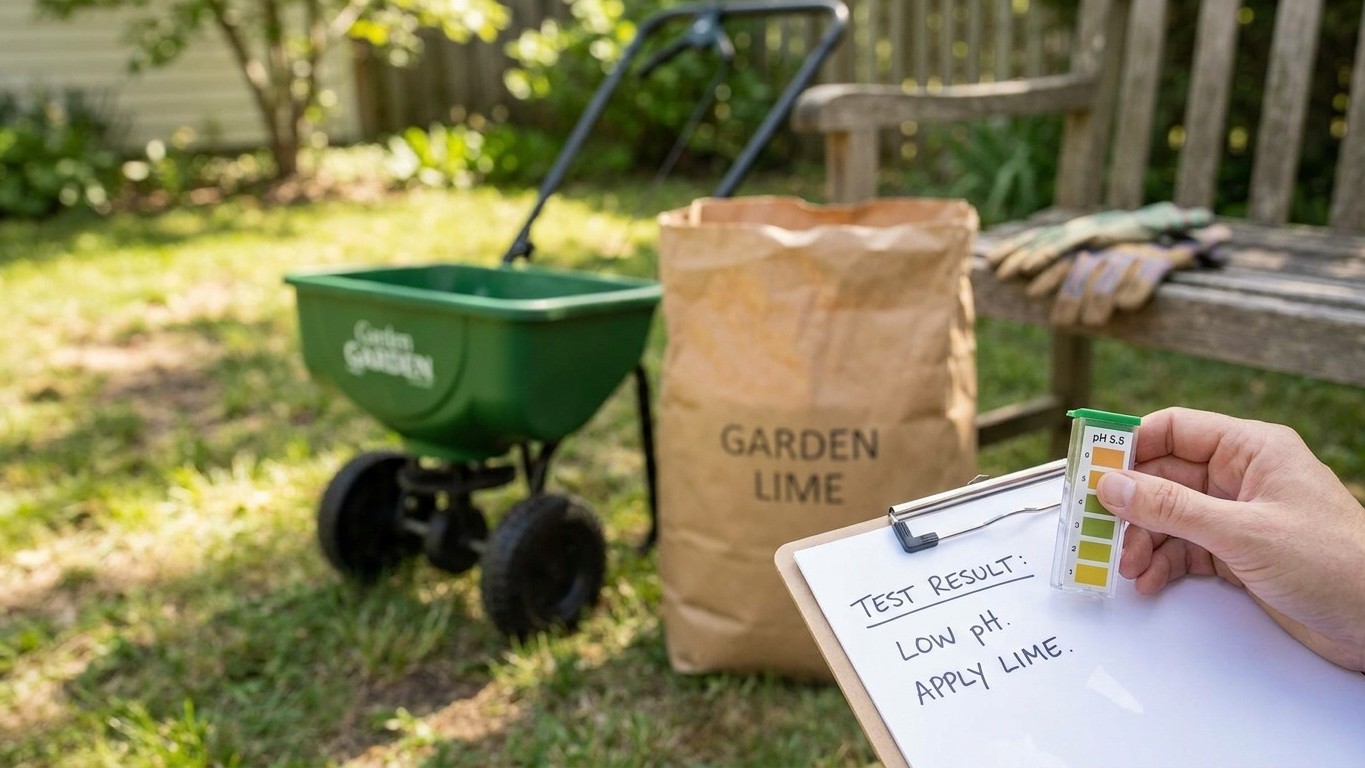

Should you put lime down this year? Only if your soil test says yes, and by the amount it names — nothing else tells you the truth about what’s under your grass. Roots keep drawing on soil that’s too acidic or too alkaline for weeks before you ever see it on top, so a lawn can look tired for reasons that have nothing to do with pH at all. Pull a sample, send it in, and wait for the number before you buy a single bag.
Why this matters
A lawn that has lost its pH balance doesn’t show it right away. Grass roots keep working through soil that’s a little too acidic or a little too alkaline for weeks before the shortage becomes visible on top. By the time you see yellowing or thin patches, the underlying problem has usually been building for a season or more.
Lime doesn’t feed grass directly. It corrects the soil chemistry that lets grass use the fertilizer you already put down. Apply lime when the soil doesn’t need it and you can push the pH too high, which locks up iron and manganese the same way an overly acidic soil locks up calcium and phosphorus. Either direction wastes the fertilizer bill you just paid and can cost another season before color comes back.
The only reliable signal is a soil test result, not the look of the turf. A lawn can be pale for reasons that have nothing to do with pH, including compaction, drought stress, or a shady spot that suits Fine Fescue but not Kentucky Bluegrass, since the two differ in shade tolerance (Penn State Extension, Lawn Establishment). Guessing at lime because the grass looks tired is how a fixable problem turns into a multi-year one. Overcorrecting pH takes longer to undo than underdoing it, so a cautious first application beats a heavy one every time.
Waiting on lab results also takes time. A lawn that needed correction this season may not see the benefit until the next one, which is one more reason to test early rather than after the color has already faded.
When to do it
Two opposite calendars
Lime dissolves into the soil and reacts with acidity over months, and that reaction works fastest while grass roots are actively growing and cycling water through the soil. Cool-season grasses such as Fine Fescues, Kentucky Bluegrass, Perennial Ryegrass and Rough Bluegrass do their growing in fall and spring, going semi-dormant through summer heat (Penn State Extension, Lawn Establishment). Warm-season grasses such as Bermudagrass, Zoysiagrass, Centipedegrass, St. Augustinegrass, Bahiagrass, Carpetgrass and Seashore Paspalum grow through the warm months and go dormant, brown but not dead, over winter (Clemson Cooperative Extension, HGIC 1214).
That split means the same bag of lime goes down at opposite times of year depending on which lawn you’re standing on. A cool-season lawn takes lime best while it’s rooting hard in fall or spring. A warm-season lawn takes it best once summer growth is underway, not while it’s still brown and dormant.
Finding your window
Tall Fescue sits with the cool-season group for scheduling purposes, even though Clemson Cooperative Extension’s HGIC 1214 lists it as the cool-season option most often grown alongside warm-season choices like Zoysiagrass and Bermudagrass in mixed climates.
Your own frost-free window and first-frost date set the exact weeks available in each season, and those dates shift by hundreds of miles even within one state, so check your grass’s own calendar rather than a generic date. Clemson Cooperative Extension publishes species-specific calendars, HGIC 1215 through 1219, covering Centipedegrass, Bermudagrass, Zoysiagrass, St. Augustinegrass and Tall Fescue, and the general Lawn Care section can point you to the one that matches what’s actually growing in your yard.
How to do it

Test before you buy anything
Pull soil from several spots around the lawn, mix them together, and send the composite sample to your state extension’s soil testing lab rather than relying on a home kit’s color chart. Sample from the depth your extension’s instructions specify, since sampling too shallow or too deep skews the reading. Clemson Cooperative Extension’s HGIC 1201, Fertilizing Lawns, walks through how the report you get back is calculated from your current pH and your soil’s buffering capacity, which is why two lawns with the same pH reading can still get different lime recommendations.
Soil pH runs on a scale from 0 to 14, with 7 as neutral. Most turfgrass prefers a range on the mildly acidic side of that scale, and your test report will state exactly how far your sample sits from the target for your species.
The report will state a rate in pounds per 1,000 square feet, if it recommends any lime at all. That number is specific to your sample and your soil type, so treat any lime rate you read elsewhere, including in this article, as background information for a conversation with your extension office, not a substitute for your own report.
Pick the right lime
Lime comes in two common forms: calcitic lime, mostly calcium carbonate, and dolomitic lime, which carries magnesium along with the calcium. Choose based on what your soil test says about magnesium levels, since a soil already high in magnesium doesn’t need more of it. Pelletized lime spreads more evenly through a broadcast or drop spreader and raises less dust than pulverized lime, though both correct pH at the same rate once they break down.
Steps to follow once the report is in hand:
- Calibrate your spreader to the rate your report gives, not a rate printed on a generic bag
- Apply on a still day so lime doesn’t drift onto beds, walkways or a neighbor’s yard
- Water the lawn lightly afterward to help lime start moving into the soil
- Hold off on any fertilizer application for the interval your report or extension office recommends
- Record the date and rate applied so you have a baseline for the next soil test
A large correction is sometimes better split into two applications months apart rather than one heavy pass. Ask your county extension office whether your specific recommendation should be divided that way. Applying too much at once risks pushing pH past the target rather than settling on it, and an overshoot takes another full test cycle to catch and fix.
Lime works slowly. Expect the pH change to show up in a retest, not in the turf’s color, and judge whether the application worked by that retest rather than by eyeballing the lawn a few weeks later.
What goes wrong
Lockout from either direction
Applying lime without a test is the most common mistake, and it plays out two ways. Either the lawn didn’t need it and now sits at a pH too high for iron and manganese to dissolve into a form roots can absorb, or it needed less than what went down and the same lockout happens after a second unnecessary application. Both show up as the same pale, yellowing turf that looks like a nitrogen shortage, which sends a lot of people reaching for more fertilizer instead of a retest.
That yellowing usually doesn’t appear until several weeks to a couple of months after the application, once the pH shift has had time to work through the root zone. By then it’s easy to blame the wrong thing, a mower set too low, a dry spell, even a fungal patch, because the timeline has drifted far enough from the lime application that the connection isn’t obvious. Checking a lawn weeds identification guide before assuming a discolored patch is a nutrient issue can save a wasted trip to the garden center, since some broadleaf weeds fade to a similar yellow-green before they’re pulled.
Timing failures
Using dolomitic lime on a soil already high in magnesium is a quieter failure. It doesn’t show up as dramatically, but it pushes the calcium-to-magnesium ratio further out of balance, and the correction takes another full season to reverse once it’s caught on a follow-up test.
Liming a dormant warm-season lawn in late winter, before Bermudagrass or Zoysiagrass have broken dormancy, wastes the trip across the yard. The lime just sits on top of turf that isn’t taking up water or nutrients yet, and rain can move it off a slope before the roots ever get a chance to use it.
How this changes across the country
Cool-season vs warm-season
A cool-season grower liming a stand of Kentucky Bluegrass or Perennial Ryegrass times the job around fall and spring growth flushes, the same windows Penn State Extension’s Lawn Establishment guidance uses for overseeding and fertilizing. A warm-season grower with Bermudagrass, St. Augustinegrass or Centipedegrass works on the opposite clock, timing lime to the summer growing season Clemson Cooperative Extension’s HGIC 1214 describes for those species.
The transition zone and soil type
The transition zone, the band of the country where neither a purely cool-season nor a purely warm-season guide fits cleanly, is where the mismatch causes the most confusion. Clemson Cooperative Extension’s HGIC 1214 lists Tall Fescue, a cool-season grass, alongside Zoysiagrass and Bermudagrass, both warm-season, as options for the same region, because summers run hot enough to stress cool-season turf while winters run cold enough to put warm-season turf into a long dormancy. A homeowner there has to know which species is actually growing in the yard before picking a liming window, not just which region they live in.
Soil type shifts the picture again. Sandy soils common along parts of the coastal Southeast hold onto less lime and need more frequent retesting than the heavier clay soils found further inland, since lime moves through a sandy profile faster. None of that changes the core rule: the rate and the timing both come from a current soil test read against your own species’ growing season, not from a neighbor’s lawn or a bag’s average instructions.
If you’re planning to reseed a bare patch while correcting pH anyway, matching species to the site matters as much as the lime rate. Fine Fescues tolerate shade well but wear poorly under foot traffic, while Kentucky Bluegrass takes wear better but needs more sun, a tradeoff worth checking against a grass seed label before you buy a bag that doesn’t match the spot.
Common questions
Can I just lime every fall like I fertilize?
No. Lime should only go down when a current soil test calls for it. Lawns that don’t need correction and get lime anyway can drift into a pH range where nutrients lock up, which is the same problem liming is supposed to fix.
Will lime green up my lawn right away?
No, and it isn’t meant to. Lime adjusts soil chemistry so nutrients already in the soil become available. Any color improvement comes later, once the correction has had time to work through the root zone, not from the lime itself acting as a fertilizer.
My soil test came back fine. Do I still need to lime?
Not this cycle. A test showing your pH already sits in the target range for your species means there’s nothing to correct, and applying lime anyway risks pushing the pH the wrong direction. Retest on the schedule your extension office recommends and revisit the question then.
Can I use wood ash instead of buying lime?
Wood ash does raise soil pH, but its nutrient content and reaction rate aren’t the same as agricultural lime, and it’s easy to overapply because there’s no standard label rate. If you want to use it, get a soil test first and ask your county extension office how to account for it, rather than substituting it pound for pound.