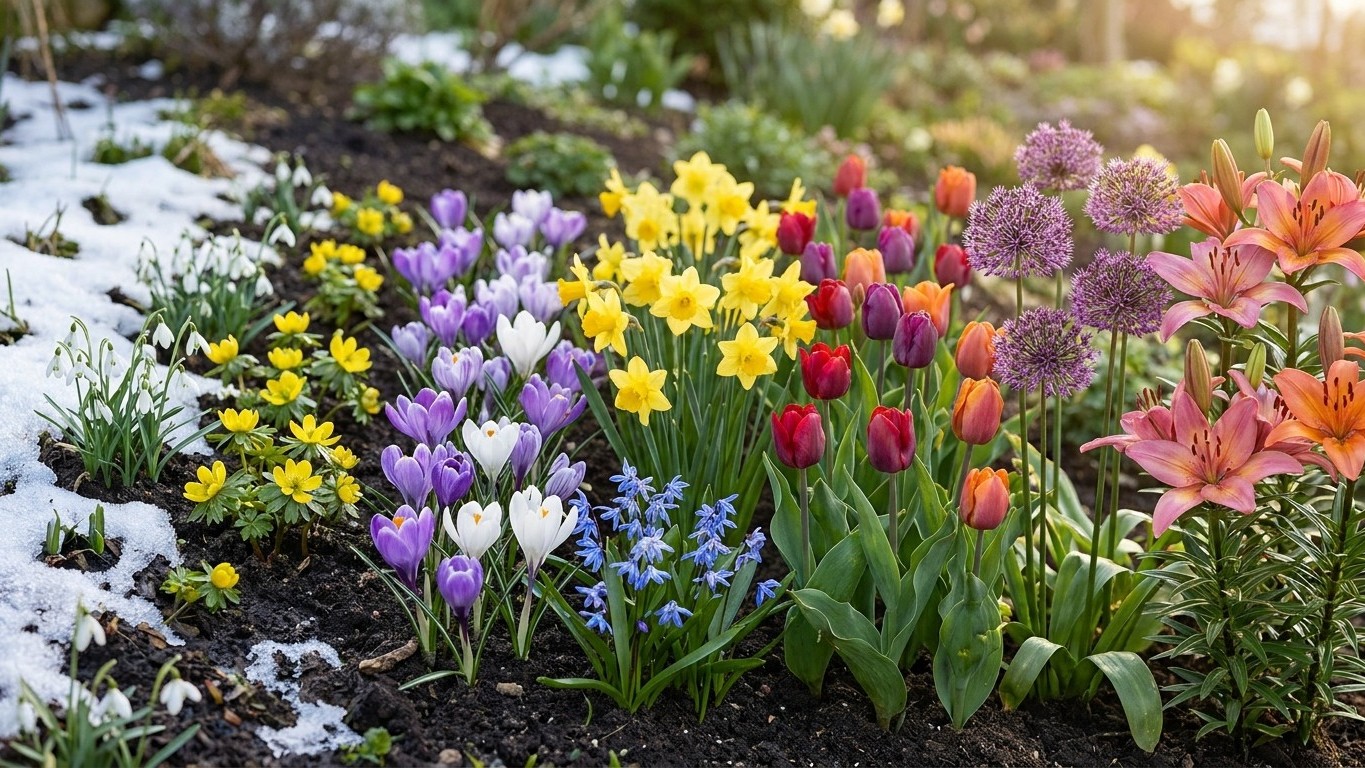

Spring bulbs don’t bloom on a single calendar date. They bloom in seven waves, each one triggered by soil warming past whatever threshold that species needs, and each wave overlapping the one before it. The order runs from snowdrop and winter aconite in late winter through to Asiatic lily in early summer. What decides which wave a bulb lands in isn’t luck or feeding. It’s a cold requirement set months earlier, before the ground even froze.
The short answer
Here are the seven waves, in order, exactly as they play out from one season’s end to the next season’s start:
| Wave | Bulbs |
|---|---|
| Late winter | Snowdrop, winter aconite, reticulated iris |
| Very early spring | Crocus |
| Early spring | Siberian squill, glory-of-the-snow, striped squill, Grecian windflower |
| Early to mid spring | Daffodil |
| Mid spring | Tulip, grape hyacinth, hyacinth, crown imperial |
| Late spring | Camassia, Spanish bluebell, ornamental allium, Dutch iris |
| Early summer | Asiatic lily |
Eighteen species, seven waves. That’s the whole answer in one table. But treat it as a sequence, not a schedule. A late winter that runs cold and wet will hold the snowdrop wave back while pushing it right up against the crocus wave, so the two blur together. A warm pocket against a south-facing wall will pull a daffodil ahead of a bulb that’s technically supposed to open first. The order holds. The dates don’t.
Why the order stays fixed even when dates slide
Each species carries its own internal clock, and that clock reads soil Temperature and cold accumulation, not the day on a wall calendar. A snowdrop is built to push through crusted, half-frozen ground; an Asiatic lily is built to wait for soil that’s been warm for weeks. Move both bulbs two states south and they’ll bloom earlier by the calendar, but the snowdrop will still open before the lily. That’s the useful part of thinking in waves instead of dates: the sequence travels with you, even when the specific week doesn’t.
This matters most when you’re planning what to plant together, or when you’re trying to figure out why one bulb in a mixed bed opened weeks ahead of its neighbor. The neighbor isn’t sick and it isn’t late. It’s simply a bulb from a later wave, doing exactly what it was built to do.
What actually decides it
The flower a bulb produces next spring isn’t built in spring. It’s already formed inside the bulb by the time you buy it, packed in miniature, waiting. Cut a dormant bulb in half at the right point in the season and you’d find the flower parts already there, folded down small. Nothing the gardener does after planting creates that flower. What the gardener supplies is cold, and enough time in the ground for roots to establish before the ground freezes.
That cold isn’t a nicety. It’s a requirement with a hard cut-off: about 13 weeks below 45 F. Below that threshold of accumulated cold, the bulb doesn’t fail to thrive or bloom small. It makes leaves and no flower at all. The chemistry inside the bulb that releases the flower simply doesn’t fire until the cold hours add up. This is the same kind of hard cut-off you’d see with day length triggering an onion to bulb; it isn’t a dial you can nudge with fertilizer or extra water. It’s a switch, and the switch stays off until the cold hours are logged.
Why this explains the whole sequence, not just one species
Once you understand the cold requirement as a threshold rather than a preference, the seven waves stop looking mysterious. A bulb built to bloom in late winter isn’t more cold-hardy in some vague sense than one built for early summer. It’s simply built to satisfy its cold requirement early and then respond to the first hint of warming soil, while a late-wave bulb needs a longer stretch of cold, warming soil, and more elapsed time in the ground before its own trigger fires. The order of the waves is really the order in which each species’ combination of cold need and warmth response gets satisfied by the same advancing season.
This is also why a gardener can reason about any spring bulb species. Ask what wave any spring bulb belongs in, and the real question is how much cold it needs before it will respond to warmth, and how it was bred or evolved to read the signal. Answer that, and the wave follows. You don’t need a chart for every species on earth once you understand that the chart is really just cold-hours-versus-response, repeated eighteen times, or eighteen hundred.
How to do it
- Work backward from your ground-freeze date. That date sets the deadline for everything else, because roots have to be established before the soil locks up.
- Plant about six weeks before the ground freezes. That window gives roots time to grow down into the soil while it’s still workable, ahead of the deep cold that starts the clock on the bulb’s dormancy requirement.
- Let the bulb sit through the full cold period undisturbed. This is the stretch where the roughly 13 weeks below 45 F accumulate. Nothing above ground signals this is happening. Resist the urge to check, dig, or move bulbs during this stretch.
- Watch the soil, not the calendar, once temperatures start climbing. The bulb responds to warming soil once its cold requirement has been satisfied, and that’s what actually starts growth, not a date on a page.
- Expect the waves to appear in order, not on a fixed schedule. Late winter bloomers show first, early summer bloomers last, with real overlap between neighboring waves depending on how the season runs.
- Let foliage die back naturally after bloom. The leaves that follow flowering are rebuilding the bulb’s stored energy and, indirectly, funding next year’s cold-triggered flower.
What goes wrong
- Leaves and no flower. This is the failure that matters most, and it has one cause: the cold requirement wasn’t met. If the bulb didn’t spend roughly 13 weeks below 45 F, it will still grow leaves, because leaf growth doesn’t need the same trigger as flowering does. No amount of fertilizer, water, or sun will force a flower that the cold switch never released. The only fix is a full, uninterrupted cold season the following year, or replacing bulbs that were stored somewhere too warm to satisfy the requirement in the first place.
- Planting too late, too close to the ground freezing. Roots need time to establish before the deep freeze locks the soil. Miss the six-week window and the bulb goes into winter with a weak root system, which weakens the whole season ahead of it, cold requirement or not.
- Assuming an early bloom means a healthy plant and a late one means a weak one. Wave order isn’t a ranking. A late spring or early summer bulb isn’t behind schedule; it’s simply built to need more cold and more elapsed time before it fires. Comparing a late-wave bulb’s timing to an early-wave neighbor is comparing two different clocks, not judging one plant against another.
- Disturbing bulbs during the cold period. Digging, moving, or otherwise interrupting bulbs while they’re meant to be logging cold hours resets or damages the process. The cold accumulation has to be continuous through the dormant season for the flower switch to release on schedule.
- Expecting the waves to line up with a fixed date every season. The order is reliable; the timing isn’t. A colder or warmer season shifts every wave in the same direction, sometimes compressing two waves so close they read as simultaneous. Treating any wave as a fixed calendar event, rather than a position in a sequence, sets up disappointment when the season runs differently than expected.
Common questions
Do all eighteen species need the same amount of cold?
No. The roughly 13 weeks below 45 F is the general cold requirement referenced here, but different species satisfy their internal trigger at different points along that cold-and-warmth sequence, which is exactly why they fall into seven separate waves rather than blooming all at once.
Can I speed up bloom by planting earlier in fall?
Planting earlier doesn’t change when the bulb blooms, because the flower is already formed and waiting on a cold trigger, not on extra time in warm soil. What earlier planting does is give roots more time to establish before the ground freezes, which supports a stronger plant, not an earlier one.
Why did two bulbs from the same wave bloom weeks apart in my yard?
Microclimate. A spot against a warm wall, a slope that drains and warms faster, or deeper planting can shift when a bulb’s soil warms past its response threshold, even though both bulbs belong to the same wave and carry the same cold requirement.
If a bulb only grows leaves this year, will it flower next year?
Only if it gets a complete, uninterrupted cold period this coming dormant season. The missed flower this year means the roughly 13-week cold threshold wasn’t met last time; nothing about this year’s leaf growth changes that, but a full cold season ahead can reset the trigger for the following spring.