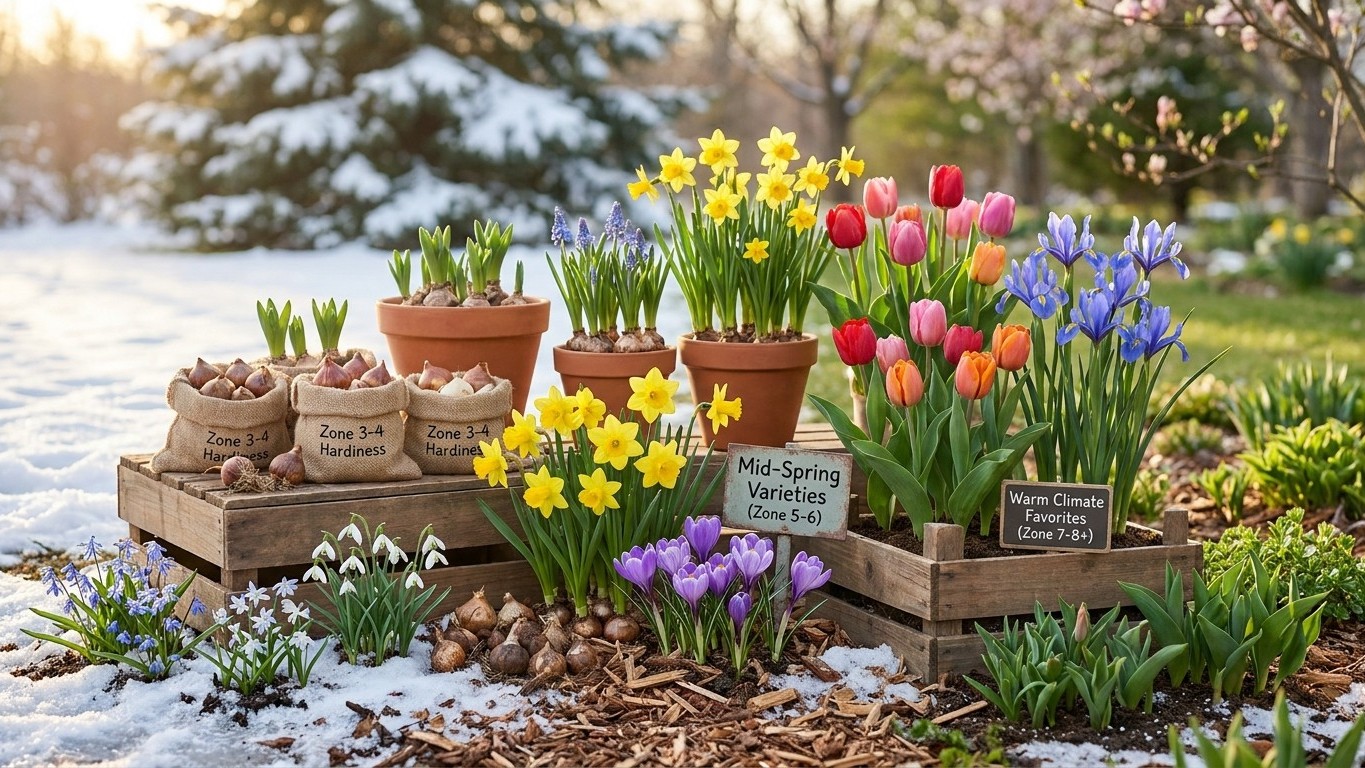

Eighteen popular spring bulbs carry hardiness ranges that run from zone 2-8 down to zone 6-9, and that spread is what decides who survives your winter and who never gets enough cold to bloom. Siberian squill tolerates zone 2, the coldest end of the group. Dutch iris needs zone 6 at minimum and fails once winters warm into zone 9. A hardiness range has two ends: one where the bulb freezes out, one where it never gets its roughly 13 weeks below 45 F to form a flower.
The short answer
Line up all eighteen species side by side and the pattern looks like a ladder, not a single cutoff number. Siberian squill sits at the cold end, hardy through zone 2-8, which means a gardener in Minnesota or North Dakota can leave it in the ground through the worst of winter without worry. Dutch iris sits at the opposite end, rated zone 6-9, and that upper number matters just as much as the lower one, even though almost nobody reads a hardiness tag that way.
| Hardiness range | Species |
|---|---|
| 2-8 | Siberian squill |
| 3-7 | Snowdrop, winter aconite |
| 3-8 | Asiatic lily, crocus, daffodil, glory-of-the-snow, Spanish bluebell, striped squill, tulip |
| 4-8 | Camassia, grape hyacinth, hyacinth, ornamental allium |
| 5-8 | Crown imperial |
| 5-9 | Grecian windflower, reticulated iris |
| 6-9 | Dutch iris |
Why the warm end matters too
Most people read a hardiness range and check only the low number, the one that tells them whether their coldest nights will kill the bulb outright. That’s the failure gardeners expect. The failure they don’t expect sits on the other side of the dash. A bulb rated 3-8 planted in a zone 9 yard isn’t at risk of freezing. It’s at risk of never freezing enough. Winter never drops the soil below that 45 F threshold for long enough, so the bulb sits there, alive, unbothered, and stubbornly leafy come spring with no flower to show for it.
That’s the real answer to the title. Survival isn’t one condition, it’s two, checked in opposite directions. Match your zone to the low end of the range and the bulb won’t freeze. Match it to the high end and the bulb will actually get cold enough to bloom. A gardener in coastal Georgia or southern Florida can grow siberian squill leaves forever and never see a flower, not because anything was done wrong, but because the range simply stops at zone 8 or 9 for a reason.
What actually decides it
Here’s the part that changes how you read every bulb catalog from now on: the flower you’ll see next spring is already built. It’s sitting inside the bulb, fully formed in miniature, before you ever put it in the ground. That’s true whether you’re planting the hardiest species on this list or the least hardy one. Nothing you do after planting creates the flower. What you’re actually managing is whether that already-formed flower gets released.
The release mechanism is cold, and it runs on a clock, not a thermostat. The threshold that matters is about 13 weeks below 45 F. Below that line of cold exposure, the bulb responds by pushing up leaves and stopping there. No bud, no stem, no color. It isn’t a matter of the plant being weak or underfed. Feeding a bulb that hasn’t had its cold is like turning up the heat on an oven that was never plugged in. The chemistry that triggers flowering inside the bulb simply hasn’t fired.
The second piece of the mechanism is rooting time, and it’s separate from the cold requirement even though the two get confused. A bulb needs its roots established in the soil before the ground itself freezes solid, because roots are what let the bulb take up moisture through winter and early spring. That’s why timing the planting date against your local ground-freeze date matters as much as the zone number on the label.
Put those two mechanisms together and you can reason about any bulb. Look up its hardiness range. Check the low end against your winter lows, and check the high end against whether your winters actually deliver sustained cold below 45 F for roughly that 13-week window. If both checks pass, plant it early enough that roots form before the ground locks up. That’s the whole system, whether the species is one of the eighteen listed here or something else entirely.
How to do it
- Find the bulb’s published hardiness range and compare both numbers to your zone, not just the lower one.
- Rule out the bulb if your zone falls above the range’s high end, since your winters won’t deliver the roughly 13 weeks below 45 F the flower needs to form.
- Rule out the bulb if your zone falls below the range’s low end, since the bulb itself will freeze out over winter.
- Mark your average ground-freeze date for the season.
- Plant about six weeks before that ground-freeze date, so roots have time to establish while the soil is still workable.
- Water in after planting to settle the soil around the roots.
- Leave the bed alone through the cold months and let the roughly 13-week cold requirement run its course naturally.
- Watch for leaves in early spring as the first sign of growth, followed by the bud and flower if the cold requirement was met.
What goes wrong
- Leaves come up but no flower ever forms. This is the failure that matters most, and it means the cold requirement, roughly 13 weeks below 45 F, wasn’t met. No amount of fertilizer, watering, or patience fixes it, because the flower inside the bulb was never released to begin with. The only remedy is choosing a species whose hardiness range’s warm end actually sits at or below your zone.
- Bulbs rot or simply vanish over winter. This points to the opposite problem, a zone colder than the bulb’s range allows. The remedy is checking the low end of the hardiness range before planting, not after a failed season, and choosing a hardier species for that spot if your winters run colder than the range’s floor.
- Bulbs planted but never rooted before spring. Planting too close to the ground-freeze date leaves roots undeveloped, so the bulb struggles even if the zone match was correct. The remedy is planting about six weeks ahead of the ground freezing, not after the first frost has already hardened the soil.
- Confusing a warm-winter failure with a disease or pest problem. Gardeners in the South sometimes treat healthy-but-flowerless bulbs for fungus or blame the soil, when the actual cause is a hardiness range whose high end simply doesn’t reach their zone. The remedy is ruling out the cold requirement first, before spending money on treatments that were never going to help.
Common questions
Can I still grow a bulb whose range doesn’t reach my zone?
If your zone falls above the range’s warm end, the bulb can survive but won’t reliably flower without an artificial cold period, since natural winter won’t supply the roughly 13 weeks below 45 F it needs.
Does a colder zone than the range’s low end always kill the bulb?
The published range reflects what the bulb is expected to survive outdoors; a zone below that floor puts the bulb at risk of freezing out over winter, which is the opposite failure from not enough cold.
Why do some species have such a narrow range and others such a wide one?
The ranges here vary from a six-zone spread (2-8) down to a four-zone spread (6-9), reflecting how much cold tolerance and cold requirement differ from one species to the next among the eighteen covered.
If leaves appear but no flower, is the bulb dead?
No. It’s alive and likely to leaf out again next year under the same conditions, but it will keep skipping the flower until it’s planted where its hardiness range’s warm end actually matches your zone.