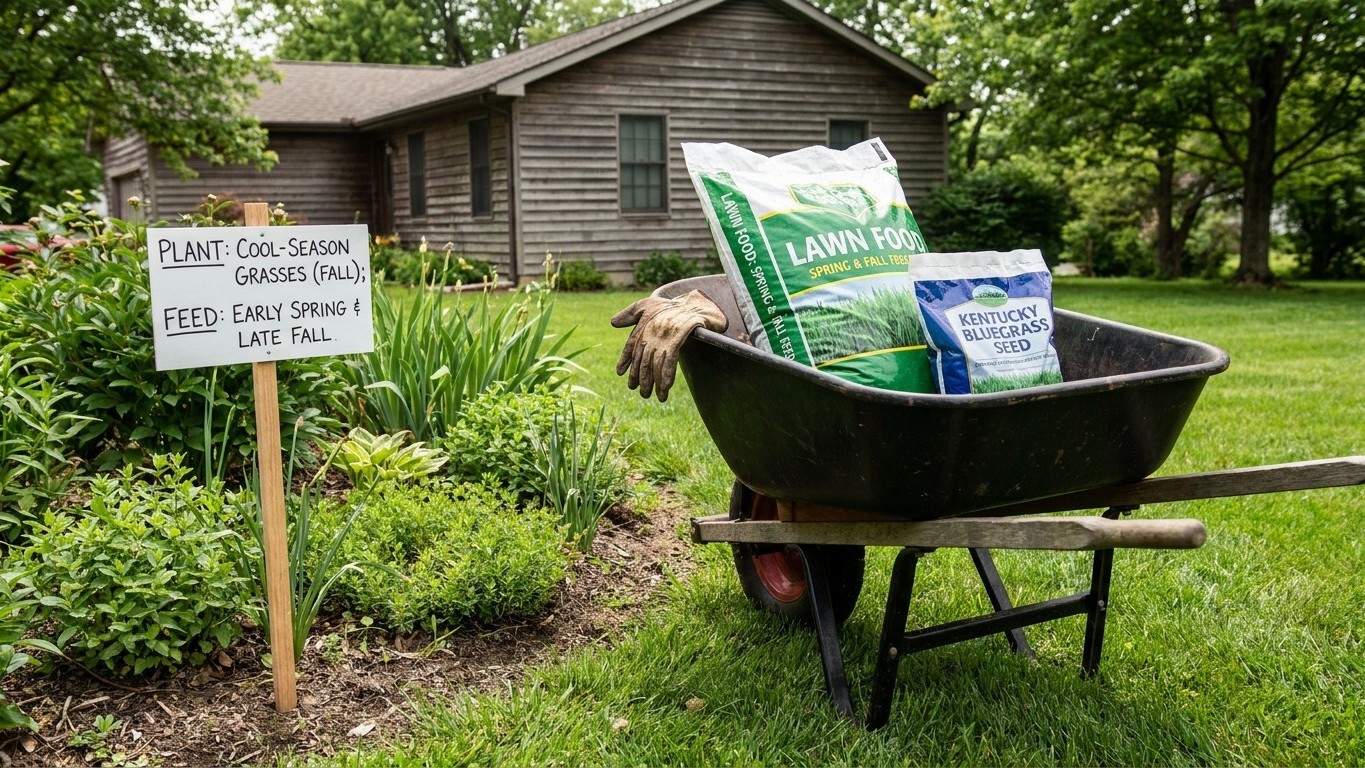

Thirty-seven days a year above 90°F, followed by winters that dip to a 26.8°F average low — that’s the math working against whatever you plant in a Kentucky yard. It’s not hot enough to trust a warm-season grass through January, and not cool enough to let a fescue lawn coast through August without stress. Most people pick a grass for its color at the garden center, not for how it survives that squeeze, and pay for it every July — understanding Kentucky lawn Best grass options starts with looking at the climate math first.
Which grass belongs in Kentucky

The two numbers that decide this are the ones NOAA’s National Centers for Environmental Information track for the Louisville reference station: an average of 37.2 days a year hitting 90°F or higher, and a coldest-month mean minimum of 26.8°F. Neither figure is extreme by itself, but together they land Kentucky squarely in what turf agronomists call the transition zone, too hot for a cool-season lawn to stay lush through July and August, too cold for a warm-season lawn to hold on through most winters without months of dormancy.
What each season of grass gets you
Clemson Cooperative Extension’s HGIC 1214 guide to selecting a lawn grass lists Tall Fescue, Kentucky Bluegrass and Perennial Ryegrass as the cool-season options grown in this zone, and Zoysiagrass and Bermudagrass as the warm-season options, with Penn State Extension backing the cool-season picks specifically.
- Cool-season: Tall Fescue, Kentucky Bluegrass, Perennial Ryegrass
- Warm-season: Zoysiagrass, Bermudagrass
Tall fescue is the most common lawn grass across the state because its deep root system tolerates heat better than bluegrass or ryegrass, though it still slows and can thin during the hottest run of 90-degree days. Kentucky Bluegrass forms the thickest, most even turf of the three cool-season species but needs more water and nitrogen to hold that quality through summer. Perennial Ryegrass establishes fast and is often mixed with the other two rather than grown alone. Zoysiagrass and Bermudagrass do the opposite: they thrive in the heat that stresses fescue and bluegrass, but a coldest-month minimum of 26.8°F at Louisville is enough to send them dormant, and colder winters farther north or at higher elevation in the state can kill an underestablished stand outright — timing these seasonal swings against the right maintenance windows is exactly what a Kentucky lawn Calendar is built for.
The trade-off, not a winner
No species excels in Kentucky, and naming one as “best” misleads you. A cool-season lawn stays green from fall through spring but struggles or browns in a hot July. A warm-season lawn holds up through the worst of summer but sits brown and dormant from roughly October through April. Choose the one whose off-season you can live with, since these figures come from the Louisville station and warmer or cooler pockets of the state will tip the balance differently. Ohio, one state north, sits solidly in the cool-season zone, where the choice is simpler because there’s no month-long summer brown to plan around the way a Kentucky transition-zone lawn must, a difference covered in Ohio Lawn Care: What to Plant and When to Feed It.
When to seed or sod here
Clemson Cooperative Extension’s HGIC 1203 guide puts the general planting windows at around May for warm-season grasses and mid to late September for cool-season grasses, and Kentucky’s transition-zone climate follows that same split rather than a single statewide date.
Cool-season seeding, anchored to frost
NOAA’s NCEI 1991-2020 climate normals for the Louisville station put the first fall freeze (32°F) in a window of November 2 to November 12, with a 30 to 70 percent probability across that stretch. Seeding tall fescue, bluegrass or ryegrass in mid to late September gives seedlings roughly six to eight weeks of cooling soil before that freeze window arrives, enough time to build roots before growth stops for winter. The National Weather Service office covering Louisville notes that this reference station runs later in spring and earlier in fall than the surrounding rural parts of Jefferson County, so a rural lawn should work toward the earlier end of that seeding window rather than the latest date in it.
Warm-season planting, anchored to soil temperature
Zoysiagrass and Bermudagrass go in around May, once the soil has warmed enough for sprigs, plugs or seed to root quickly rather than sit stalled in cold ground. Because these species spend the cold months dormant rather than actively growing, a late spring frost is less of a threat to them than it is to a spring-seeded cool-season lawn. But a stand that goes into its first winter thin and underestablished is far more likely to suffer winterkill, given the 26.8°F coldest-month minimum NOAA’s normals record for Louisville.
Whichever grass you plant, sod can go down at nearly any time the ground isn’t frozen, since it arrives already rooted. Seed needs its species’ own window to germinate and establish before the season turns against it. A cool-season seeding window this specific doesn’t hold everywhere in the country: gardeners working Louisiana’s warm, humid climate follow an entirely different lawn calendar, laid out in Louisiana Lawn Care: What to Plant and When to Feed It.
The feeding calendar that fits this climate
Nitrogen goes down when the grass is actively building roots and shoots, not on a fixed calendar date, and that month is different for the two kinds of lawn Kentucky grows.
Cool-season lawns: feed in fall
A tall fescue, bluegrass or ryegrass lawn does most of its root growth once the heat that stresses cool-season turf through summer has broken, which is why Clemson Cooperative Extension’s HGIC 1219 Tall Fescue Maintenance Calendar concentrates nitrogen applications on the fall months rather than spring. A heavy spring feeding pushes leaf growth at exactly the time the lawn should be sending energy into roots to survive the coming summer, and that’s a common mistake on Kentucky fescue lawns. Check the calendar directly for the exact pounds of actual nitrogen per 1,000 square feet for each application, rather than relying on a fertilizer bag’s generic schedule.
Warm-season lawns: feed after green-up
Zoysiagrass and Bermudagrass take nitrogen the opposite way. Clemson’s HGIC 1217 Zoysiagrass Maintenance Calendar and HGIC 1216 Bermudagrass Maintenance Calendar both schedule the first feeding after the lawn has fully greened up in late spring, not before, because nitrogen applied to a still-dormant or half-dormant warm-season lawn feeds the weeds that beat it out of dormancy rather than the turf itself. Applications continue through the summer growing season and taper off before the grass starts hardening off for winter.
| Grass | Season type | Main feeding window | Full calendar |
|---|---|---|---|
| Tall Fescue, Kentucky Bluegrass, Perennial Ryegrass | Cool-season | Fall, during peak root growth | HGIC 1219 |
| Zoysiagrass | Warm-season | Late spring through summer, after green-up | HGIC 1217 |
| Bermudagrass | Warm-season | Late spring through summer, after green-up | HGIC 1216 |
Feed the calendar for the grass you actually have. A fescue lawn fed on a bermudagrass schedule, or the reverse, is one of the more common feeding mistakes on transition-zone lawns, since the two calendars run in opposite halves of the year.
Mowing height and watering here
Mowing height by species
Cut cool-season lawns tall for this climate. Tall fescue holds up best mowed at 3 to 4 inches, and letting it grow toward the top of that range through summer shades the soil and slows moisture loss during the days above 90°F that stress it. Kentucky Bluegrass and Perennial Ryegrass are usually mowed a bit closer, around 2 to 3 inches. Zoysiagrass and Bermudagrass are mowed much lower, typically 1 to 2 inches for zoysia and as low as 0.5 to 1.5 inches for bermudagrass, because both spread by stolons and stay dense at a low cut in a way cool-season grasses cannot.
Whatever the species, follow the one-third rule: never remove more than a third of the leaf blade in a single mowing. Skipping a week during fast spring growth and then scalping the lawn back down to its usual height in one pass stresses the turf and opens the door to the diseases covered below.
Watering through the growing season
About an inch of water a week, from rain and irrigation combined, is the common baseline for an established lawn in active growth. Kentucky’s summer heat, tracked by NOAA’s Louisville normals at 37.2 days a year above 90°F, pushes that figure higher during the hottest stretches, since a lawn loses more moisture to evaporation on those days than a mild spring or fall week accounts for. Humidity works against overwatering rather than for it: routine leaf wetness combined with warm nights raises the risk of the brown patch fungus described below, so water in the morning and let the lawn dry before evening rather than watering little and often. Sandy soil drains fast and needs more frequent, lighter watering than the clay soils common across much of the state, which hold moisture longer but drain more slowly after a heavy rain.
What goes wrong on lawns in Kentucky

Summer disease and drought stress
Kentucky’s combination of summer heat and humidity, the same weather behind NOAA’s 37.2 days above 90°F at Louisville, is exactly what brown patch fungus needs: warm nights, wet leaves and thick, heavily-fed turf. Watch for:
- Roughly circular patches of tan or brown turf, from a few inches to a few feet across
- A darker, smoke-gray ring at the patch edge, most visible on humid mornings
- Grass blades that pull loose easily at the rotted leaf base, not at the root
Cutting back on nitrogen through the worst of summer and watering in the morning instead of the evening does more to prevent brown patch than any fungicide applied after the fact.
A hot, dry stretch causes a different problem that can look similar but isn’t: a cool-season lawn that goes crisp and straw-colored in July or August is very often dormant, not dead. Tall fescue, bluegrass and ryegrass can hold in dormancy through weeks of drought and green back up once rain returns and temperatures ease. Mowing a dormant lawn or walking on it heavily is what turns dormancy into real turf loss.
Weeds that don’t stop over a mild winter
A winter that never gets reliably cold lets cool-season weeds like henbit and chickweed keep growing instead of dying back, and they’re already established by the time a fescue lawn breaks dormancy in spring. Because Kentucky’s coldest-month minimum runs around 26.8°F at the Louisville station per NOAA’s normals, a milder winter here doesn’t reliably knock these weeds back the way a harder freeze farther north would, so fall pre-emergent timing matters more in this zone than in a solidly cold, cool-season state. Warm-season lawns face the mirror image: a zoysia or bermuda lawn sitting brown and dormant from roughly October through April gives winter and early-spring weeds months of bare, sunlit ground with no competition from the turf itself, which means pre-emergent timing matters just as much on a warm-season lawn, just on a different schedule tied to that grass’s own dormancy period.
Local help
A soil test is the one step that turns this whole calendar from guesswork into a plan, since it tells you the actual phosphorus, potassium and pH levels in your yard rather than a statewide guess. The University of Kentucky’s Cooperative Extension Service, reachable through its county offices via extension.ca.uky.edu, runs soil testing and gives county-level advice suited to the clay, sand or loam under your particular lawn. Start there before buying a bag of fertilizer, since the right nitrogen rate depends on what the soil already has.
Common questions
Can I mix a warm-season grass with fescue in the same lawn?
Not in a way that looks good. The two grow on opposite calendars, so one is always dormant while the other is growing, which produces a patchy, two-toned lawn rather than a blend. Pick one type and accept its off-season instead of trying to cover both.
What if I miss the fall seeding window for fescue or bluegrass?
Seeding still works outside that window, but germination and establishment slow down as soil temperature drops, and a late-fall seeding may not root deeply enough before winter. Many Kentucky gardeners wait for the next fall window rather than seeding into a cold, short-day period with little growth left in it.
Why is my zoysia or bermudagrass lawn brown right now?
If it’s fall, winter, or early spring, brown almost always means dormant, not dead. Warm-season grasses shut down color production once temperatures drop and green back up once the soil warms in spring, following the same October-to-April pattern described above.
Does Kentucky bluegrass actually come from Kentucky?
No. The species is native to parts of Europe, Asia and North Africa, and picked up its common name because it was widely grown in Kentucky pastures generations ago, not because it originated there.
Do I need to dethatch my lawn every year?
Not automatically. Thatch becomes a problem only once it builds past about half an inch, which happens faster on heavily-fed, frequently-watered lawns than on lean ones. Check by pulling back a small plug of turf before assuming dethatching is needed.