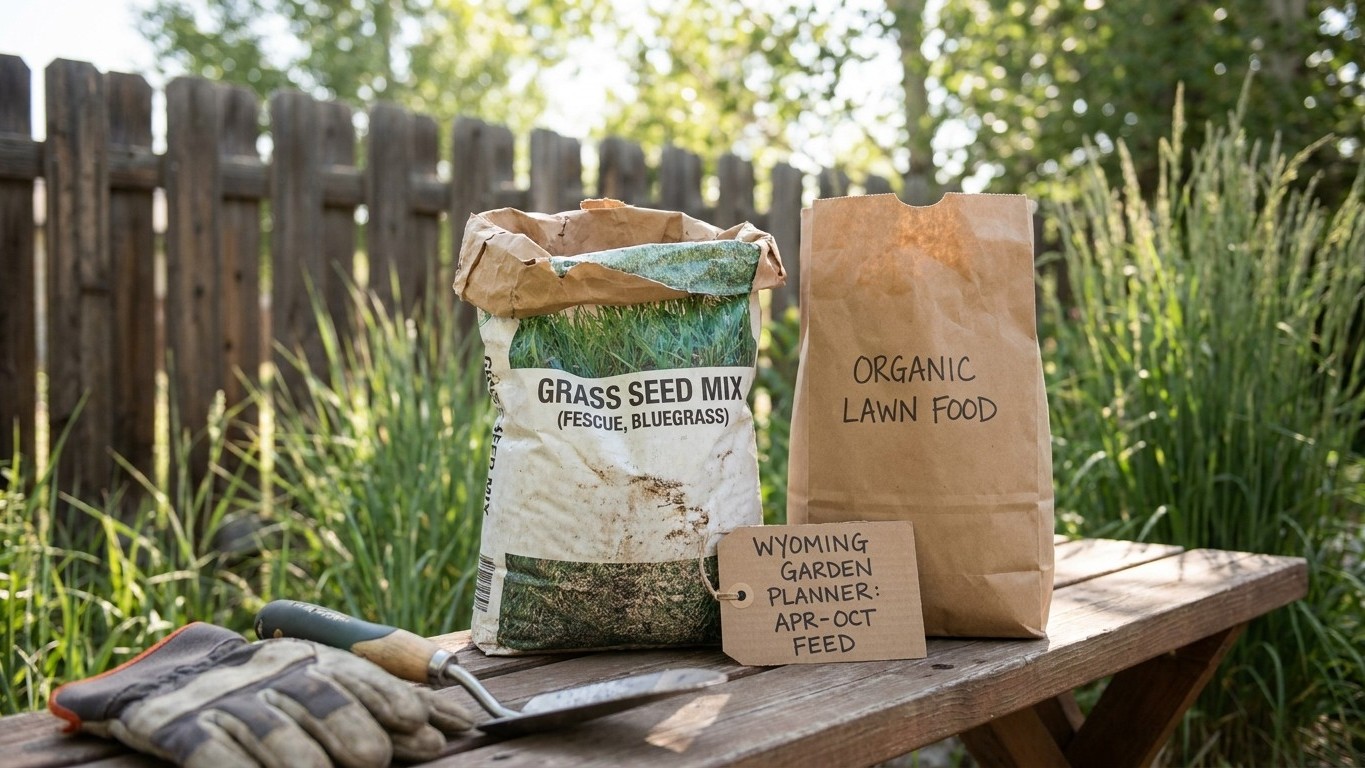

Right kind of grass, planted at the right moment — that’s the whole game with a Wyoming lawn Best grass choice, and most trouble in this state traces back to getting one of those two things backward. Kentucky bluegrass, tall fescue, or a fine fescue blend are what actually hold up here; anything warm-season is wrong no matter what the bag promises. Before you buy seed or sod, check that the label lists one of those cool-season names — that single line tells you whether the rest of your work this year has a chance.
Which grass belongs in Wyoming

The choice starts with two numbers, not a bag label. NOAA’s 1991-2020 climate normals for Cheyenne record only 10.4 days a year that reach 90°F or higher, and a coldest-month mean minimum of 17.3°F. That combination rules out warm-season turf outright: a grass built for a Deep South summer never gets the sustained heat it needs to grow well here, and the winter minimum a Gulf Coast species tolerates is nowhere close to what a Wyoming January delivers. The same two figures point just as firmly toward the cool-season side of the turf list.
What actually grows
Clemson Cooperative Extension’s guide to selecting a lawn grass (HGIC 1214), read alongside Penn State Extension’s work on the cool-season species, names five options for this climate: Kentucky bluegrass, tall fescue, perennial ryegrass, the fine fescues, and rough bluegrass. Each earns its place on the list by a different trait.
- Kentucky bluegrass spreads by rhizome and heals its own bare spots, but asks for more water than the others here.
- Tall fescue tolerates drought and foot traffic better than bluegrass, though its clumping habit means it does not self-repair as fast.
- Fine fescues (hard, chewings, creeping red) take shade and low fertility better than any grass on this list, and struggle in full sun and heavy traffic.
- Perennial ryegrass germinates fast, which makes it useful in a nurse-grass blend, but it is the least cold-hardy of the five.
- Rough bluegrass handles wet, shaded ground the others resent, and gives out quickly once conditions turn dry and sunny.
Most seed sold as a general-purpose mix in this state is some combination of these five, usually weighted toward bluegrass and fescue. Elevation changes the calculation more than county lines do: a lawn at 7,000 feet works with a shorter, cooler growing season than the Cheyenne figures describe, and a fine fescue or tall fescue mix chosen for drought toleran, timed according to a Wyoming lawn Calendarce often outperforms straight bluegrass once you climb out of the valley floor.
When to seed or sod here
Cool-season grass goes into the ground in late summer to early fall, not spring. Clemson Cooperative Extension’s HGIC 1203 lawn establishment guidance sets warm-season planting around May and cool-season planting in mid to late September, because each species is timed to root ahead of its dormant season rather than during its active one. Wyoming grows the cool-season half of that list, so the September window is the one that applies here.
Reading the frost window
Anchor that window on frost, not a generic calendar page. NOAA’s NCEI 1991-2020 normals put the first fall freeze at the Cheyenne-area reference station (USW00024018) in the range of September 24 to October 5, with a 30 to 70 percent chance of a 32°F freeze landing somewhere inside that stretch. Seed or sod put down a few weeks ahead of that range still has enough soil warmth left to root before the ground shuts down for winter. Wait past it and germination slows to a crawl, or stops outright.
That frost range is measured near Cheyenne, and higher ground or the far north and south of the state sees frost earlier. NOAA’s data note that at 6,000 feet the frost-free season runs to roughly 130 days, with frost possible in any month at the highest elevations. A gardener working land well above the reference station’s elevation should treat the September window as a late deadline, not a target, and move seeding earlier rather than later.
Spring seeding is possible but riskier here. Young cool-season grass planted in spring has to establish through the state’s summer heat and dry, wind-heavy air before it ever settles in, while a fall-seeded lawn arrives at that same summer with a full season of root growth already behind it. Sod skips the germination step but not the frost math: it still needs enough warm soil after laying to root down before winter, so the same window applies.
The feeding calendar that fits this climate
Nitrogen goes down when the grass is actually building root and shoot growth, not on a date pulled off a bag. For a cool-season lawn, that means the season’s heaviest feeding lands in early fall, the same growth surge that makes September the right month to seed. Clemson Cooperative Extension’s Tall Fescue Maintenance Calendar (HGIC 1219) lays out that pattern month by month, and though it is written for a different climate, the seasonal logic holds for the cool-season species growing in Wyoming: feed on the grass’s own calendar, not on a date borrowed from a different crop.
Rates and timing
Extension guidance works in pounds of actual nitrogen per 1,000 square feet rather than bags of product, because bag concentrations vary widely. A typical cool-season program puts down nitrogen as the main feeding in early fall, with a lighter application possible in late spring if growth calls for it. Skipping a summer feeding is deliberate: pushing nitrogen into a cool-season lawn during its heat-stressed months feeds top growth at the root system’s expense, right when that root system needs to be storing energy for winter instead.
Reading a fertilizer bag matters more here than the brand behind it. The first of the three numbers printed on the bag is the nitrogen percentage, and dividing a target pounds-of-actual-nitrogen figure by that percentage gives the pounds of product to apply per 1,000 square feet. The full species-by-species calendar is worth reading before buying anything: see Clemson’s Tall Fescue Maintenance Calendar for the month-by-month breakdown a Wyoming tall fescue lawn can follow directly.
A soil test taken before the first fall feeding answers a question no bag can: whether the lawn needs nitrogen at all, or whether phosphorus, potassium, or soil pH is the actual limiting factor. That test is worth running through the state’s own extension service rather than guessing from a national average.
Mowing height and watering here
Mowing
Cool-season lawns in Wyoming want to be kept longer than most people expect. Tall fescue and Kentucky bluegrass generally hold up best mowed in the 2.5 to 3.5 inch range, and fine fescues can run a little shorter. The one-third rule matters more than any specific height: never remove more than a third of the blade in a single cutting, or the plant spends the next week regrowing leaf instead of building root, right when a high-elevation lawn can least afford it.
Watering
An inch of water a week, from rain and irrigation combined, is the standard figure extension services use for cool-season turf. Wyoming’s low humidity and near-constant wind push that figure’s real effect down rather than up: moisture leaves the soil surface and the grass blade faster here than it does in a humid state, so the same inch of water does less work on the ground. Sandy or fast-draining soil, common on the high plains, loses that moisture even quicker and may need it split into two applications instead of one.
Water early in the day rather than in the evening. Wyoming’s summer air dries out fast once the sun is up, so morning watering gives the lawn time to take up moisture before evaporation claims it, and it leaves less standing moisture on the blade overnight, which matters more in a wet year than a dry one.
What goes wrong on lawns in Wyoming

Heat, drought, and dormancy mistaken for death
A hot, dry stretch sends cool-season grass into dormancy, not the grave. The blades brown and growth stops, but the crown stays alive below the soil line and greens back up once temperatures drop and moisture returns. Digging up a patch to check for a firm, pale crown before reseeding an area that looks dead saves a lot of wasted seed.
Wind compounds the drying effect. Wyoming’s persistent wind pulls moisture out of the top inch of soil faster than a calmer state’s climate does, so a lawn here can show drought stress on a week with less heat than a lawn further east would need to show the same symptoms.
Disease and winter weeds
Brown patch and other fungal diseases that thrive in humid, still air are a smaller risk here than in a wetter state, simply because Wyoming’s air rarely holds the humidity those fungi need for long. When brown patch does show up, it tends to follow an unusually wet, warm stretch rather than being a routine summer problem the way it is in more humid climates.
A mild winter is the bigger local risk. A winter that never delivers a hard, sustained freeze lets cool-season weeds like annual bluegrass keep growing through months a lawn would otherwise use to rest. That is a different failure mode from what a warmer, wetter state deals with, where the same mild winter mostly means weeds never stop rather than a lawn never resting. Illinois Lawn Care: What to Plant and When to Feed It covers that transition-zone version of the problem, where summer heat and humidity bring on the fungal diseases that Wyoming’s dry air mostly avoids.
At the opposite extreme, a lawn worked in a territory with almost no frost-free season at all faces a different set of limits again. Nunavut Lawn Care: What to Plant and When to Feed It covers how far a growing season can shrink before turf grass stops being a realistic option at all.
Local help
A county-specific soil test is the fastest way to turn any of the figures above into an actual fertilizer plan, and the University of Wyoming Extension runs that testing along with county-level advice on grass selection and lawn problems particular to a given elevation. Call before buying a season’s worth of fertilizer: a soil test result changes the numbers in the feeding calendar above more than guesswork ever will.
Common questions
Can I plant a warm-season grass like Bermuda in Wyoming?
Not reliably. NOAA’s 1991-2020 climate normals for Cheyenne show a coldest-month minimum of 17.3°F, well below what Bermuda and other warm-season species need to survive winter, and only 10.4 days a year reach the heat those grasses want to grow well. Stick with the cool-season species named above.
My lawn turned brown in August, is it dead?
Probably not. Cool-season grass goes dormant under heat and drought stress rather than dying outright, and it typically greens back up once cooler, wetter weather returns. Dig up a small patch and check the crown at the soil line: a firm, pale crown means the plant is alive and waiting.
Should I overseed in spring or fall?
Fall, for the same reason full establishment is timed there. Cool-season grass roots in ahead of winter instead of fighting through summer heat right after germinating. Aim for a few weeks ahead of the area’s typical first frost rather than waiting for a specific date on a calendar.
How much nitrogen is too much for one feeding?
There is no single answer without a soil test, but extension guidance for cool-season lawns generally works in modest, split applications rather than one heavy dose. A soil test through the University of Wyoming Extension will tell you whether the lawn needs nitrogen at all before you buy a bag.
Does elevation actually change any of this?
Yes, more than county lines do. NOAA’s frost-date figures above are measured near Cheyenne, and ground at a meaningfully higher elevation runs a shorter, colder season than that reference station describes, which means an earlier fall seeding deadline and closer attention to winter injury on exposed sites.