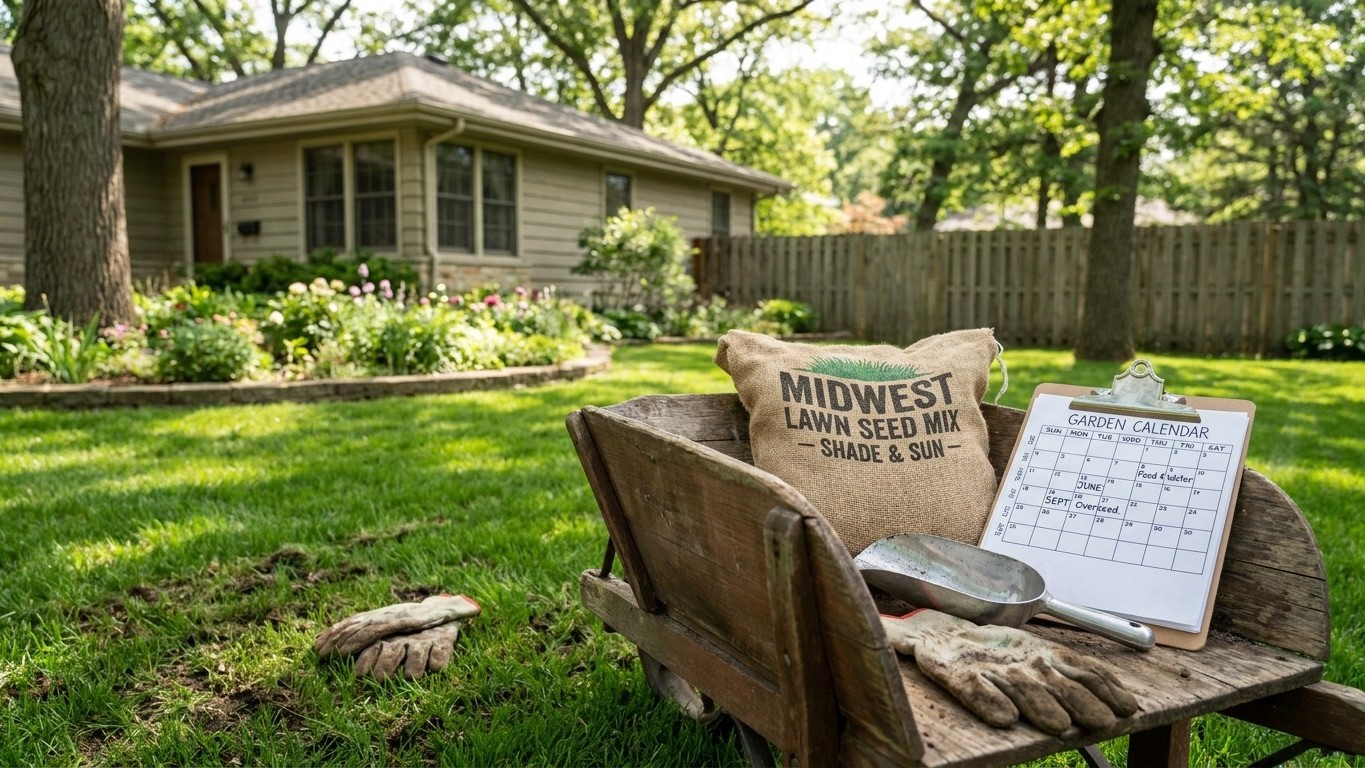

Cool-season grass is what belongs in an Illinois yard, and September is when you feed it hard. The state gets too few 90-degree days and too cold a winter for warm-season turf to survive, but that same short, cold pattern is exactly what Kentucky Bluegrass, Tall Fescue, Perennial Ryegrass and the fine fescues are built for. Before buying seed or fertilizer, walk the yard and find out which of those grasses is already there — that tells you the mowing height, shade tolerance, and feeding schedule to follow from here, and the Illinois lawn Calendar can help time each step through the season.
Which grass belongs in Illinois

The case for cool-season turf rests on those same two numbers. NOAA’s NCEI 1991-2020 climate normals, measured at the Chicago reference station, put the average at just 14.0 days a year reaching 90°F or higher, not enough sustained heat to keep a warm-season lawn growing through what would be its own season. The same normals put the coldest month’s average minimum at 16.5°F, cold enough to kill warm-season turf outright over an unprotected winter. On that basis, cool-season grass is the only sound choice for most of the state.
Clemson Cooperative Extension’s HGIC 1214 and Penn State Extension both list the species suited to this climate: Kentucky Bluegrass, Tall Fescue, Perennial Ryegrass, Fine Fescues and Rough Bluegrass. Each fits a different yard, and a closer look at Illinois lawn Best grass options can help narrow the choice.
| Species | Mowing height | Shade tolerance | Best fit |
|---|---|---|---|
| Kentucky Bluegrass | 2.5 to 3.5 in | Low to moderate | Full-sun lawns, self-repairing sod |
| Tall Fescue | 3 to 4 in | Moderate | Drought tolerance, high foot traffic |
| Perennial Ryegrass | 2 to 3 in | Low | Fast germination, overseeding bare spots |
| Fine Fescues | 2.5 to 4 in | High | Dry shade, low-input areas |
| Rough Bluegrass | 1.5 to 2.5 in | High in wet shade | Damp, shaded low spots |
A state the size of Illinois is not one climate. Chicago’s normals describe the northern third fairly well, but southern Illinois runs warmer and can edge toward the transition zone, where a cool-season lawn holds up less confidently through August heat. Gardeners near the Ohio River should watch their own summer stretch of 90-plus days rather than assume the Chicago figure applies unchanged. Neighboring Indiana sits in a similar cool-season band for much the same reasons; see Indiana Lawn Care: What to Plant and When to Feed It for how its numbers compare county by county.
When to seed or sod here
Illinois lawns are cool-season, so the planting calendar runs opposite to a warm-season lawn’s. Clemson Cooperative Extension’s HGIC 1203 puts the warm-season seeding window around May and the cool-season window in mid to late September, and every species named above falls into the second category.
Anchor that window on this territory’s own frost dates rather than the generic month. NOAA’s 1991-2020 climate normals put the Chicago area’s first fall freeze, at the 30 to 70 percent probability band for 32°F, between October 24 and November 3. Counting six to eight weeks back from that range lands seeding in early September into early October, which overlaps the mid-to-late-September date Clemson names for the species and gives new grass enough cool, moist weeks to root before frost stops growth.
That frost window comes from an airport station. Suburban and rural yards typically see their first fall frost arrive earlier than the airport figure, sometimes by one to two weeks, more at elevation or in low-lying cold pockets. A gardener outside the immediate Chicago area should check their own county’s frost history rather than seed to the airport date, and shift the window a week earlier if their yard has a history of early frost.
Spring seeding is possible but works against the grass. Weeds germinate fast in spring warmth and outcompete new seedlings, and summer heat arrives before roots have had a full season to establish. Fall seeding avoids both problems, which is why extension calendars for cool-season species consistently favor it.
The feeding calendar that fits this climate
Nitrogen timing follows the grass’s growing season, not the wall calendar. A cool-season lawn does most of its root and shoot growth in spring and fall, so the heaviest feeding goes down in September, when top growth has slowed but roots are still active, not at the first hint of green in April.
What the calendar actually recommends
Clemson Cooperative Extension’s HGIC 1219 tall fescue maintenance calendar sets out specifics for that species: split fall nitrogen into two applications rather than one heavy dose, roughly one pound of actual nitrogen per 1000 square feet in September and another in October. Kentucky Bluegrass and the fine fescues run on a similar fall-weighted schedule, though the exact split differs enough between species that it’s worth checking a calendar written for the grass actually in the yard.
Never treat spring feeding as the main event on a cool-season lawn. A heavy spring nitrogen dose pushes soft top growth right as disease pressure rises with summer humidity, and it does nothing for the root system that fall feeding builds. Read the full schedule on Clemson’s tall fescue maintenance calendar before buying fertilizer bags by the pallet.
Mowing height and watering here
Mowing
Cool-season lawns in Illinois hold up better mowed on the tall side of their range: Tall Fescue at 3 to 4 inches, Kentucky Bluegrass at 2.5 to 3.5 inches, Fine Fescues from 2.5 to 4 inches. Follow the one-third rule regardless of species: never remove more than a third of the blade length in a single pass. A lawn kept at 3 inches gets cut again once it reaches about 4.5 inches, not left to shoot up to 6 between mows.
Watering
An inch of water a week, counting rainfall and irrigation together, is the standard baseline for cool-season turf. That baseline moves in this climate. On the 14.0 days a year the Chicago area averages at or above 90°F, per NOAA’s 1991-2020 normals, evaporative demand climbs and an inch a week stops being enough for a lawn under active stress. Soil texture matters too: a lawn on sandy soil in the central or southern parts of the state drains fast and needs more frequent, lighter watering, while the heavier prairie clay common farther north holds moisture longer and can go with less frequent, deeper soaking.
What goes wrong on lawns in Illinois

Brown patch in humid summers
Tall fescue and the other cool-season species are vulnerable to brown patch fungus when nights stay warm and humid, most often through the peak of summer. The grass thins and yellows in roughly circular patches rather than dying outright, and a lawn with brown patch typically recovers on its own once conditions turn cooler and drier, without reseeding.
Dormancy mistaken for death
During the days each summer that reach or pass 90°F, cool-season turf goes dormant and turns brown as a survival response, not because it has died. NOAA’s 1991-2020 Chicago normals put that at 14.0 days a year on average, and a dormant lawn will usually green back up once rain returns. Digging up and reseeding a dormant lawn in the middle of August wastes both money and seed in most cases.
Weeds that never stop in a mild winter
A winter that stays mild longer than usual lets cool-season weeds like chickweed and henbit keep growing instead of going dormant, giving them a head start on the lawn come spring. Farther north, in a colder cool-season climate like Ontario’s, that head start is shorter and the weed pressure looks different by comparison; see Ontario Lawn Care: What to Plant and When to Feed It for how a harder winter changes that calendar.
Local help
For a soil test or advice specific to your own county, contact the University of Illinois Extension. Soil pH and phosphorus levels vary block to block in older neighborhoods, and a soil test costs far less than a season spent guessing at fertilizer rates. Extension staff can also confirm which cool-season species suits a particular yard’s soil and shade, and flag disease pressure specific to that part of the state, through University of Illinois Extension.
Common questions
Can I grow Bermuda grass or zoysia in Illinois?
Not reliably across most of the state. NOAA’s 1991-2020 normals put Chicago’s coldest-month minimum at 16.5°F, cold enough to kill warm-season turf in an unprotected winter most years. A gardener in the far southern tip might find a warmer microclimate, but it’s a gamble rather than a plan, and the species named for this climate will perform far more consistently.
Is it too late to seed if I missed the September window?
It gets riskier the closer you get to the first fall freeze. Chicago’s first fall freeze falls between October 24 and November 3 per NOAA’s normals, and seed sown right up against that date has little time to root before growth stops for winter. A late seeding into thin turf can still take, but a bare or heavily damaged lawn is better held over to the next fall window or overseeded lightly in spring instead.
Why does my lawn look dead in August but green up again in September?
That’s dormancy, not death. Cool-season grass shuts down top growth in extended heat and drought as a survival strategy, and the crowns stay alive underground waiting for cooler, wetter weather. An occasional deep watering during a dormant spell helps keep the crowns alive without trying to force the grass green again.
Do I need to dethatch every year?
Most Illinois lawns don’t need it annually. Tall fescue in particular rarely builds heavy thatch, while Kentucky bluegrass is more prone to it over several years. Check by pulling back the grass and looking at the layer between soil and green blades. Anything under about half an inch isn’t worth the disruption of dethatching.
Does lawn care differ much between Chicago and southern Illinois?
Yes, and the difference is mostly timing, not species. Southern Illinois runs warmer, with a longer stretch of summer heat days than the Chicago figures used here, which can push the fall seeding and feeding windows a little later and shift the calendar closer to a transition-zone lawn’s. A local University of Illinois Extension office can confirm how much that shift matters for a specific county.