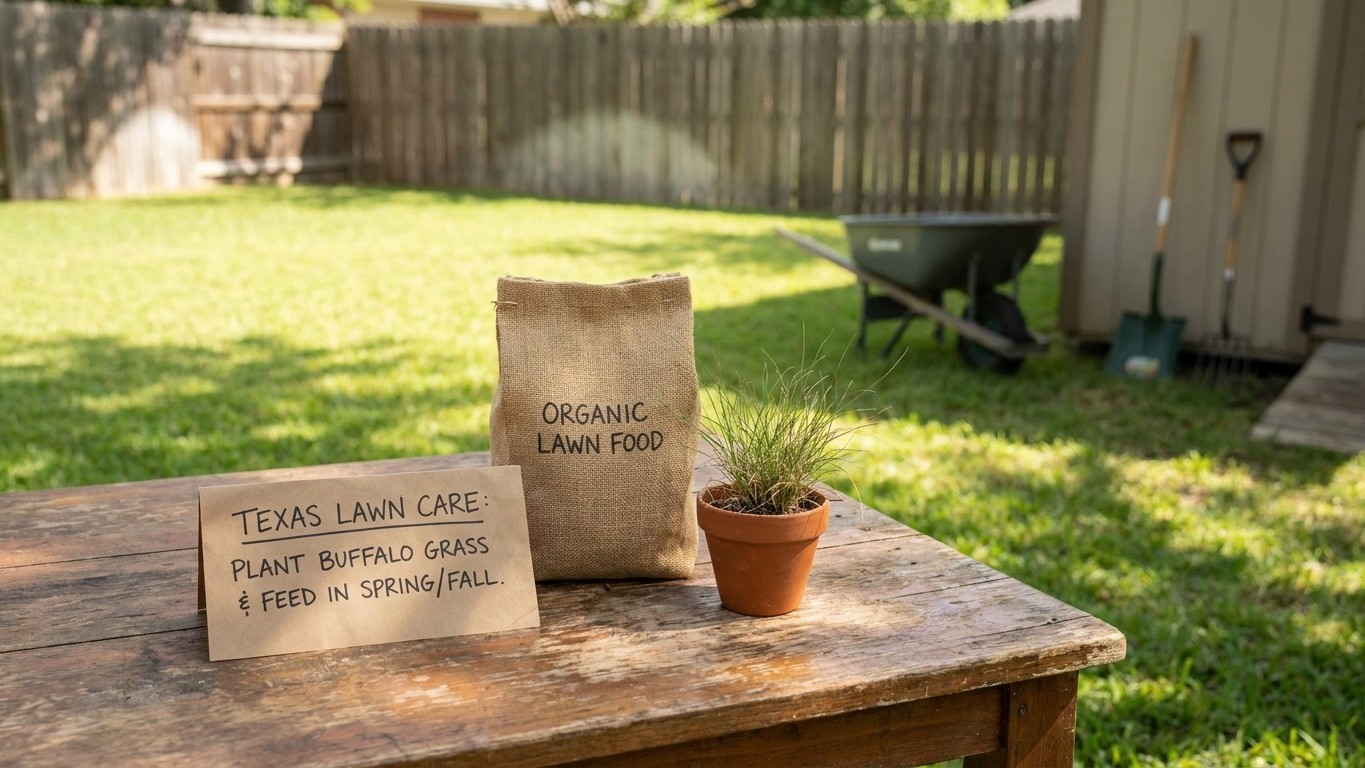

102.4 days a year hot enough to hit 90°F, paired with a coldest month that only sinks to 43.2°F on average — that’s the climate math Houston lawns live with, and it’s brutal on the wrong grass. Tall fescue and Kentucky bluegrass want real winter cold and cool summer nights to recover; this stretch of Texas offers neither. So before you touch fertilizer or seed, the weather itself has already narrowed your options to warm-season grasses built for exactly this kind of heat and mild winter.
Which grass belongs in Texas

What the numbers rule out
The two Houston numbers from NOAA’s 1991-2020 climate normals settle the question before you ever walk into a garden center. A summer that reaches 90°F or hotter on 102.4 days a year, combined with a coldest month that only drops to a 43.2°F average minimum, is too hot in summer and too mild in winter for cool-season grass like tall fescue or Kentucky bluegrass to hold on. Those species need real winter cold to rest and cool nights to recover from summer stress, and Houston gives them neither. A warm-season lawn is the only realistic choice for most of Texas, and Clemson Cooperative Extension’s HGIC 1214 fact sheet lists the species that fit: Bahiagrass, Bermudagrass, Carpetgrass, Centipedegrass, Seashore Paspalum, St. Augustinegrass, and Zoysiagrass.
Matching species to your yard
None of those seven is automatically the right one for your yard. Bermudagrass wants full sun and tolerates heavy foot traffic, but it thins out fast under shade. St. Augustinegrass handles shade far better and is the default in a lot of older Houston neighborhoods, but it is thirstier and more prone to fungal trouble in humid weather. Centipedegrass asks for very little nitrogen and holds up on the acidic, sandy soils common in East Texas, but it will not take the traffic Bermudagrass shrugs off. Zoysiagrass sits in between: slower to establish, denser once it fills in, and reasonably shade-tolerant. The right pick depends on how much sun, wear, and irrigation the lawn actually gets, not on which grass a neighbor happens to have — the Texas lawn Best grass guide breaks down these tradeoffs species by species. Once you’ve settled on a species, the Texas lawn Calendar lays out when to feed, mow, and treat it through the year.
Why Texas isn’t one climate
Every one of those figures comes from the Houston station in NOAA’s data set, and Texas is too large a state for one city’s numbers to stand in for all of it. The Panhandle sits far enough north and high enough in elevation that its winters run considerably colder than Houston’s, and a lawn there faces a different calculus than one near the Gulf. In a genuinely cold state, the choice flips entirely. Read how Alaska Lawn Care: What to Plant and When to Feed It handles a climate where cool-season grass is the only grass that survives at all, and it’s clear why the same seven warm-season species thriving in Houston would die there in a single winter.
When to seed or sod here
The general rule
Clemson Cooperative Extension’s HGIC 1203 fact sheet gives the general rule that applies here: warm-season grass goes into the ground around May, and cool-season grass goes in during mid to late September. Since Houston’s climate rules out cool-season turf entirely, the September window in that rule doesn’t apply to a Texas lawn. The May window does, and it lines up with the point in spring when warm-season grass has broken dormancy and soil temperatures are reliably warm enough for new roots to take hold.
Houston’s long growing season
What extends that window past a single month is how late the growing season runs. NOAA’s 1991-2020 climate normals put Houston’s first fall freeze, measured at the 30 to 70 percent probability band, somewhere between December 1 and December 19 at the IAH station. That is a long stretch of frost-free growing time after May, which means sod or plugs put down well into summer still have months to root in before any cold sets back their growth. A late-summer planting is a real option here in a way it would not be farther north, though earlier is still safer, since it gives roots more time before the shorter days of fall slow growth down.
Method depends on species
That frost window is specific to the IAH weather station, and NOAA’s own data shows Houston’s Hobby airport runs about two weeks milder, so a lawn closer to the coast has even more room to work with while one well inland has less. It is worth checking your own area’s freeze record rather than assuming the IAH figure travels statewide. Method matters too: Bermudagrass and Centipedegrass are commonly seeded as well as sodded, Zoysiagrass is usually sodded or plugged because seeded varieties fill in slowly, and St. Augustinegrass is planted almost exclusively from sod, plugs, or sprigs since it doesn’t produce commercially viable seed.
The feeding calendar that fits this climate
Warm-season vs cool-season timing
Nitrogen goes down when the grass is actually growing, not on a fixed calendar date. A cool-season lawn, the kind common in a state like the one covered in Oregon Lawn Care: What to Plant and When to Feed It, gets fed heaviest in early fall because that is when cool-season grass does most of its rooting. A warm-season lawn works on the opposite schedule. It feeds during late spring and summer, when the grass is putting out new leaf and root growth, and it should not be pushed with nitrogen once growth slows heading into fall.
How much nitrogen, by species
How much nitrogen depends on the species, and the difference is large. Centipedegrass is a low-input grass and typically needs only about half a pound to one pound of actual nitrogen per 1,000 square feet per application, with a modest total for the year. Bermudagrass sits at the other end and, kept as a dense home lawn, commonly runs two to four applications a year at around one pound of actual nitrogen per 1,000 square feet each time. St. Augustinegrass and Zoysiagrass fall in between, usually landing on two to three feedings across the growing season at a similar per-application rate. Applying Bermudagrass-level nitrogen to a Centipedegrass lawn is one of the most common ways to kill it, since it forces thatch and disease pressure the grass was never bred to handle.
Where to find exact months
The exact months and split between applications are laid out species by species in Clemson Cooperative Extension’s maintenance calendars: HGIC 1216 for Bermudagrass, HGIC 1217 for Zoysiagrass, HGIC 1215 for Centipedegrass, and HGIC 1218 for St. Augustinegrass. Match the calendar to the grass actually growing in the yard, because feeding a Centipedegrass lawn on a Bermudagrass schedule is exactly the mismatch that causes trouble. Stop nitrogen well before the growing season ends. Since NOAA’s 1991-2020 normals put Houston’s first fall freeze between December 1 and December 19, that means backing off nitrogen once summer growth visibly slows, not waiting for a frost date that in this area arrives quite late.
Mowing height and watering here
Mowing height by species
Mowing height depends entirely on which of the seven warm-season species is in the ground, and the one-third rule holds across all of them: never cut off more than a third of the leaf blade in a single pass, or the grass responds by pulling resources from its roots to replace lost leaf area. Mow often enough that you are removing clippings, not scalping the lawn, especially during the fastest growth of early summer.
| Species | Mowing height | Mow again once it reaches |
|---|---|---|
| Bermudagrass | 1 to 2 inches | about 1.5 to 3 inches |
| Zoysiagrass | 1 to 2.5 inches | about 1.5 to 3.75 inches |
| St. Augustinegrass | 2.5 to 4 inches | about 3.75 to 6 inches |
| Centipedegrass | 1.5 to 2 inches | about 2.25 to 3 inches |
Watering that fits Houston’s heat
Watering starts from the same rule most US lawn advice gives: about an inch of water a week, delivered in one or two sessions rather than a daily sprinkle that only wets the surface. That figure moves in a Texas yard more than in most places. Houston’s summers reach 90°F or above on 102.4 days a year on NOAA’s 1991-2020 normals, and that much heat pulls moisture out of grass and soil faster than the general rule assumes. Heavy Gulf Coast clay holds water longer and can go a bit longer between waterings without stressing the grass, while the sandier soils common farther east, or on newer subdivisions built over fill dirt, drain fast and need water more often in smaller amounts to avoid runoff.
Humidity and timing
Humidity works against the reader too, though not in a way that shows up on a rain gauge. Warm-season grass growing in Houston’s humid air holds surface moisture on the leaf blade longer after watering or dew, and that damp leaf surface is exactly the condition fungal disease needs. That is part of why watering in the morning rather than the evening matters more here than the raw inch-a-week number does.
What goes wrong on lawns in Texas

Brown patch in humid summers
A humid Houston summer is brown patch weather. The fungus that causes it thrives in warm, wet conditions on St. Augustinegrass and Zoysiagrass especially, showing up as circular patches of collapsed, tan-brown grass blades that pull away from the runner with almost no resistance when tugged. Watering in the evening, when the leaf stays wet all night, is the single habit most likely to trigger it, which is why the morning watering habit mentioned above matters as prevention, not just efficiency.
Dormancy mistaken for death
A hot, dry stretch produces the opposite-looking problem with the opposite meaning. Warm-season grass that goes fully brown across the whole yard, rather than in scattered patches, during a rainless summer stretch is very likely dormant, not dead. It is a survival response, and NOAA’s 1991-2020 normals showing 102.4 days a year at or above 90°F at Houston explain why that response gets triggered so often here. The test is simple: tug on a few blades. Dormant turf holds firm at the crown, and dead turf pulls loose.
Weeds that never stop in a mild winter
A mild Houston winter is exactly why lawn weeds here never really take a season off. NOAA’s normals put the coldest month’s average minimum at 43.2°F, well above the hard freeze that would knock back winter annual weeds like henbit and annual bluegrass farther north, so those weeds keep germinating and growing through most of the winter instead of dying back. A pre-emergent herbicide timed to soil temperature, not a calendar date, is what actually catches them before they get established, and a county extension agent can tell you when soil temperature in your area typically crosses that mark.
Local help
A soil test is the fastest way to find out what a Texas lawn actually needs before spending money on fertilizer or lime, and county-level advice accounts for the swings between the Gulf Coast, the Hill Country, and the Panhandle that a single article never can. Texas A&M AgriLife Extension, reachable through agrilifeextension.tamu.edu, runs the county offices that handle soil testing and can point to grass and timing guidance specific to your part of the state.
Common questions
Can I grow a cool-season grass like fescue in Texas?
Not reliably in most of the state. Fescue and other cool-season grasses need winter cold to rest and struggle through the long, hot summers that NOAA’s 1991-2020 normals show at Houston, where 102.4 days a year reach 90°F or higher. Some higher-elevation pockets in the far north or west of Texas run cooler than Houston and occasionally support a struggling cool-season lawn, but it is fighting the climate rather than working with it.
Why did my whole lawn turn brown at once instead of in patches?
That pattern points to dormancy, not disease or death. Warm-season grass across the entire yard browning together, usually during a hot dry stretch or ahead of a cold snap, is a normal survival response. Patchy, circular browning in warm, humid weather is a different problem and usually means a fungal issue like brown patch instead.
How soon after laying sod can I mow it?
Wait until it has rooted enough that it doesn’t shift under your feet, generally once you can tug a corner and feel resistance rather than the piece lifting loose. That usually takes a couple of weeks of consistent watering in Texas heat, and mowing before then just tears up new roots before they’ve had a chance to hold.
Do I need to dethatch a Texas lawn every year?
Not every year, and not on every species. Bermudagrass and Zoysiagrass build up thatch faster and may need it every year or two, while Centipedegrass and St. Augustinegrass usually go longer between dethatching. Check by pushing a finger down through the grass to the soil. More than about half an inch of spongy brown material between the green blades and the soil surface is the usual sign it’s overdue.
Is it too late to plant grass if I missed the May window?
No, not in most of Texas. Because NOAA’s 1991-2020 normals put Houston’s first fall freeze as late as December 1 to December 19 at the IAH station, warm-season sod or plugs put down well into summer still have months to root before any cold weather arrives. Earlier is still better, but a missed May planting is not a lost year.