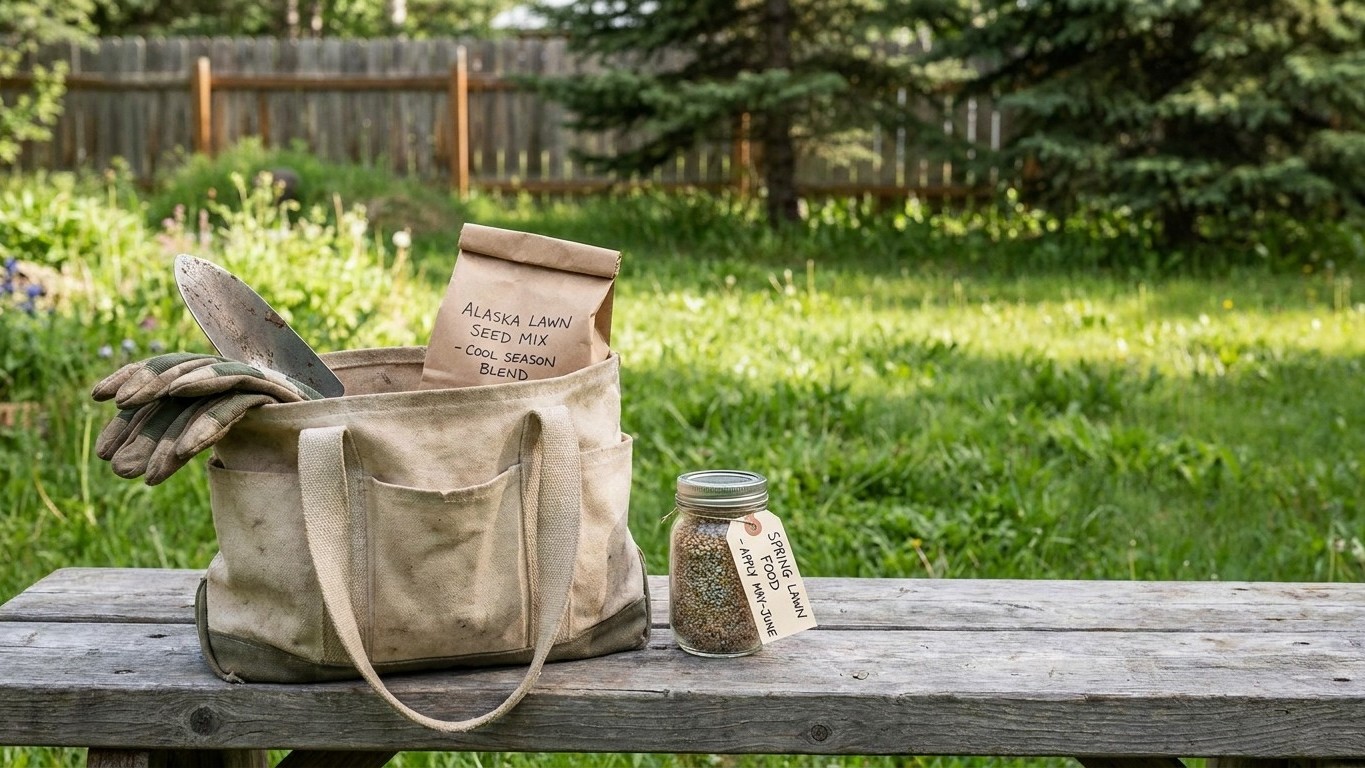

Alaska lawn care means cool-season grass, no exceptions. Anchorage averages zero days a year at or above 90°F and a coldest-month minimum of 11.1°F, according to NOAA’s NCEI 1991-2020 climate normals, numbers too cold for any warm-season turf grass to make it through a winter here. Buy seed labeled Kentucky bluegrass, fine fescue, tall fescue, perennial ryegrass, or rough bluegrass, and skip anything sold as Bermuda, zoysia, or St. Augustine.
Which grass belongs in Alaska

Your grass has to survive an Anchorage winter, and that means only one kind of seed belongs in your yard: cool-season turf like Kentucky bluegrass, fine fescue, tall fescue, perennial ryegrass, or rough bluegrass. Nothing sold as Bermuda, zoysia, or St. Augustine will make it through the cold months here, no matter how good the bag looks at the store. So before you buy anything, check The Best Grass Seed for Alaska Lawns and flip the bag over to confirm the label shows one of those five names — if it’s not there, put it back.
The five grasses that fit
Clemson Cooperative Extension’s HGIC 1214 guide to selecting a lawn grass, together with Penn State Extension’s work on cool-season species, names five grasses that fit this pattern: Kentucky bluegrass, fine fescues, tall fescue, perennial ryegrass, and rough bluegrass. None of them are native to Alaska and none were bred with the state in mind, but they share the trait that matters here: they green up in cool soil, keep growing through mild summers, and go dormant rather than die when the ground freezes.
Fine fescues (a group that includes creeping red, chewings, and hard fescue) tolerate the acidic, thin soils common under spruce and birch canopy better than the others, which matters if your lot has any shade at all. Kentucky bluegrass spreads by rhizome and self-repairs foot traffic and thin patches, but it wants more sun and more water than fescue does. Tall fescue’s coarse, deep-rooted growth handles drought stress once it’s established, useful in the drier Interior even though Anchorage itself is mild. Perennial ryegrass germinates fast and is often mixed into a blend to hold soil while slower grasses fill in. Rough bluegrass tolerates wet, shaded ground that would thin out the others.
None of this applies if you’re coming from real summer heat. A reader used to California Lawn Care: What to Plant and When to Feed It is starting from Bermuda grass and other warm-season turf that would die outright at Anchorage’s winter minimum, so the entire seed selection changes, not just the schedule — for a season-by-season breakdown of what to do and when, see the Alaska lawn Calendar.
There’s no transition-zone hedging to do here. Anchorage’s climate isn’t borderline between cool and warm turf, it sits firmly in cool-season territory, and the real choice among the five recommended grasses comes down to shade, traffic, and soil, not season.
When to seed or sod here
Clemson Cooperative Extension’s HGIC 1203 guide splits lawn-seeding dates by season type: warm-season grass goes in around May, cool-season grass in mid to late September, timed to the milder end of the Lower 48. Anchorage doesn’t fit that second window comfortably. NOAA’s 1991-2020 climate normals put the first fall freeze at Anchorage between September 22 and October 1, which leaves cool-season seedlings only a few weeks of cooling soil before growth stops for the year, not the full month the generic calendar assumes further south.
Why earlier beats later
A cool-season lawn needs enough warm soil after germination to build real root mass before the ground locks up. With the freeze window landing in the last third of September at Anchorage, seeding any later than late summer cuts that runway short. Sod is more forgiving than seed because the roots are already established, but it still needs time to knit into the soil before frost, so the same late-summer to early-fall push, not the tail end of it, is the safer target.
Spring seeding is the other real option, once the soil has thawed and warmed enough to germinate, though the NOAA normals cited here cover the fall freeze only, not a specific spring thaw date for Anchorage, so treat any spring window as a judgment call based on your own ground rather than a fixed day.
Other parts of the state run on a different clock entirely. The Interior sees a shorter frost-free season than the coast, and the Anchorage figures above describe the mildest inhabited part of Alaska, not the state as a whole. A reader comparing notes with someone working through Washington Lawn Care: What to Plant and When to Feed It will find a longer, gentler fall window there than anything Anchorage or the Interior offers, which is why a seeding date that works in Seattle can fail here even though both places grow the same cool-season species.
The feeding calendar that fits this climate
Nitrogen timing follows the grass, not the calendar on the wall. A cool-season lawn like the ones recommended for Alaska does its real root-building in fall, after top growth slows, so the heaviest feeding of the year belongs in September, not spring. Feeding hard in spring pushes leaf growth at the expense of the root system a short growing season can’t afford to skip.
Clemson Cooperative Extension’s HGIC 1219 Tall Fescue Maintenance Calendar lays out a full month-by-month nitrogen schedule in pounds of actual nitrogen per 1,000 square feet, and it’s worth reading in full if tall fescue is what’s growing in your yard, since the rate changes by month and by how the lawn looked the previous summer. If Kentucky bluegrass, fine fescue, or one of the other species is what you seeded instead, the same fall-first principle holds, but the exact pounds-per-1,000 figure differs by species, so check the rate for your specific grass rather than borrowing the tall fescue number.
What this means for a September-heavy schedule
In practice, that means holding off on a big feeding in May or June even though the ground has just thawed and the grass looks hungry. A light application to green things up after winter is reasonable, but the bulk of the year’s nitrogen budget should land in early to mid fall, while the plant still has weeks of mild soil temperature ahead of it to convert that nitrogen into root growth rather than leaf that gets mowed off or killed back by the first freeze.
This is the opposite of what a warm-season lawn needs, where the heavy feeding happens in late spring as the grass comes out of dormancy. Since Alaska grows nothing but cool-season species, that warm-season schedule never applies here, and a bag of fertilizer labeled for a Bermuda or zoysia lawn is the wrong product regardless of when you’d apply it.
Mowing height and watering here
Cool-season grasses in this climate do better mowed on the taller side, since more leaf blade means more surface for photosynthesis during a short growing season and better shade over the soil to hold moisture. Kentucky bluegrass generally runs from about 2.5 to 3.5 inches, fine fescues from 2.5 to 4 inches, tall fescue from 3 to 4 inches, perennial ryegrass from 2 to 3 inches, and rough bluegrass from 2 to 3 inches, all cut toward the higher end of those ranges wherever the lawn sits in any shade. Never take off more than a third of the blade in a single mow, the standard rule for any cool-season turf, since cutting deeper than that stresses the plant and slows the very root growth the fall feeding schedule is trying to build.
| Grass | Mowing height | Where it does best |
|---|---|---|
| Kentucky Bluegrass | 2.5 to 3.5 in | Full sun, self-repairs traffic |
| Fine Fescues | 2.5 to 4 in | Shade, thin or acidic soil |
| Tall Fescue | 3 to 4 in | Sun to light shade, drought-tolerant once rooted |
| Perennial Ryegrass | 2 to 3 in | Fast germination, often blended with bluegrass |
| Rough Bluegrass | 2 to 3 in | Wet, shaded ground |
How much water this climate actually needs
An inch of water a week, whether from rain or a sprinkler, is the usual figure quoted for cool-season lawns, but it assumes ordinary conditions. Anchorage’s short, cool summers mean lower evaporation than a hot inland climate, so a lawn here often needs less than that figure to stay green, and the long daylight of an Alaska summer lets whatever water does fall go further per hour of sun. Watch the grass rather than the calendar: a cool-season lawn that starts to gray out or fold its blades lengthwise is asking for water regardless of what the weekly total says it should need.
What goes wrong on lawns in Alaska

Snow mold, not summer disease

The failures that show up in a hot, humid climate, brown patch and other heat-driven fungal disease, aren’t the risk here. Anchorage’s problem is the opposite: long snow cover sitting on unfrozen or barely frozen turf breeds snow mold, a fungal disease that leaves matted, discolored patches when the snow finally melts back in spring. A lawn that looks dead under melting snow is usually just moldy, not dead, and most patches green back up once the grass dries out and gets its first mow of the season.
Winterkill from ice, not cold

Cool-season grass tolerates genuine cold well, that’s the whole reason it’s the only option this far north, but it doesn’t tolerate sitting under a sheet of ice for weeks with no oxygen exchange. A thaw-and-refreeze cycle that traps standing water under ice does far more damage than a straight, steady winter would, and there’s little to do about it mid-winter beyond breaking up ice where it’s practical to reach.
Slow, patchy spring green-up

Because the growing season is short even at its mildest, a lawn that took any winter damage doesn’t have much time to fill back in before the next fall freeze arrives. Overseeding thin patches as soon as the soil is workable in spring, rather than waiting to see if they fill in on their own, buys back some of that lost time.
Weeds behave differently here too. A hard, reliable freeze each winter, unlike the mild winters some warmer states get, knocks back a good share of annual weed growth every year rather than letting it run through the cold season, so a lawn that’s thin from mold or ice damage is competing against less weed pressure than the same bare patch would face somewhere with year-round green.
Local help
A soil test is the fastest way to find out why a lawn is thin or slow to green up, and the University of Alaska Fairbanks Cooperative Extension Service runs that testing along with county-level advice for the state. Check with UAF Extension before guessing at a fertilizer blend or a lime application, since soil across Alaska varies enough between the coast and the Interior that a recommendation calibrated to one part of the state can be wrong for another. Find your local office through the UAF Cooperative Extension Service.
Common questions
Will Bermuda grass survive here if I just plant it later in summer?
No. Bermuda and other warm-season grasses need real summer heat to grow at all, and Anchorage averages zero days a year at or above 90°F according to NOAA’s NCEI 1991-2020 normals. Changing the planting date doesn’t fix a grass that has no season warm enough to use.
My lawn looks brown right after the snow melts, is it dead?
Probably not. That look is typically snow mold or plain winter dormancy, and most cool-season lawns green back up once the ground dries and gets its first mow. Give it a few weeks before assuming the worst and reseeding.
Does the long summer daylight mean I can water less than an inch a week?
Possibly, but it’s the cooler temperatures doing most of that work, not the daylight length by itself. Long daylight extends the hours a lawn can photosynthesize, but water need tracks evaporation and soil moisture, so check the grass itself rather than assuming daylight alone cuts the water bill.
I already fed my lawn heavily in spring, can I skip the fall feeding?
Skipping it undoes most of the benefit. Spring feeding pushes leaf growth on a plant that’s about to spend a short summer growing anyway, while fall feeding builds the root system that gets it through winter, so the two aren’t interchangeable even at the same total nitrogen amount.
Do I need to aerate or dethatch a lawn this far north?
Compacted soil and heavy thatch slow a lawn down here just like anywhere else, but timing matters more given the short season. Doing either job while the grass is actively growing, rather than right before the first fall freeze, gives it time to recover before winter instead of going into the cold already stressed.