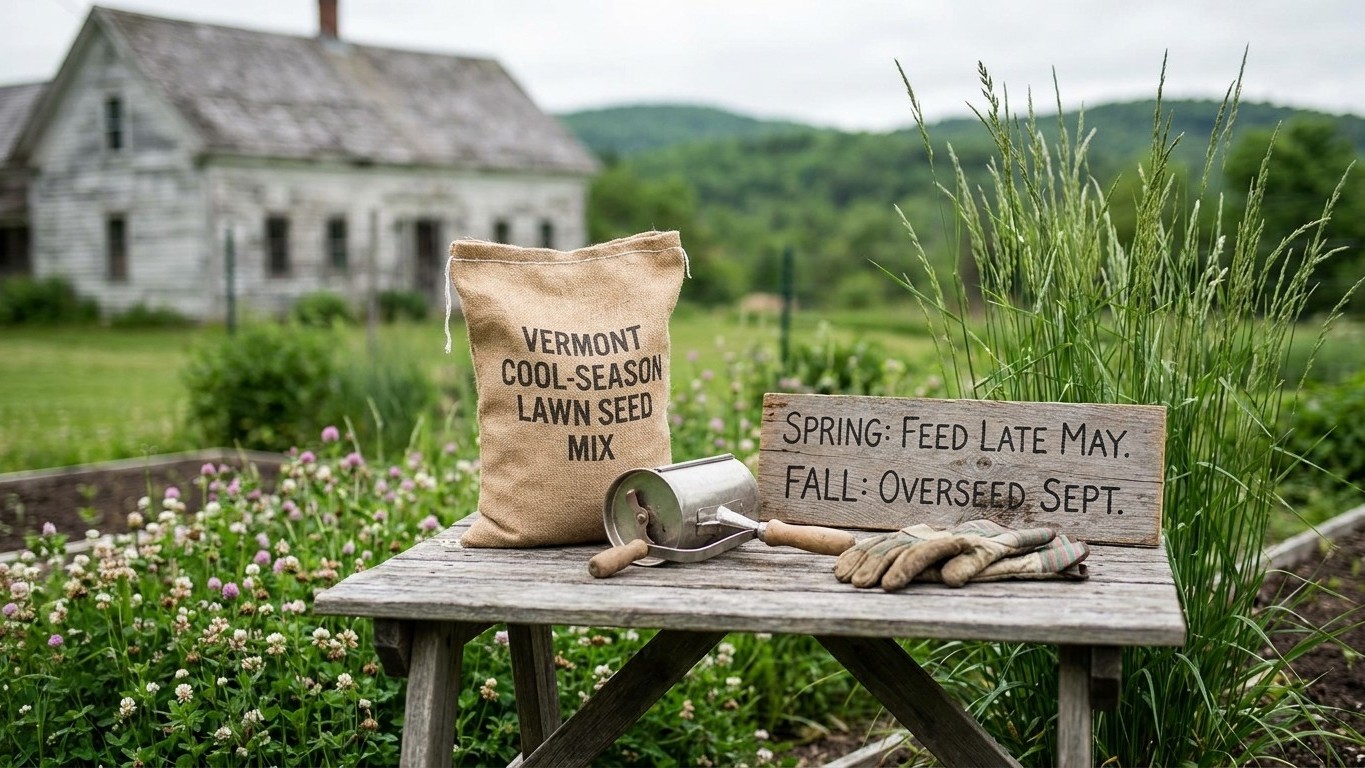

What grass belongs in your Vermont yard? Something built for cold, not heat — Kentucky bluegrass, tall fescue, or fine fescue, because your winters get down near 10°F and you only get about five days a year hot enough to trouble a warm-season grass like bermuda. That’s the whole decision, really: pick from that cool-season group, and don’t settle for just one of them. For a closer look at how to choose between them, see The Best Grass Seed for Vermont Lawns. The one thing to do standing there right now is choose a blend of at least two, since the sunny stretch and the shady stretch under your trees are going to need different grasses to make it through the year.
Which grass belongs in Vermont

Burlington’s climate normals settle this fast. NOAA’s 1991-2020 data puts the reference station at 5.4 days a year reaching 90°F or higher, and a coldest-month mean minimum of 10.2°F. That combination rules out warm-season turf outright. Species like bermudagrass or zoysia need sustained summer heat to grow, and go dormant, brown but not dead, at temperatures well above anything Vermont’s winters produce. There’s no transition-zone hedging needed here: this is cool-season country, the same category as much of the Pacific Northwest.
Clemson Cooperative Extension’s HGIC 1214 and Penn State Extension name the cool-season species that fit New England conditions: Kentucky bluegrass, tall fescue, perennial ryegrass, fine fescues, and rough bluegrass. Each earns its place for a different reason, and none of them is the single right answer for every yard in the state.
| Grass | Where it earns its keep | Trade-off |
|---|---|---|
| Kentucky bluegrass | Full sun, high-traffic lawns, self-repairs by rhizome | Slower to establish from seed, thirstier in dry spells |
| Tall fescue | Deep-rooted, tolerates drought and light shade | Clumping habit needs overseeding to stay dense |
| Perennial ryegrass | Germinates fast, good for patching and overseeding | Less cold-hardy on its own than bluegrass or fescue |
| Fine fescue | Shade and low-input areas, needs little nitrogen | Wears out faster under foot traffic |
| Rough bluegrass | Wet, shaded, low spots where other species rot | Struggles in full sun or dry soil |
Most Vermont lawns do best as a blend, not a monoculture: Kentucky bluegrass and perennial ryegrass for the sunny front yard, tall fescue or fine fescue where a maple canopy cuts the light. Timing those seeding and feeding choices around the state’s actual frost dates matters just as much as picking the species, which is where the Vermont lawn Calendar comes in. Vermont’s cool-season lineup reads almost the same as the wetter, cooler side of the West Coast, a similarity covered in Oregon Lawn Care: What to Plant and When to Feed It, though the two states diverge sharply once winter cold becomes the limiting factor instead of summer drought.
When to seed or sod here
Clemson Cooperative Extension’s HGIC 1203 splits the seeding calendar cleanly by grass type: warm-season species go in around May, cool-season species in mid to late September. Vermont lawns run cool-season, so September is the window, not spring, even though spring seeding is technically possible and commonly attempted.
The reason fall wins is germination timing against the first freeze. NOAA’s 1991-2020 climate normals put Burlington’s first fall frost, the date with a 30 to 70 percent chance of a 32°F reading, between October 3 and October 13. Seed put down in mid to late September has several weeks of cooling but still-warm soil to germinate and root before that frost band arrives, without the heat stress and weed competition that spring seeding runs into. Burlington sits on Lake Champlain, the mildest corner of the state: the Green Mountains and the Northeast Kingdom see their first frost noticeably earlier, which pulls the safe seeding window earlier too. A reader north or east of Burlington should push seeding toward the earlier half of that mid-to-late-September range rather than the later half.
Sod follows the same logic but with more flexibility, since it isn’t germinating from scratch. Early fall is still the best time to lay it, for the same reason: root establishment happens fastest while soil is still warm and rainfall is more reliable than in a dry August. Spring sodding works too, but the new sod then has to survive its first summer with a shallow root system, which is a harder ask. By contrast, in a warm-season state like New Mexico, the sod and seed calendar runs in the opposite half of the year entirely, a difference laid out in New Mexico Lawn Care: What to Plant and When to Feed It.
The feeding calendar that fits this climate
Why fall carries the nitrogen
Nitrogen timing follows the grass’s growing season, not the calendar month. A cool-season lawn does its real root and rhizome growth in spring and fall, goes semi-dormant in summer heat, and needs its heaviest feeding when that growth is happening, which is fall, not midsummer. Feeding hard in June or July mostly just pushes leaf growth the plant can’t sustain once heat arrives.
Clemson Cooperative Extension’s HGIC 1219 tall fescue maintenance calendar, written for a species that shows up in plenty of Vermont seed blends, sets the year’s largest nitrogen application in early fall, with a second smaller feeding in late fall before growth stops. The commonly cited rate for both applications is around 1 pound of actual nitrogen per 1,000 square feet per feeding, adjusted down on sandy soil where nitrogen leaches faster and up slightly on lawns carrying heavy traffic.
Because Burlington’s first fall frost lands between October 3 and October 13 per NOAA’s 1991-2020 normals, and the Green Mountains and Northeast Kingdom see frost earlier still, the late-fall feeding needs to happen while the grass is still actively taking up nitrogen, before growth shuts down for the year, not after. That means the second application generally needs to land a few weeks ahead of whatever local frost date applies, rather than being pushed to the very end of the calendar the way a milder climate might allow. Skip the old habit of a heavy spring feeding: it burns nitrogen the lawn will need in fall.
Mowing height and watering here
Mowing
Kentucky bluegrass holds up best cut at 2.5 to 3.5 inches, tall fescue at 3 to 4 inches, and fine fescue blends around 2.5 to 3.5 inches, a bit higher still in shade. The height matters less on any single mow than the one-third rule: never remove more than a third of the blade in one cutting. Scalping a cool-season lawn in July, right when heat is already stressing the plant, is one of the fastest ways to open the door to disease and weed germination.
Watering
The commonly cited watering guideline for cool-season turf is about an inch of water a week, including rainfall, delivered in one or two sessions rather than daily sprinkling. In Vermont’s case, the low number of 90°F-plus days NOAA records for Burlington, just 5.4 a year on average, means heat-driven water stress is a smaller factor here than in most of the country. Sandy, fast-draining soil in parts of the Champlain Valley is the more likely reason a lawn needs water sooner than that weekly figure suggests, since sandy ground loses moisture days faster than the clay-heavier soils found elsewhere in the state.
What goes wrong on lawns in Vermont

Disease in a humid summer
A stretch of warm, humid weather is what brown patch needs to take hold in tall fescue and perennial ryegrass, showing up as roughly circular patches of thinned, discolored turf. It’s a fungal disease tied to humidity and heavy nitrogen going into summer, not a sign the lawn is dying outright, and it usually fades once conditions dry out.
Dormancy mistaken for death
A hot, dry stretch, even a short one by Vermont standards, can push cool-season grass into summer dormancy, where the top growth goes brown and stops but the crown stays alive underground. The brown is not dead, and mowing or watering aggressively to “fix” it usually does more harm than waiting for cooler, wetter weather to bring it back.
Weeds in a mild winter
A run of mild winters, or even one mild stretch inside a normal winter, lets cool-tolerant weeds like chickweed and dandelion keep growing through periods a harder freeze would normally shut down. That’s less a Vermont-specific failure than a reminder that this climate’s cold is the main thing keeping weed pressure in check, and any softening of it shows up in the lawn first.
Local help
Soil testing and county-level advice for a specific Vermont property go beyond what a state-wide figure can settle, since soil type, drainage, and local frost timing all shift the picture. UVM Extension runs soil testing and offers county-specific guidance that accounts for those differences, and it’s the better next step than guessing from a statewide average.
Common questions
Can I plant warm-season grass like zoysia in Vermont if I want a tougher lawn?
No. NOAA’s 1991-2020 climate normals for Burlington show a coldest-month minimum of 10.2°F, well below what zoysia or bermudagrass can survive through winter. It would die back and not return, not just go dormant.
Is it too late to seed if I miss the September window?
Seeding later into fall gets riskier the closer it runs to the first frost, which NOAA’s 1991-2020 normals put between October 3 and October 13 for Burlington, earlier in the Green Mountains and Northeast Kingdom. A late seeding that doesn’t establish before frost will need to wait until spring or the following fall.
Why does my lawn look dead in August but the neighbor’s is still green?
That’s usually a soil and watering difference, not a grass difference. Sandy patches dry out and go dormant faster than heavier soil nearby, even under the same rainfall, and dormant is not the same as dead.
Do I need to feed my lawn in spring at all?
A light feeding is fine if the lawn looks thin coming out of winter, but the bulk of the year’s nitrogen belongs in fall, when cool-season grass is actually building roots. A heavy spring feeding mostly fuels leaf growth that struggles once summer heat arrives.
What’s the fastest way to thicken a thin lawn without starting over?
Overseed with perennial ryegrass or a bluegrass blend during the same September window used for a new lawn, since it germinates into an already-established stand rather than bare soil. Trying to overseed in spring runs into the same heat-stress problem a full spring seeding does.