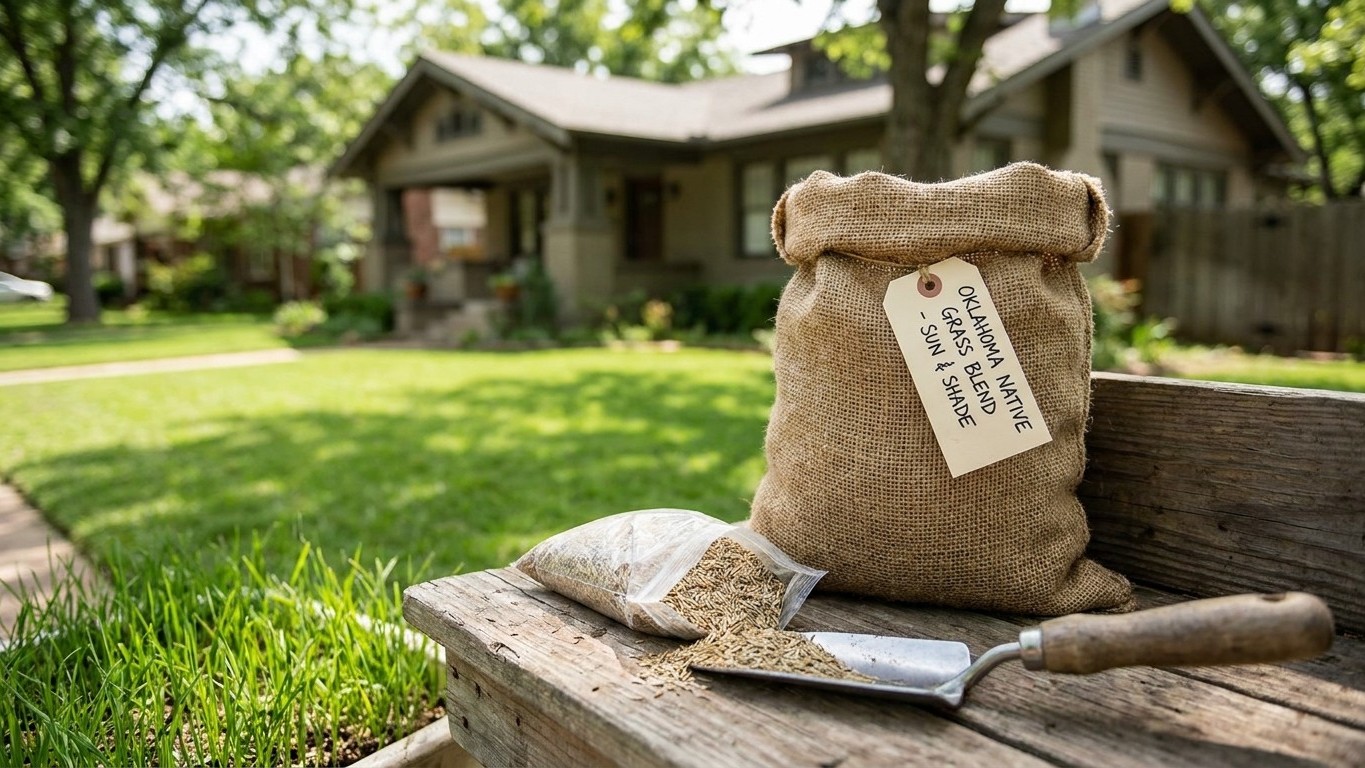

The best grass seed for Oklahoma isn’t one seed at all — it’s a choice between a lawn that’s green all winter and one that’s green all summer, because Oklahoma sits right in the crack between the two climates and no single grass covers both ends. Tall fescue keeps its color through the cold months and struggles in July heat; bermudagrass does the opposite, thriving in summer and going brown the moment frost hits. So before you buy anything, walk your yard and decide which season you’d rather look at bare dirt.
The short answer for Oklahoma
Oklahoma has no single winning grass because it straddles the line between the cool-season states to the north and the warm-season states to the south. Clemson Cooperative Extension’s HGIC 1214 groups grasses into cool-season species, tall fescue, Kentucky bluegrass and perennial ryegrass, and warm-season species, bermudagrass and zoysiagrass, and Oklahoma City’s climate suits both about equally, and neither one completely. There is no single winning grass here. A tall fescue lawn stays green from roughly October through May and then thins through the hottest weeks of summer. A bermudagrass lawn does the opposite: it greens up in late spring, spreads aggressively all summer, and turns straw brown the moment the first fall freeze hits.
What the choice depends on
Which grass costs you less depends on what you are willing to lose. Cool-season fescue needs supplemental water and some shade tolerance to get through Oklahoma’s worst heat, but it keeps color through a mild winter. Warm-season bermuda or zoysia shrugs off summer heat and drought once established, but sits brown and dormant for months, roughly matching the stretch from when NOAA’s 1991-2020 climate normals put the first fall freeze at Oklahoma City’s Will Rogers World Airport, between October 29 and November 8, until green-up the following spring.
The decision also depends on how the lawn gets used. A shaded front yard under mature trees does better with tall fescue or perennial ryegrass, since bermudagrass thins badly without full sun. A sunny backyard that takes summer foot traffic holds up better under bermudagrass or zoysiagrass. Match the grass to the site before you match it to a bag on the shelf.
Working through the year

Ranked by how realistically each grass performs in Oklahoma’s transition-zone climate, tall fescue and bermudagrass are the two workhorses, with Kentucky bluegrass, perennial ryegrass and zoysiagrass filling narrower roles. Timing matters as much as the species you pick, and the Oklahoma Lawn Care Calendar, Month by Month lines up seeding, mowing and feeding windows against the frost dates.
| Grass | Season type | Shade tolerance | Summer performance | Winter performance |
|---|---|---|---|---|
| Tall Fescue | Cool-season | Good | Thins and wilts in extended heat | Stays green |
| Kentucky Bluegrass | Cool-season | Moderate | Dormant or thin in prolonged heat and drought | Stays green, dense sod |
| Perennial Ryegrass | Cool-season | Moderate | Struggles like fescue, often used as a nurse grass | Stays green |
| Zoysiagrass | Warm-season | Fair for a warm-season grass | Handles heat and drought well once established | Brown and dormant |
| Bermudagrass | Warm-season | Poor, needs full sun | Grows aggressively, handles heat and drought | Brown and dormant |
Tall Fescue

Tall fescue is the most forgiving cool-season choice for Oklahoma because its deep root system tolerates the state’s clay soils and short dry spells better than bluegrass does. Establish it by seed in early to mid autumn, well ahead of the first freeze NOAA’s 1991-2020 normals place at Oklahoma City between October 29 and November 8, so seedlings have time to root before the ground cools. Without supplemental irrigation, expect it to thin and lose color during the driest weeks of summer.
Kentucky Bluegrass

Kentucky bluegrass forms a denser, finer sod than tall fescue and fills in bare patches on its own, a trait Penn State Extension credits to its spreading rhizomes. It is the least heat-tolerant of the three cool-season options here and is more often blended into a tall fescue seed mix than planted alone, so budget for some thinning during a hot, dry August.
Perennial Ryegrass

Perennial ryegrass germinates fast, which is why seed mixes use it to hold soil while slower tall fescue gets established underneath. On its own it shares tall fescue’s dislike of Oklahoma summers and rarely persists as a permanent lawn grass here without regular renovation.
Zoysiagrass

Zoysiagrass builds a dense, wear-tolerant turf that handles Oklahoma summer heat and drought better than any cool-season grass, and its tight growth crowds out most weeds once it fills in. The tradeoff is a slow start: it is usually planted from sod or plugs rather than seed, can take more than one growing season to cover fully, and goes completely brown for the winter.
Bermudagrass

Bermudagrass is the most heat- and drought-tolerant grass on this list and the fastest to spread, which is why it shows up on sunny, high-traffic yards and sports fields alike. It needs full sun, since Clemson Cooperative Extension’s HGIC 1214 notes it thins badly in shade, and it turns brown at the first hard freeze and stays that way until late spring.
Once a lawn is established, the feeding and mowing rates differ by species and by which half of the year the grass is actively growing. Follow Clemson Cooperative Extension’s HGIC 1219 Tall Fescue Maintenance Calendar for a cool-season lawn, HGIC 1216 for bermudagrass, or HGIC 1217 for zoysiagrass, rather than mixing instructions meant for the other type of grass.
What changes across Oklahoma
The transition-zone label above applies to Oklahoma City, where NOAA’s 1991-2020 normals are measured at Will Rogers World Airport. The rest of the state does not share that exact climate.
The Panhandle and elevation
The Panhandle, around Guymon, sits at higher elevation and further from the moderating effect of the state’s lakes, so it tends to run colder in winter and see its first freeze arrive earlier than the Oklahoma City normals show. Ground above roughly 2,000 feet in the western part of the state cools faster at night than the reference point near Oklahoma City, which pushes both the first fall freeze and the last spring frost against the gardener and shortens a warm-season grass’s growing window on both ends.
Lakes and the southeast
Southeastern Oklahoma, around McAlester and into the Ouachita foothills, runs milder and more humid, closer to the warm-season end of the transition zone, where bermudagrass and zoysiagrass hold their color longer into fall. Large reservoirs such as Lake Texoma and Grand Lake moderate the immediate shoreline, delaying the first light frost by a matter of days compared with open farmland a few miles inland.
None of this changes which grasses are realistic. Cool-season and warm-season species are both grown across the whole transition zone, but the calendar shifts. Treat the Oklahoma City frost window as a starting point, not a fixed date, and expect a rural or elevated county to need its seeding and dormancy dates adjusted by a week or two in either direction.
The mistakes this climate punishes
Most lawn failures in this climate trace back to timing, not the seed itself.
Timing mistakes
- Feeding bermudagrass or zoysiagrass late in the season. Nitrogen applied after the growing season should be winding down pushes soft new growth that has no time to harden off before the first freeze, and that soft growth is what dies back hardest, showing up as large dead patches rather than an even dormant brown.
- Seeding tall fescue, bluegrass or ryegrass once summer heat has already arrived. Cool-season seed put down late germinates poorly, and any seedlings that do come up rarely survive their first Oklahoma July, failing as bare, weedy patches by August, months after the seed went down.
Mowing and watering mistakes
- Cutting warm-season grass too short during a heat wave. Scalping bermudagrass or zoysiagrass below its healthy mowing height removes the growing point along with the leaf, and the yellow, stressed look that follows within days is often blamed on the heat when the mower is the real cause.
- Watering on a fixed schedule instead of by need. A cool-season lawn that gets the same watering in April as in August is underwatered exactly when it needs the most help, while a dormant warm-season lawn watered heavily through winter wastes water the grass is not using.
- Planting bermudagrass under trees. It thins out and eventually fails wherever shade falls for more than a few hours a day, a slow decline that often gets misread as disease or pests instead of a sunlight problem.
Most of these mistakes trace back to skipping a basic step covered under Oklahoma Lawn Care, like checking mower blade height before the first hot week of the year or testing soil before feeding at all.
Checking this against your county
Oklahoma State University Extension keeps county-level guidance that goes further than a single reference-city figure can, including local variety trials and county offices that know their own soil and frost patterns. Your county’s numbers may differ from the Oklahoma City figures used above, sometimes by a week or two, more at elevation or far from the reference station.
Before buying seed or sod, check Oklahoma State University Extension’s site at extension.okstate.edu for your county’s contact information and any current local trial results.
Common questions
Can I mix bermuda seed and fescue seed in the same lawn?
You can, but they will not blend evenly because they grow on opposite calendars. The fescue carries color in winter while the bermuda is dormant, and the bermuda takes over in summer while the fescue struggles, so most lawns that try this end up patchy rather than seamless.
Why did my new tall fescue die in its first summer?
New fescue seedlings have shallow roots and cannot yet reach the moisture a mature, deep-rooted stand relies on. First-summer fescue almost always needs more frequent watering than an established lawn, even though the species is considered drought-tolerant once mature.
Is it too late to seed if it is already October?
It depends on the grass. Cool-season seed still has a chance if it goes down well before NOAA’s 1991-2020 normals put the first fall freeze at Oklahoma City, October 29 to November 8, but cutting it closer than that risks seedlings that never root deeply enough to survive winter. Warm-season grass should not be seeded in fall at all. Wait for the following late spring.
Will bermudagrass spread into my flower beds?
Yes, and this is one of its defining traits. Bermudagrass spreads by both surface stolons and underground rhizomes, so it will cross an unedged border into mulch or garden soil, and pulling it by hand rarely removes enough of the rhizome to stop regrowth.