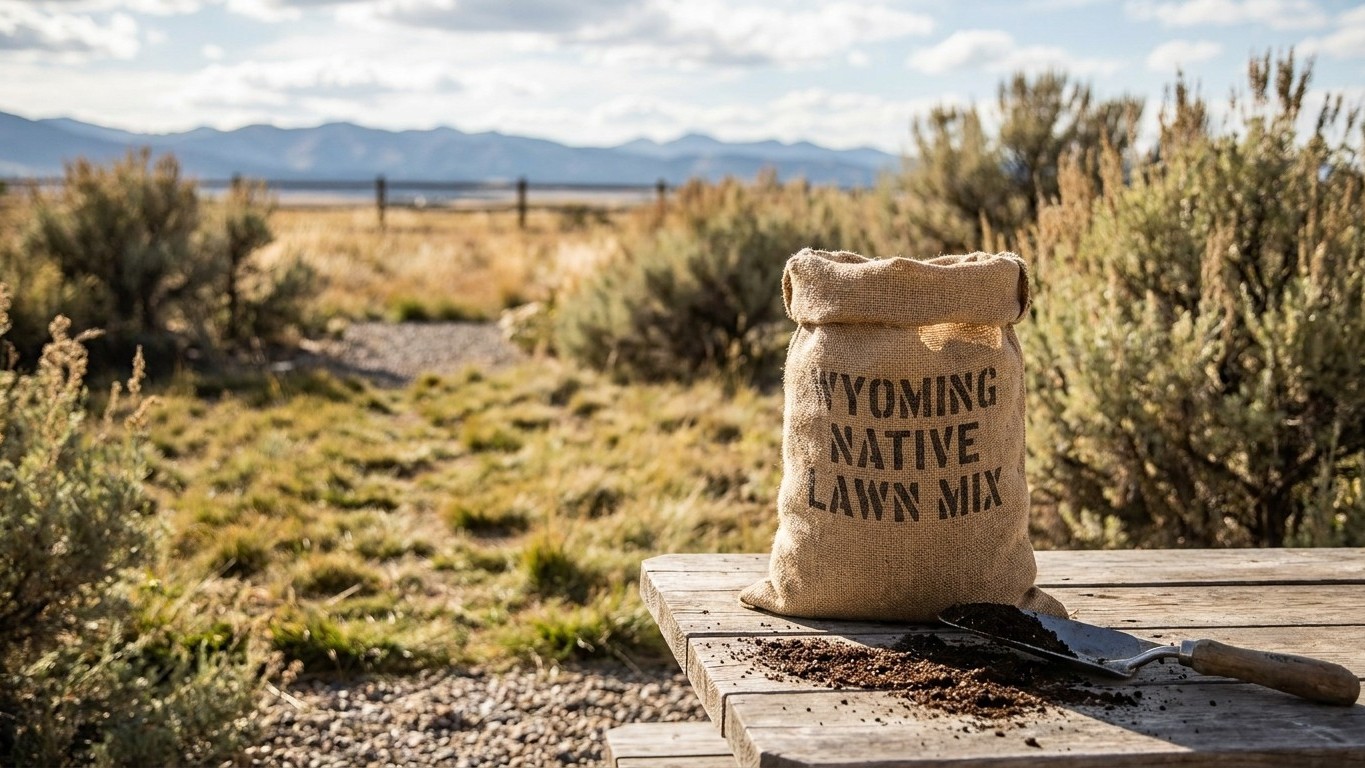

Wyoming sits in the cool-season turf zone, at least at Cheyenne, the reference city for the figures here. The Homestead Post’s zone classification, backed by Clemson Cooperative Extension’s HGIC 1214 species guide and Penn State Extension, names five species that hold up: Kentucky bluegrass, tall fescue, perennial ryegrass, fine fescues and rough bluegrass. No single one wins outright. Pick a blend of at least two based on your sun, traffic and water situation, and get seed down in late summer, not spring.
The short answer for Wyoming

Wyoming lawns live or die by one fact: this is cool-season turf country, so the grass question is never “which single seed” but “which blend for your yard.” If you’re standing outside right now guessing, the honest answer is a mix of at least two species—Kentucky bluegrass, tall fescue, perennial ryegrass, fine fescue, or rough bluegrass—chosen for your sun and traffic, not a bag with one name on it. The one thing to do today is pick that blend and get it into the ground in late summer, since spring seeding here just fights a losing battle against heat and weeds.
Which one earns a spot in your yard depends on sun exposure, foot traffic, and how much water you’re willing to run through a Wyoming summer. Kentucky bluegrass spreads on its own and heals wear, but wants more water than the others. Tall fescue tolerates heat and drought better. Fine fescues take shade that would thin out bluegrass fast. There is no single “best” grass for the whole state, only a best mix for your particular yard.
Soil matters too. Wyoming ground runs from alkaline high-plains soil to river-valley loam, and any of the five species establishes faster once the soil has been tested and amended, a step covered in Wyoming Lawn Care.
That answer holds for Cheyenne’s elevation and climate. Higher ground, and the far north and west of the state, can sit a full zone colder, a point the next section covers.
Working through the year
Ranking the cool-season options
Kentucky bluegrass is the default choice for open, sunny yards with regular water. It spreads through underground rhizomes and fills in bare patches on its own, but it is the thirstiest of the five and thins out fastest if watering lapses during a dry spell.
Tall fescue trades some of that self-repair for toughness. Its deep root system tolerates drought and heat better than bluegrass, a reasonable pick for a yard with an inconsistent watering schedule, though it spreads by tillering rather than rhizomes and will not fill bare spots without reseeding.
Perennial ryegrass germinates fastest of the group, often within about a week under good conditions, which makes it useful mixed into a bluegrass or fescue blend to hold soil while the slower species establish. On its own it wears out faster under heavy foot traffic and does not recover well from a hard winter without reseeding.
Fine fescues, a group that includes creeping red, chewings and hard fescue, take shade and poor soil better than anything else on this list, and need the least nitrogen to stay green. They struggle in full sun with summer heat, so they suit tree-shaded yards and north-facing slopes more than open plains lots.
Rough bluegrass tolerates wet shade better than the others but spreads aggressively where it is not wanted and struggles with any real drought, so it belongs only in consistently damp, shaded spots, not a general-purpose lawn.
| Grass | Drought tolerance | Shade tolerance | Wear tolerance | Establishment speed |
|---|---|---|---|---|
| Kentucky bluegrass | Low | Low | High, self-repairs | Slow |
| Tall fescue | High | Moderate | Moderate | Moderate |
| Perennial ryegrass | Low | Low | Low | Fast |
| Fine fescues | Moderate | High | Low | Moderate |
| Rough bluegrass | Very low | High in wet shade | Low | Moderate |
When to put seed down
All five species establish best in the weeks before the first fall frost, not in spring. NOAA’s 1991-2020 climate normals put the first 32°F freeze at Cheyenne, station USW00024018, between September 24 and October 5. Counting six to eight weeks back from that window puts the best seeding stretch at roughly late July through late August, early enough for roots to establish before cold sets in, late enough to dodge the worst of summer heat.
Spring seeding is possible but works against you. Cool-season seed sown in April or May competes with weed germination and then has to push through summer heat before it has a real root system, a stress test most seedlings fail. Clemson Cooperative Extension’s HGIC 1219 tall fescue maintenance calendar prioritizes fall overseeding over spring for the same reason, though that calendar is built for South Carolina’s longer season and the actual months shift earlier here to fit Cheyenne’s shorter frost-free window. For a month-by-month version adjusted to this state, check The Wyoming Lawn Care Calendar, Month by Month.
What changes across Wyoming
Elevation and the mountain ranges
Cheyenne sits at roughly 6,000 feet, where NOAA’s climate normals put the frost-free season at around 130 days. Most of Wyoming’s high plains sit in a similar range, but the state’s mountain ranges change the math fast.
The Wind River Range, the Bighorn Mountains, and the higher parts of the Snowy Range and Medicine Bow National Forest run well above Cheyenne’s elevation, and a lawn up there works with a shorter, less predictable season. NOAA’s data notes that frost is possible in any month at higher elevations, which squeezes the seeding math from both ends: the fall window closes earlier and the spring one starts later.
Wind, valleys, and lower ground
Lower ground fares better. River valleys such as those along the North Platte and the lower Bighorn Basin sit below Cheyenne’s elevation and typically hold a longer frost-free stretch, though NOAA’s cited figures apply specifically to the Cheyenne station and not to those valleys. A grower there should treat Cheyenne’s dates as a starting estimate, not a fixed calendar.
Wind is a separate factor across the state’s open plains. It dries out newly seeded soil faster than the same conditions would in a sheltered yard, so a freshly seeded lawn in an exposed spot needs more frequent light watering to keep the top inch of soil damp through germination, regardless of elevation. Elevation itself adds another layer: thinner air and stronger sun pull moisture out of grass blades faster than the same air temperature would at sea level, so a lawn near the Wind River foothills often needs more frequent, shorter irrigation than the same species would at Cheyenne’s elevation, even on a cooler-feeling day.
The mistakes this climate punishes
Five errors that show up later
Some errors barely matter in a milder state and wreck a lawn here.
- Seeding in May or June instead of late summer: cool-season seedlings hit peak heat before their roots establish, and germination rates drop even when the seed itself is fine.
- Mowing too short during a hot, dry stretch: cool-season turf that gets scalped in July loses the leaf area it needs to shade its own roots and browns faster. Brown is not dead; it is dormancy, and it usually greens back up once temperatures drop and rain or irrigation returns.
- Skipping fall fertilizing in favor of a heavy spring feeding: Clemson’s HGIC 1219 tall fescue calendar puts the priority nitrogen application in fall, when roots build winter reserves, not spring, when a flush of top growth just adds mowing without building a stronger lawn.
- Waiting past NOAA’s Cheyenne frost window, September 24 to October 5, to overseed thin spots: seed put down after that point does not have time to root before the ground freezes, and the gap fills with weeds the following spring instead of grass.
- Planting a warm-season species like bermudagrass or zoysia because a bag was on sale: these need a long hot season to establish and spread, which this climate does not provide, and they go dormant at the first freeze and often fail to come back rather than surviving as a lawn.
Each mistake shows its damage on a delay. A May seeding failure does not look obvious until July heat kills off the thin stand. A skipped fall feeding shows up as slow, pale green-up the following spring, not as an immediate problem.
Checking this against your county
Every figure above is read at or near Cheyenne. Albany, Sheridan, Teton and Sweetwater counties sit at different elevations and see different frost dates, so treat Cheyenne’s numbers as a starting point, not a final answer for your yard.
The University of Wyoming Extension Service can confirm local frost dates, run a soil test, and point to which of the five species performs best in your county. Reach the statewide office at uwyo.edu/uwe before you buy seed by the pound.
Common questions
Can I grow a warm-season grass like Bermuda in Wyoming?
Not reliably. Bermudagrass and zoysia need a long, hot season to establish and spread, and this cool-season climate does not provide it, so a warm-season lawn here typically goes dormant at the first freeze and fails to recover the following spring rather than resuming growth.
Is it too late to seed if I missed the late-summer window?
Late seeding after NOAA’s Cheyenne frost window of September 24 to October 5 risks failure, since seedlings will not root deeply enough before the ground freezes. A dormant seeding, laid down just before hard freeze so the seed germinates the following spring, is a workaround worth asking your county extension office about rather than gambling on a normal fall seeding running late.
What’s the fastest-growing grass seed for a Wyoming lawn?
Perennial ryegrass germinates fastest of the five cool-season species named by Clemson Cooperative Extension’s HGIC 1214, often visible within about a week under good conditions, though it wears out faster under heavy foot traffic than tall fescue or Kentucky bluegrass.
Do I need to water grass seed every day after planting?
Newly seeded cool-season lawns need the top inch of soil kept consistently damp, which usually means light watering more than once a day until germination, then a gradual taper to fewer, deeper waterings as roots develop. Wind and low humidity on Wyoming’s open plains dry that top inch out faster than the same weather would in a sheltered yard, so exposed sites need closer attention during germination.