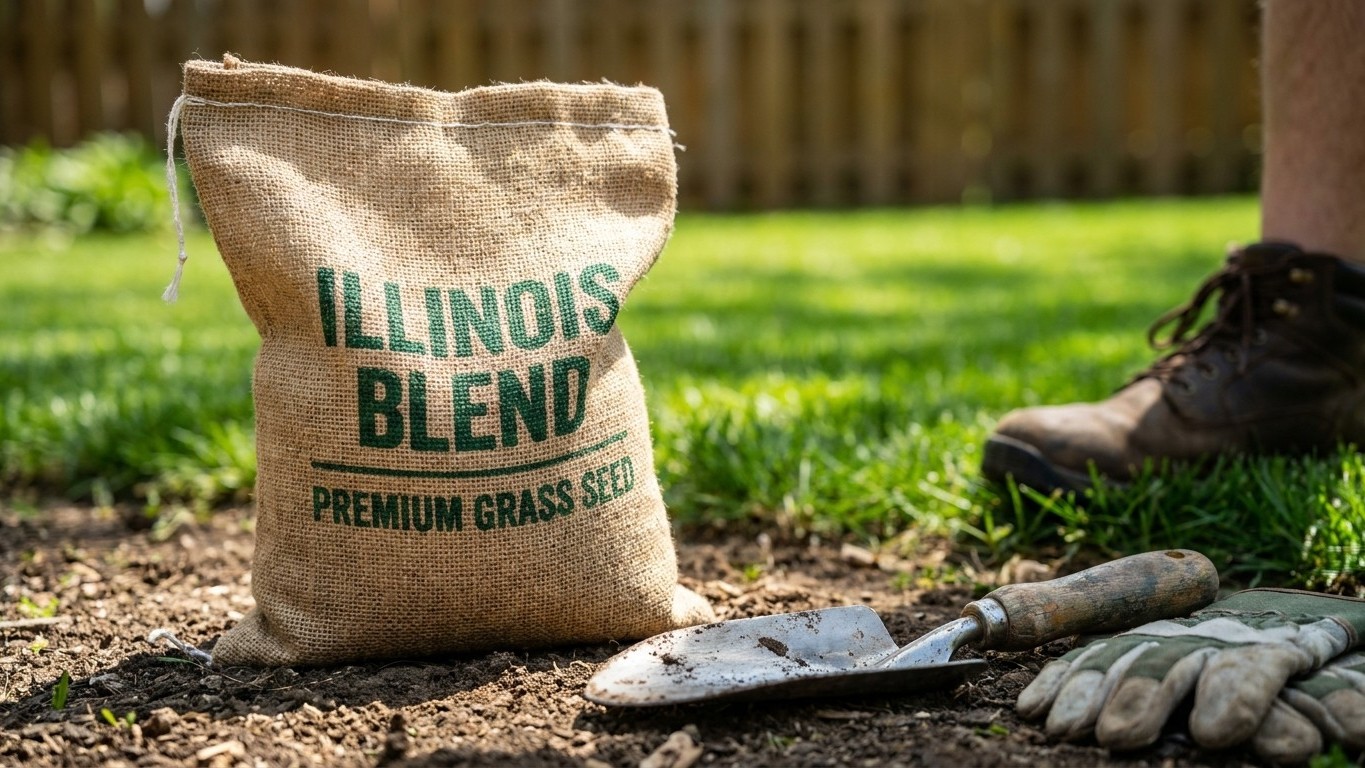

Illinois lawns all want the same category of grass — cool-season — but which of the five, Kentucky bluegrass, tall fescue, perennial ryegrass, fine fescue, or rough bluegrass, actually takes in your yard comes down to sun and traffic, not the map. Walk the yard right now and mark which spots bake all day and which stay shaded, because that split decides the species long before frost date or seeding rate matter. Once you know sun versus shade, the seed choice narrows itself.
The short answer for Illinois
The whole state falls in the cool-season turf zone, at least by the numbers measured near Chicago. Clemson Cooperative Extension’s HGIC 1214 guide and Penn State Extension both point to the same five species for this region: Kentucky bluegrass, tall fescue, perennial ryegrass, fine fescues and rough bluegrass. None of them is a warm-season grass like bermudagrass or zoysia, and none of them will hold up on a warm-season schedule. They green up in spring, do most of their growing in spring and fall, and slow down or brown out under summer heat.
The best time to get seed in the ground is late summer into early fall, timed against the first freeze rather than a calendar month. NOAA’s 1991-2020 climate normals, measured at the Chicago airport station, put the first fall frost between October 24 and November 3. Seed needs roughly six weeks of growing weather before that freeze to root deeply enough to survive winter, which for the Chicago area lands sowing in mid to late September. Gardeners farther south in the state will see their own frost arrive later and can shift the window back accordingly, but should confirm the date locally rather than borrowing Chicago’s.
Which of the five species wins in a given yard depends less on the state and more on the yard itself: how much sun it gets, how much foot traffic it takes, and how much mowing and watering the owner is willing to keep up. A shaded side yard and a sunny front lawn in the same town often call for different seed entirely.
Working through the year

Ranking the five by trade-off
Kentucky bluegrass spreads by rhizome and knits over minor damage on its own, but it wants full sun and takes longer to establish from seed than the others. Tall fescue roots deeper than any of the other four, which is why it holds up through the driest stretches of an Illinois summer, but it grows in bunches rather than spreading, so a bare patch stays bare until it’s reseeded. Perennial ryegrass germinates faster than anything else on the list, often within a week, which makes it useful mixed in as a nurse grass, but it doesn’t hold up alone for more than a few years. Fine fescues are the shade specialists of the group, doing the best of the five under trees, though their thin blades don’t take much foot traffic. Rough bluegrass wants damp shade and struggles the moment the soil dries out, which makes it a narrow-use grass rather than a general lawn seed.
| Species | Best suited to | Main trade-off |
|---|---|---|
| Kentucky bluegrass | Full sun, high-visibility lawns | Slow to establish, needs full sun |
| Tall fescue | Average sun, dry spells | Clumps rather than spreads |
| Perennial ryegrass | Quick cover, overseeding mixes | Short-lived on its own |
| Fine fescue | Shade under trees | Thin blades, low wear tolerance |
| Rough bluegrass | Damp, shaded low spots | Fails if soil dries out |
Season by season
Most Illinois lawns, whatever the actual seed mix, follow the same rough seasonal shape as a tall fescue lawn, because the tasks land in the same months. Clemson’s HGIC 1219 Tall Fescue Maintenance Calendar lays out that shape: a first mowing and light feeding as growth resumes in spring, a pause on heavy nitrogen and traffic through summer heat, then the year’s main push of seeding, aeration and fertilizing once nights cool off in fall. That calendar’s exact dates are written for South Carolina, so use its seasonal structure and shift the actual dates to your own frost window rather than copying its months directly.
In practice, spring in Illinois is for mowing, spot-treating weeds, and holding off on heavy nitrogen that would push leaf growth right before summer stress arrives. Summer is for watering deeply but infrequently and raising the mower rather than lowering it, since a scalped cool-season lawn recovers slowly under heat. Fall, ahead of that October to November frost window, is when new seed goes down, when the year’s biggest fertilizer application goes on, and when core aeration does the most good on the compacted clay soil common across much of the state’s row-crop ground. For the month-by-month version of this built around Illinois’s own frost dates, The Illinois Lawn Care Calendar, Month by Month lays the tasks out in order.
What changes across Illinois
Every figure above is measured at the Chicago airport weather station, and Chicago is not the whole state. Illinois runs roughly 380 miles from its northern to its southern border, so treat these numbers as a reference point rather than a state-wide rule. Lake Michigan moderates the immediate lakefront, holding heat into fall and pushing the first freeze there later than at inland spots a few miles west at the same latitude. Once you’re away from the lake’s influence, in places like Rockford or the outer suburbs, frost typically arrives earlier than the Chicago airport figure suggests.
Central Illinois, around Springfield and Peoria, sits well outside the lake’s reach and swings harder between summer heat and winter cold, which pushes both the spring green-up and the fall seeding window earlier than Chicago’s. Southern Illinois, down toward Cairo, runs warm enough that it edges toward the transition zone rather than sitting cleanly in the cool-season zone. That doesn’t make the five species above wrong there, but it does mean summer heat stress on cool-season turf is a bigger and longer problem the farther south the lawn sits.
Elevation plays almost no role in this variation the way it might in a mountainous state. Illinois’s highest ground, in the northwest, barely tops 1,200 feet, nowhere near enough to shift a growing season on its own. The real drivers here are latitude, distance from Lake Michigan’s moderating water, and how quickly a piece of ground sheds cold air on a still night, which is why two towns at the same latitude can still see frost a week apart depending on whether they sit in a low spot or on a ridge.
The mistakes this climate punishes
Illinois lawns are cool-season lawns, and most of the damage people do here comes from timing borrowed from warm-season practice, or from panicking over normal summer browning.
- Seeding in late spring instead of fall. New grass sown in May has to survive its first summer as a seedling, and most of it burns off by July, leaving a thin stand going into the next winter.
- Feeding heavily in early summer, which pushes leaf growth right when the plant should be sending energy to its roots, and the lush growth it produces is the first tissue to scorch in a dry August.
- Cutting too short once temperatures climb. A scalped cool-season lawn loses the shade its own canopy was giving the soil, and the thinning doesn’t show up for weeks, once the roots have already been starved of the sugar those leaf blades were making.
- Treating summer brown as dead turf. Cool-season grass goes dormant and tan in a dry, hot stretch as a survival response, not a death. Ripping it out and reseeding in August wastes seed that would have greened back up on its own once nights cooled off.
- Skipping the fall window entirely and relying only on spring seeding, which pits new seedlings directly against crabgrass and other summer annual weeds germinating at the same time.
Every one of these habits traces back to the same root problem: treating a cool-season lawn like it runs on a warm-season clock. Bermudagrass and zoysia take their nitrogen and their mowing changes in early summer and drop dormant at frost. A cool-season lawn does close to the opposite, and mixing the two calendars is the single most common cause of a thin Illinois lawn. For the full year’s task list built around that cool-season clock, see Illinois Lawn Care.
Checking this against your county
Illinois Extension, the state’s land-grant service, keeps county offices that can confirm your local frost dates and any species notes specific to your area, reachable through Illinois Extension.
A basic soil test through that same office is worth doing before buying any seed at all, since pH and drainage decide how well any of the five species listed above actually performs, whatever the bag claims.
Common questions
Can I overseed a thin lawn instead of starting from bare dirt?
Yes, and for most Illinois lawns that’s the better move. Overseeding into existing turf during that same late-summer to early-fall window, ahead of the first frost, lets new seedlings establish with less competition than starting from bare soil, and it avoids the erosion risk of stripping a lawn down entirely.
What if I miss the fall seeding window this year?
Wait for the next one rather than forcing it into spring. A spring-sown cool-season lawn has to fight through a full summer as a seedling and compete with crabgrass germinating at the same time, so the fall window that runs ahead of the region’s first frost gives seed a much better shot even though it means a longer wait.
Will bermudagrass or zoysia ever work in Illinois?
Not reliably across most of the state, since both are warm-season grasses that go dormant and brown at the first hard freeze, and Illinois’s cool-season climate rarely gives them enough time to fill in before that happens. The far southern counties run closer to a transition climate where some gardeners experiment with them, but that’s a local exception to check with Illinois Extension rather than a state-wide option.
The seed bag says it germinates in 7 to 10 days, so why does this article talk about six weeks?
Those are two different clocks. The days-to-germination figure on the bag is a catalog number measured under ideal conditions and tells you when the seed sprouts, not when it’s rooted deeply enough to survive frost. The six-week figure in this article is about root establishment, which takes far longer than germination and is the number that actually decides whether fall-sown grass survives its first winter.