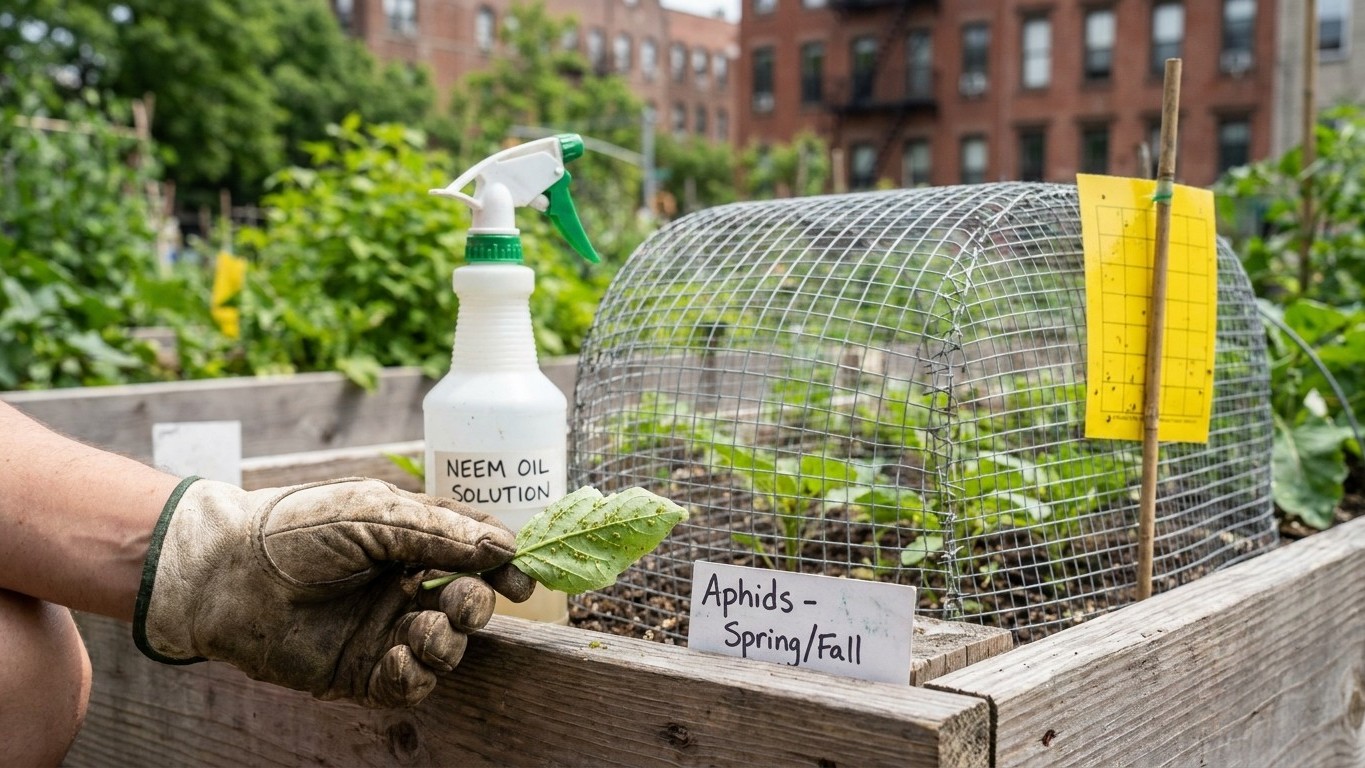

Cornell University’s CALS Insect Diagnostic Laboratory names ten insect pests as the ones New York home gardeners most often bring in for identification, from the striped Colorado potato beetle New York growers battle on their potato and eggplant patches, to the Squash vine borer New York gardeners find wilting their zucchini and pumpkin vines mid-summer, to one insect with an exact figure attached: near New York City, Apple maggot in New York flies emerge mid-June to early July, peak mid-to-late July, and stay active into September. Start checking susceptible plants weekly from mid-June, and hang red sticky traps in apple trees before that window opens so you catch the first flies before they lay eggs.
What New York gardens actually deal with

Asparagus beetles hit the spears first, right as they push through the soil in spring — bluish-black with cream squares, or orange-red with black spots, chewing scars into tips before you’ve even harvested a stalk. Cabbage maggots follow close behind, tunneling into the roots of young transplants while the leaves above still look fine, and not long after, the Striped cucumber beetle New York gardeners dread shows up on cucumber and squash seedlings, around the same time the Fourlined plant bug in New York leaves its telltale sunken spots on mint, basil, and other tender herbs. New York’s pest calendar runs on this kind of sequence, one insect handing off to the next, and knowing which one is active tells you exactly what to do about it.
Asparagus beetles

Asparagus beetles in New York are two species that turn up on emerging spears each spring: the common asparagus beetle, bluish-black with cream squares along its back, and the spotted asparagus beetle, orange-red with black spots. Both chew spears and ferny foliage, leaving scarred, discolored tips. Hand-picking works well because the beetles are large and slow, and cutting back old fern growth each fall removes their overwintering sites.
Cabbage maggot

Cabbage maggot in New York shows up as a white, legless larva that tunnels into roots and the stem base of young cabbage, broccoli and related transplants, causing wilting and stunted growth that looks like a watering problem at first glance. By the time leaves yellow, the roots are already riddled. Floating row cover sealed at the soil line before the adult flies find the bed is the most reliable block, since there’s no rescuing a plant once maggots are established in the root. A close relative, Onion maggot in New York, attacks alliums the same way, tunneling into onion, garlic and leek roots early in the season, and growers watch for it just as closely. Above ground, the same cabbage-family plants also attract Imported cabbageworm in New York, which gardeners contend with as its velvety green caterpillars chew ragged holes straight through the leaves.
Onion maggot

This maggot behaves like its cabbage-family cousin but targets onion, leek and garlic. Seedlings collapse suddenly, and bulbs show soft, tunneled tissue that rots in storage. Rotating onion-family crops to a new bed each year and covering seedlings through the vulnerable early weeks cuts losses more than any spray applied after damage appears.
Imported cabbageworm

The white butterfly drifting over the cabbage patch isn’t the problem. Its pale green, velvety caterpillar is, chewing ragged holes through leaves and boring into developing heads. Bacillus thuringiensis, sprayed on foliage while caterpillars are still small, controls this pest without harming the butterflies’ natural predators.
Colorado potato beetle

Yellow-orange adults with ten black stripes overwinter in the soil and walk into potato beds as plants emerge. Their humpbacked, orange-red larvae do most of the defoliation, stripping plants to bare stems if left unchecked. Hand-picking adults and crushing egg clusters on leaf undersides early in the season keeps numbers from building to the point a spray becomes necessary.
Fourlined plant bug

This yellow-green bug with four black stripes leaves a telltale pattern of small, round, sunken spots scattered across mint, basil and many perennials, where it pierces leaf tissue to feed. Damage looks worse than the pest count suggests, since a few bugs mark a lot of leaf surface. Most gardens tolerate it without treatment, since the marks are cosmetic and the bug is a light feeder overall.
Striped cucumber beetle
Yellow with three black stripes, this beetle attacks cucurbit seedlings the moment they emerge, chewing the stem and cotyledons badly enough to kill young plants outright. Older plants tolerate feeding, but the beetle carries bacterial wilt, which is the more serious threat over the season. Row cover over seedlings until flowering, removed then for pollination, prevents both the direct damage and the disease it spreads.
Viburnum leaf beetle
Yellowish-green larvae with black spots feed in groups on the undersides of viburnum leaves, skeletonizing them to a lace of veins before the small brown adults take over later in the season. Cutting and destroying larvae-infested twig tips before they pupate, or scraping visible egg sites off bare stems in late winter, breaks the cycle without a single spray.
Squash vine borer
By the time a squash or zucchini plant wilts suddenly at midday despite damp soil, the wrinkled, cream-white larva is usually already inside the stem, feeding out of sight. The orange-and-black day-flying moth that lays the eggs is easy to mistake for a wasp. Slitting the stem to remove the larva, then mounding soil over the wound to encourage new roots, saves plants that would otherwise collapse.
Apple maggot
Adult flies, black with white-banded wings, lay eggs just under the skin of ripening apples. Their white larvae tunnel through the flesh, leaving brown, winding trails that ruin the fruit for fresh eating. Near New York City, Cornell CALS records adults emerging mid-June to early July, peaking mid-to-late July, and remaining active into September, though timing shifts earlier or later in cooler parts of the state. Red sticky-ball traps hung in the canopy by early summer catch adults before they lay eggs, and picking up dropped fruit promptly removes larvae before they pupate in the soil.
Telling damage apart

A ruined leaf tells you almost nothing on its own. The pattern of the damage, and what’s near it, tells you whether you’re dealing with an insect, a disease, or a watering problem, and that call decides whether you reach for Bt, a fungicide, or just the hose.
Reading the pattern
- Ragged holes with chewed edges point to a chewing insect like imported cabbageworm or Colorado potato beetle larvae.
- Tiny pale or bronze stippling across a leaf surface usually means a piercing-sucking feeder such as fourlined plant bug, working from beneath.
- Skeletonized leaves, where only the veins remain, are the signature of viburnum leaf beetle larvae feeding in groups.
- Sudden wilting despite moist soil signals a borer or maggot working inside the stem or root, not a watering fault.
- Sticky residue or a black sooty coating on leaves usually comes from aphids or other sap feeders, not from anything on this list, and is worth a separate look.
- Tunnels or trails inside fruit or roots, visible only when you cut into them, mean a maggot or borer larva already did its damage before symptoms showed above ground.
Insect, disease or water stress
Wilting is the trickiest symptom because insects, fungal disease, and plain underwatering all produce it. Check the soil first. If it’s damp and the plant still wilts, especially at midday, suspect a borer or maggot severing the plant’s plumbing from inside rather than a dry root zone. Fungal wilts tend to move slowly up one side of a plant and often come with discolored streaks inside the stem when you slice it open, while insect damage above ground, chewed leaves or skeletonized tissue, is usually visible without cutting anything at all. A disease rarely produces neat round holes or scalloped leaf edges. Those shapes belong to a mouth, not a pathogen.
When each one shows up
Insect activity in a New York garden tracks plant growth stages and soil temperature more closely than the calendar does. Asparagus beetles appear as soon as spears push through the soil in early spring, while cabbage maggot and onion maggot flies are laying eggs at the base of transplants within days of setting them out, since both target the cool, moist soil around young seedling roots.
Early to late season
Imported cabbageworm butterflies and Colorado potato beetle adults show up as their host crops establish: cabbageworms once cabbage-family leaves are large enough to feed a caterpillar, potato beetles as soon as potato foliage breaks ground after overwintering in the soil. Fourlined plant bug and striped cucumber beetle follow as the weather warms enough for cucurbit and herb seedlings to grow fast, so check the undersides of the first true leaves on squash and cucumber transplants as soon as they unfurl. Viburnum leaf beetle larvae feed in the weeks after new viburnum growth flushes out, moving to the adult stage and a second round of leaf damage later in summer. Squash vine borer moths stay active through the height of summer, laying eggs at the base of vines, which is why the wilting they cause tends to show up mid-to-late season rather than at planting.
Apple maggot is the one pest in this group with a documented window: Cornell CALS records adults emerging mid-June to early July near New York City, with a peak mid-to-late July, and continued activity through September. Gardeners in cooler parts of the state, the Adirondacks or the Tug Hill Plateau for instance, should expect that whole window to run later, since CALS ties emergence to accumulated warmth rather than a fixed date on the calendar.
What actually works
Prevention first
Most of the pests on this list are stopped more cheaply before they arrive than after. Crop rotation breaks the cycle for cabbage maggot, onion maggot and Colorado potato beetle, all of which overwinter in or near the soil where last year’s host crop grew. Moving cabbage-family and onion-family plantings to a different bed each year denies newly emerged adults an easy meal right where they overwintered.
Timing matters as much as rotation. Delaying transplant dates by even a week or two can let cabbage-family seedlings miss the peak flight of cabbage maggot flies, and setting squash and cucumber transplants out under row cover until they start flowering keeps striped cucumber beetle off seedlings during the window when it does the most damage. Encouraging predators, ground beetles, parasitic wasps and birds, by leaving some flowering plants nearby and skipping broad-spectrum insecticides, keeps populations of nearly every pest on this list lower without any extra work on your part.
Targeted intervention
When prevention isn’t enough, hand-picking works for anything large and slow enough to catch: asparagus beetles, Colorado potato beetle adults and their egg clusters, and squash vine borer moths if you catch them before they lay. Bacillus thuringiensis controls imported cabbageworm without harming bees or predatory insects, since it only affects caterpillars that eat it. Row cover, sealed at the edges, blocks cabbage maggot, onion maggot and striped cucumber beetle flies from ever reaching the plant in the first place.
Several widely repeated remedies do nothing against this group of pests. Planting marigolds around squash does not repel squash vine borer or cucumber beetles, and no research from Cornell CALS or any land-grant extension supports it. Ultrasonic pest repellers have no documented effect on any insect pest either. Neighboring states deal with overlapping but distinct pressure: Pennsylvania gardeners face much of the same squash vine borer and Colorado potato beetle pressure covered in Garden Pests in Pennsylvania, while a much drier climate like California’s runs an entirely different pest calendar, laid out in Garden Pests in California.
What control costs
None of these controls carry a fixed national price, but they differ enormously in the time and repetition they demand over a season, and that’s the real cost for most home gardeners.
| Method | Money cost | Time cost | Repetition needed |
|---|---|---|---|
| Hand-picking | None | A few minutes daily during peak activity | Ongoing through the pest’s active window |
| Row cover / barriers | Low, reusable for several seasons | Set once at planting, removed for pollination | Replace only if torn or worn out |
| Biological controls (Bt, beneficial insects) | Moderate, bought per application or as habitat plants | Spray reapplied after rain; habitat plants are a one-time setup | Every one to two weeks while caterpillars are active |
| Sprays (insecticidal soap, kaolin clay, etc.) | Moderate to higher, repeat purchases | Mixing and application each round | Every one to two weeks, more after rain |
For a typical home garden, hand-picking and row cover together are the cheapest route by a wide margin, since both rely on materials you already own or buy once and reuse rather than a product you replace all season. Biological controls and sprays cost more over a full season because they’re consumed with every application, and a wet stretch of weather that washes off Bt or soap sprays means buying and applying them again sooner than planned. The trade-off is time: barriers and hand-picking ask for a few minutes of regular attention, while a spray schedule asks for less frequent but more involved sessions.
Local help
When you can’t tell one pest from another, or you suspect something not on this list, Cornell Cooperative Extension offices across the state identify specimens and track local outbreaks county by county. Submitting a photo or a sample through your county office is faster than guessing, especially for a pest that leaves damage before you ever see the insect responsible. Reach the statewide directory of offices at Cornell Cooperative Extension.
Pest-by-Pest Guides for New York Gardens
Once you know a pest is active, it helps to see the details laid out for your region. If your tomatoes and potatoes are getting chewed, the Colorado potato beetle guide covers the soil-temperature trigger that wakes them up, from late April on Long Island to late May in the North Country. Mint, basil, and dahlia growers dealing with sudden stippled leaves in early summer should check the fourlined plant bug page, which walks through that narrow mid-May-to-late-June hatch window. Squash growers watching for wilting vines will want the squash vine borer breakdown, timed to the late June through early August flight period that hits Long Island and the Hudson Valley first. Anyone with young cucumbers, melons, or squash should read the striped cucumber beetle page, which explains the late-May-to-mid-June arrival tied to warming soil. And if your viburnum shrubs are looking skeletonized, the viburnum leaf beetle guide lays out the two-wave season, spring larvae and midsummer adults, that catches so many gardeners off guard.
Common questions
Why do my squash plants wilt overnight even though I’m watering them?
That sudden wilt, especially in squash, zucchini or pumpkin, usually means a squash vine borer larva has already tunneled into the base of the stem and cut off the plant’s water flow from inside. Check the stem near the soil line for a small entry hole and a pile of wet, sawdust-like frass before assuming it’s a watering problem.
Do I need to spray every week all summer to keep pests off?
No. Most of the pests covered here are stopped by rotation, timing and barriers set up once at planting, and only a few, like imported cabbageworm, call for repeat treatment through their active weeks. Weekly spraying without checking for an actual pest first wastes money and kills off the predator insects that would otherwise keep numbers down on their own.
I found a beetle I can’t match to any of these. What now?
New York hosts far more insects than the ten Cornell CALS highlights for home vegetable gardens, so an unfamiliar beetle isn’t unusual. Take a clear photo, including something for size comparison, and send it to your county Cornell Cooperative Extension office rather than guessing from an online image search.
Is it too late to do anything once I see damage?
It depends on the pest and the stage. Chewing damage from cabbageworm or beetle larvae can often still be stopped mid-season, since more feeding is still ahead of you. Once a borer or maggot is already inside a stem, root or fruit, no spray reaches it, and removal or prevention next season becomes the more realistic goal.