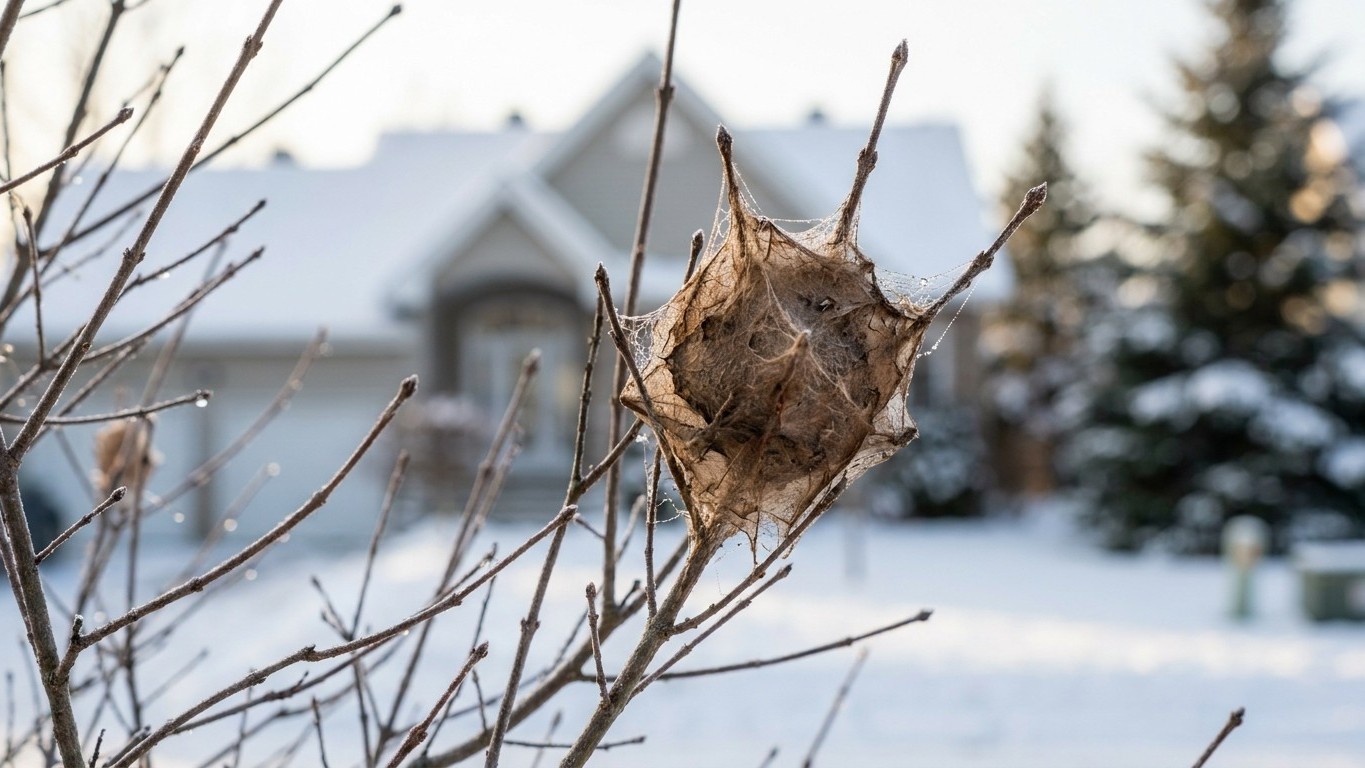

Browntail moth caterpillars become a problem in Quebec twice a year: a short window in late April through June when they feed and shed toxic hairs, and again in late summer when new colonies settle into winter webs on bare branch tips. The only proven way to stop an infestation before it spreads is mechanical, cutting and destroying those visible winter webs between November and early April, combined with a targeted Bacillus thuringiensis kurstaki (Btk) spray in the narrow window when caterpillars are small and still exposed.
Where Browntail Moth Has Been Confirmed in Quebec

This species isn’t native to North America. European browntail moth (Euproctis chrysorrhoea) arrived in Massachusetts around 1897 and spent more than a century mostly contained to coastal Maine and Cape Cod. That changed over the past decade. Populations pushed north through New Hampshire and Vermont, and Quebec’s border regions, particularly the Eastern Townships (Estrie) and parts of Montérégie, have recorded detections as the insect follows river corridors and ornamental tree plantings across the border.
Quebec’s forestry authorities treat browntail moth as a watch-list pest rather than a widespread established species, unlike the situation in Maine, where entire counties deal with dense populations every spring. That distinction matters for homeowners: in Quebec, catching a colony early, often a single winter web on one ornamental tree, can prevent the kind of multi-acre outbreaks seen further south.
Host Trees to Check First
Browntail caterpillars aren’t picky, but they show clear preferences. Oak and wild cherry top the list, followed by apple, crabapple, hawthorn, rose bushes, and shadbush. Rural properties with mixed hedgerows or old orchard trees carry more risk than a lawn with only maples and conifers, since the moth ignores softwoods almost entirely.
The Life Cycle That Sets the Calendar
Everything about controlling this pest comes down to timing, because the caterpillars are only reachable at certain points in their year-long cycle.
Adult moths, white-winged with a distinctive brown tuft at the tip of the abdomen, fly for about two weeks in July. Females lay egg masses on the undersides of leaves, and those eggs hatch in August. The young caterpillars feed briefly, skeletonizing leaves in small groups, then spin a dense silk web around the tip of a branch before the leaves drop. That web is where they spend the entire winter, and it stays clearly visible on bare branches through the cold months.
Come April, as temperatures climb, the caterpillars leave the winter web and start feeding aggressively on new leaf growth. This is the most damaging and most hazardous phase, lasting through May and into June. They pupate in late June, and the cycle restarts with the July flight.
What Actually Stops It
Three interventions work, and they work at three different times of year. Nothing else on the market has shown reliable results against this species outside of these windows.
Winter Web Removal (November to Early April)
This is the single most effective and lowest-risk control available to homeowners. Once leaves fall, the silk webs stand out against bare branches, usually white or silvery-gray and roughly the size of a fist, wrapped around the outer few inches of a twig. Cutting these off with pruners and destroying them, either by burning where local burn bylaws allow, or by soaking them in soapy water, removes the entire overwintering population before it ever gets a chance to feed.
Reaching webs high in a mature oak isn’t a DIY job for most people; that’s when calling in a licensed tree care company with a bucket truck or extendable pole pruner makes sense. Quebec municipalities in affected areas sometimes run seasonal web-cutting programs for street trees, so checking with the local municipal office before hiring a private crew can save money.
Bt Spray on Young Caterpillars (Late April to Mid-May)
Once the caterpillars leave the winter web and start feeding on fresh leaves, a Btk-based insecticide applied at that stage kills them before they reach the larger, hairier instars that cause the worst skin reactions. Btk only affects caterpillars, not bees, birds, or pets, which is why it’s the standard recommendation from state and provincial forest health programs rather than broad-spectrum chemical sprays. Timing is tight, usually a two-to-three week window, and spraying after mid-May does far less good because the caterpillars have already dispersed and grown past the size where Btk is effective.
Professional Treatment for Heavy Infestations
Properties with dozens of winter webs or mature trees too tall for a homeowner ladder should bring in a licensed arborist or pest control company. Some larger trees get a systemic insecticide trunk injection in early spring, an option worth discussing with a professional if webs are concentrated high in the canopy and manual removal isn’t realistic.
The Health Risk Behind the Urgency
Browntail caterpillars carry microscopic barbed hairs that break off and become airborne, especially when disturbed by wind, lawn mowing, or leaf blowing near an infested tree. Contact causes a poison-ivy-like rash that can last for weeks, and breathing in the hairs can trigger coughing or breathing trouble, particularly in people with asthma. According to Massachusetts state health guidance, those hairs can remain active and cause reactions for up to three years after they’ve been shed, since they persist in soil, on siding, and in leaf litter long after the caterpillars themselves are gone. Massachusetts state health guidance recommends showering immediately after any yard work in an infested area and washing clothes separately in hot water.
This is the main reason authorities push winter web removal so hard. Cutting webs from a leafless tree in January means dealing with dormant caterpillars still curled up inside their silk shelter, a far safer task than confronting active, hair-shedding larvae crawling across bark and leaves in May.
Reading a Quebec Property for Risk
A short walk through the yard in late fall or winter tells most of what’s needed. Look at the outer branch tips of oaks, wild cherries, and any fruit or ornamental trees for tight silk clusters that stayed put through several windstorms, since old bird nests and other debris tend to blow apart while browntail webs hold their shape. Check fence lines and hedgerows too; the moth spreads along windbreaks planted decades ago, and a property backing onto an overgrown fencerow near a wooded lot carries higher exposure than one surrounded by open lawn.
Properties within a few miles of confirmed detections in Estrie or Montérégie should treat any winter web as a priority to remove, rather than waiting to see if the population grows. Early, small-scale action costs far less than dealing with a canopy-wide infestation two seasons later, and it avoids the liability of caterpillar hairs drifting onto a neighboring property.
Quebec’s situation right now looks a lot like Maine’s did in the late 1990s, before populations exploded across the coast. Homeowners who treat a single winter web as worth cutting today are the reason some New England towns still have manageable populations decades later, while others gave up early and now deal with browntail moth every single spring.