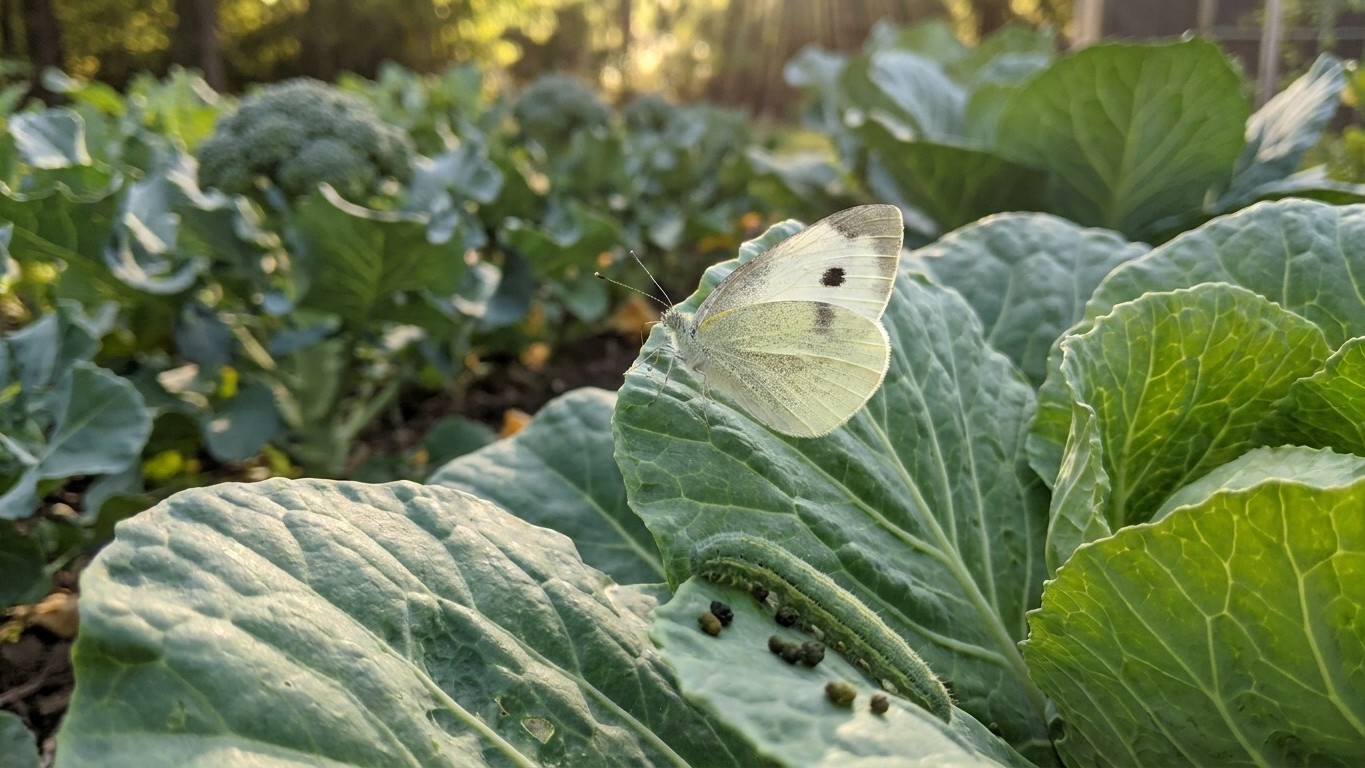

Imported cabbageworm shows up in Alabama gardens as early as March in the southern part of the state and stays active clear through November, sometimes longer in mild years. The white butterflies you see fluttering around your collards or broccoli in early spring are already laying eggs. Stopping the damage comes down to three things: catching the eggs and young larvae before they burrow into heads and hearts, using row covers or Bt sprays at the right moment, and keeping an eye on your crucifer beds every few days during the growing season.
What the Imported Cabbageworm Actually Is

The pest itself is the larval stage of a small white butterfly, Pieris rapae, sometimes called the cabbage white. Adults have a wingspan of about an inch and a half, with one or two black spots on each forewing. They’re easy to mistake for a harmless garden visitor because they look almost decorative drifting between flowers. The damage comes later, from their offspring.
Larvae are velvety green, blend almost perfectly with cabbage leaves, and carry a faint yellow stripe down the back. Full-grown caterpillars reach about an inch long. They chew ragged holes through leaves and, given enough time, tunnel straight into the heart of a cabbage or the crown of broccoli, leaving behind dark green pellets of frass that foul the crop even where they haven’t eaten.
Alabama gardeners often confuse this insect with two other cabbage feeders: the cabbage looper and the diamondback moth caterpillar. The looper is also green but lacks legs in the middle of its body, so it arches into a loop when it moves, similar to an inchworm. The diamondback larva is smaller, more slender, and thrashes wildly when disturbed. Imported cabbageworm larvae, by contrast, tend to stay put and curl slightly when picked at.
When It Shows Up in Alabama
Alabama’s climate keeps this pest on a longer clock than gardeners in cooler states deal with. Winters in the Gulf Coast counties rarely get cold enough to fully halt development, so in south Alabama it’s possible to find some larval activity even in December during a warm spell. Farther north, around Huntsville and the Tennessee Valley, a hard freeze usually knocks populations back until pupae start emerging again in early spring.
Generally, expect the first wave of adult butterflies statewide between late February and early April, depending on how mild the winter was. From there, the insect runs through several overlapping generations, often four to six per year in Alabama’s warm growing season, meaning eggs, larvae, pupae, and adults can all be present in the same bed by midsummer. That overlap is part of why a single spray or a single round of handpicking rarely finishes the job.
Pressure tends to ease slightly during the hottest stretch of July and August, not because the insect disappears but because extreme heat can reduce egg viability and larval survival somewhat. It picks back up sharply once temperatures moderate in September, right when many Alabama gardeners are planting a fall round of collards, kale, and turnips. That fall crop is often hit harder than the spring planting simply because populations have had all season to build.
Which Crops Are at Risk
Anything in the crucifer family is fair game. That covers the crops Alabama home gardens are built around: cabbage, broccoli, cauliflower, collard greens, kale, mustard greens, turnips, and Brussels sprouts. Radishes and turnip roots themselves usually escape serious damage since the larvae feed on foliage, but heavy leaf loss on young radish plants can still stunt root development.
Collards deserve a specific mention because they’re a staple in Alabama gardens and are grown almost year-round in the southern counties. Their broad, tender leaves are exactly what the larvae prefer, and a planting left unchecked for two or three weeks can go from a few chewed edges to skeletonized leaves fast.
Cultural Controls That Work Before Spraying Anything
The single most effective tool for home gardeners is floating row cover, installed at planting time and sealed at the edges with soil or stakes. Since the adult butterfly has to land on the plant to lay eggs, a physical barrier stops the problem before it starts. Row cover needs to come off, however, once plants flower if you’re growing something that requires pollination, and it should be checked periodically for gaps where butterflies can sneak in.
Crop rotation helps modestly, since pupae can overwinter in garden soil and debris near where the previous season’s crucifers grew. Clearing old cabbage and collard stalks after harvest, rather than letting them sit through winter, removes some of that overwintering shelter. It won’t eliminate the pest, since adults fly in from surrounding areas regardless, but it reduces the head start local populations get each spring.
Timing plantings to avoid the worst pressure windows is another underused strategy. Alabama Cooperative Extension System publications on cole crops note that early spring plantings, timed to mature before pest populations build to peak levels in late spring, often need less intervention than later plantings. The same logic applies in reverse for fall crops: getting collards and kale in the ground as early as August, so they’re established before the September population surge, gives plants a head start.
Handpicking and Inspection
Checking the undersides of leaves every three to five days catches the problem at its cheapest stage: the egg. Imported cabbageworm eggs are small, pale yellow, and shaped like tiny bullets standing on end, usually laid singly rather than in clusters. Crushing eggs or removing infested leaf sections before larvae hatch is tedious but genuinely effective on a small garden scale, especially combined with row covers.
Once larvae are present, they’re easiest to spot early in the morning or evening when they’re actively feeding, rather than during the heat of the day when they tend to tuck into leaf folds. A quick visual sweep of five or six plants can tell you whether the population is still manageable by hand or has crossed into spray territory.
Biological and Organic Options
Bacillus thuringiensis subspecies kurstaki, sold widely as Btk, remains the standard organic-approved treatment for caterpillar pests on crucifers. It’s a naturally occurring soil bacterium that produces a protein toxic specifically to caterpillar digestive systems, meaning it spares bees, beneficial beetles, and other non-caterpillar insects. Application timing matters more than almost anything else with Btk: it needs to be ingested by young larvae to work, so spraying on newly hatched worms before they’ve done much damage gives far better results than waiting until leaves are already tattered.
Spinosad, derived from a soil bacterium different from Bt, is another organic-listed option that works on slightly older larvae and has some residual activity after drying. It carries more risk to bees if applied while flowers are open, so evening application, after pollinators have finished for the day, reduces that exposure.
Natural predators do a fair amount of unpaid work in Alabama gardens already. Parasitic wasps in the genus Trichogramma attack cabbageworm eggs, while Cotesia wasps parasitize larvae directly. Paper wasps, lady beetles, and various songbirds also pick off caterpillars. Avoiding broad-spectrum insecticide sprays, which kill these predators along with the pest, helps keep natural suppression working in your favor over a full season.
When Chemical Control Makes Sense
For gardeners not restricted to organic methods, pyrethroid insecticides labeled for caterpillar control on vegetable crops offer faster knockdown than Btk, though they’re less selective and will also harm beneficial insects present at the time of spraying. Reading the label for the specific crop, since collards, broccoli, and cabbage sometimes carry different pre-harvest intervals, is not optional. Alabama’s warm season means multiple harvests off the same collard or kale planting, and skipping the waiting period between spray and harvest is a real risk if you’re eating leaves within days of application.
Rotating between different modes of action, rather than relying on the same product all season, reduces the chance of local populations developing resistance, an issue documented in imported cabbageworm populations in parts of the country with heavy, repeated pesticide use on commercial crucifer fields.
Signs You’re Actually Dealing With This Pest
Ragged, irregular holes concentrated on outer leaves, dark green frass pellets scattered on leaf surfaces, and small white butterflies patrolling the bed during daylight hours are the clearest tip-off. If you’re finding damage but no butterflies and the caterpillars loop when they crawl, you’re more likely looking at cabbage looper. If the worms are tiny, fast-moving, and prone to dropping off the leaf on a silk thread when disturbed, diamondback moth is the better bet. Getting the identification right matters because Btk works against all three, but spray timing and thresholds differ slightly, and some gardeners waste a season assuming they’ve solved a problem that’s actually a mix of two pests overlapping in the same bed.