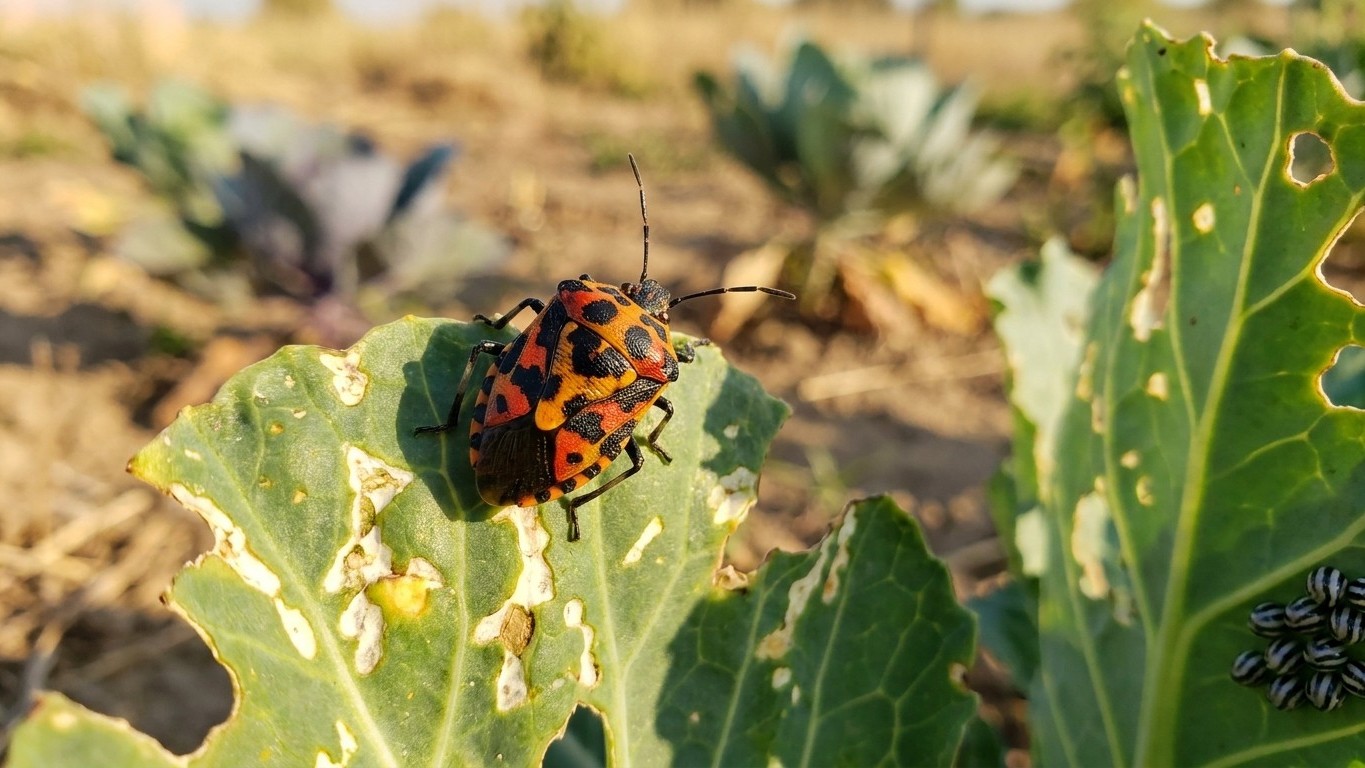

Harlequin bugs start showing up in Kansas gardens as early as May in the southern counties, but the real trouble begins in July when populations explode on cabbage, kale, and broccoli. The most effective way to stop them combines destroying overwintering debris in fall, handpicking egg clusters through summer, and rotating brassica crops so the bugs can’t settle into a predictable food source year after year.
What a Harlequin Bug Actually Looks Like

This is not a subtle insect. Adult harlequin bugs (Murgantia histrionica) measure about 3/8 inch long, shaped like a shield, and painted in bold patches of black, orange, and red. Gardeners sometimes mistake them for a fancy stink bug, and that’s not far off. They belong to the same family, and if you crush one, you’ll get the same acrid smell as a squashed stink bug.
The eggs give them away before the adults ever appear. Females lay barrel-shaped eggs in tidy double rows, usually twelve per cluster, striped black and white like tiny beach balls stacked on end. Find these on the underside of a cabbage leaf and you know an infestation is starting, often days before you spot the adults themselves.
Nymphs go through five stages before reaching adulthood, each one a slightly larger, wingless version of the last, cycling through orange and black patterns. All life stages feed the same way: piercing plant tissue and sucking out fluid, which leaves white or yellow blotches on leaves that eventually turn brown and papery. On a heavily hit plant, leaves look bleached and skeletal within a week.
When Harlequin Bugs Show Up in Kansas
Kansas sits near the northern edge of where this insect can reliably survive winter. The bug originated in Mexico and Central America, and it needs a mild enough cold season to make it through as an adult tucked under leaf litter, mulch, or garden debris. That’s why sightings cluster more heavily in the southern and eastern parts of the state, particularly around Wichita and the counties bordering Oklahoma, where winters run a few degrees warmer than in the northwest.
First activity typically appears in late April or May, once soil temperatures climb enough to wake overwintering adults. Those survivors mate and lay the first egg batches on early brassicas, and depending on how warm the summer runs, Kansas can see two to three generations before frost. Compare that to Texas or the Gulf Coast, where four or more generations are common, and it’s clear why infestations in Kansas, while real, rarely reach the severity seen further south.
Peak pressure lands in July and August. That’s when second and third generation nymphs overlap with adults, and a single uncontrolled cabbage patch can host hundreds of bugs at once. A hard freeze in October usually ends the season, though a mild fall can stretch activity into early November in sheltered gardens.
One detail catches gardeners off guard: harlequin bugs don’t fly far or fast. They’re strong walkers but weak fliers, which means an infestation often traces back to a specific patch of overwintering debris nearby rather than a swarm arriving from across the county. Check compost piles, old mulch, and dead plant material left standing over winter, because that’s usually where the next season’s problem is already waiting.
Which Plants Take the Hit
This pest sticks almost exclusively to the mustard family. Cabbage, kale, broccoli, Brussels sprouts, collards, radish, turnip, and mustard greens are all fair game. Kansas gardeners growing tomatoes, peppers, or squash rarely see harlequin bug damage at all, since the insect has little interest in crops outside that family, unless brassicas nearby have run out and hungry nymphs start sampling neighboring plants out of desperation.
What Actually Stops Harlequin Bugs
No single tactic wipes out a harlequin bug problem on its own. What works is layering a few methods so the insect never gets a stable foothold across seasons.
Cultural Controls: Starve the Next Generation
Fall cleanup matters more than most gardeners realize. Pulling and destroying brassica stalks and leaves after harvest, rather than leaving them to decompose in place, removes the shelter overwintering adults depend on. Composting infested debris in an open pile doesn’t count as destruction; the bugs simply relocate to the pile itself. Burning, bagging for trash pickup, or burying debris a foot deep breaks the cycle far more reliably.
Crop rotation adds another layer. Moving brassicas to a different bed each year, ideally with at least 100 feet of separation if space allows, forces surviving adults to travel further to find food in spring. Since harlequin bugs walk more than they fly, distance alone can cut early-season colonization significantly.
Trap Cropping: Give Them Somewhere Else to Go
Kansas State University Extension entomologists have long recommended trap cropping for brassica pests, and harlequin bugs respond well to it. Planting a border of mustard or collards a few weeks before the main crop draws adults to the trap plants first. Once the trap crop is loaded with bugs and eggs, growers pull and destroy it entirely, eliminating a large share of the population before it ever reaches the main harvest.
Handpicking and Physical Removal
For home gardens under an acre, handpicking remains one of the most effective tools available, mostly because harlequin bugs are slow, visible, and don’t scatter the way some pests do. Checking leaf undersides twice a week during peak season, crushing egg clusters and dropping adults into a jar of soapy water, keeps small infestations from becoming large ones. It’s tedious, not glamorous, but it works without any chemical input at all.
Floating row covers installed at planting time block adults from reaching young seedlings in the first place. This matters most in May and early June, before natural predator populations have built up enough to help.
Biological and Chemical Backup
Natural enemies do some of the work if given the chance. Tachinid flies parasitize harlequin bug adults, and general predators like spiders and ground beetles pick off nymphs. Avoiding broad-spectrum insecticide use early in the season helps these predators establish, since a spray that kills harlequin bugs will also kill the insects hunting them.
When populations spike beyond what handpicking can manage, insecticidal soap or neem oil applied directly to nymphs offers a lower-impact option than synthetic pyrethroids. Nymphs are far more vulnerable to these treatments than hardened adults, so timing application to the first flush of eggs hatching produces the best results. Pyrethrin-based products work faster if an infestation has gotten out of hand, though they should be used as a last step rather than a first response, given their effect on beneficial insects too.
One thing separates harlequin bug management from most other garden pest problems: the fight is largely won or lost in autumn, not summer. Gardeners who clear brassica debris thoroughly after the last fall harvest routinely report far fewer bugs the following May, while those who leave dead cabbage stalks standing over winter tend to face the same infestation, sometimes worse, year after year.
Related guides
- Harlequin bug in Oklahoma: When It Shows Up and What Stops It
- Harlequin bug in Colorado: When It Shows Up and What Stops It
- Harlequin bug in Maryland: When It Shows Up and What Stops It
- Harlequin bug in Tennessee: When It Shows Up and What Stops It
- Harlequin bug in West Virginia: When It Shows Up and What Stops It
- Harlequin bug in Virginia: When It Shows Up and What Stops It