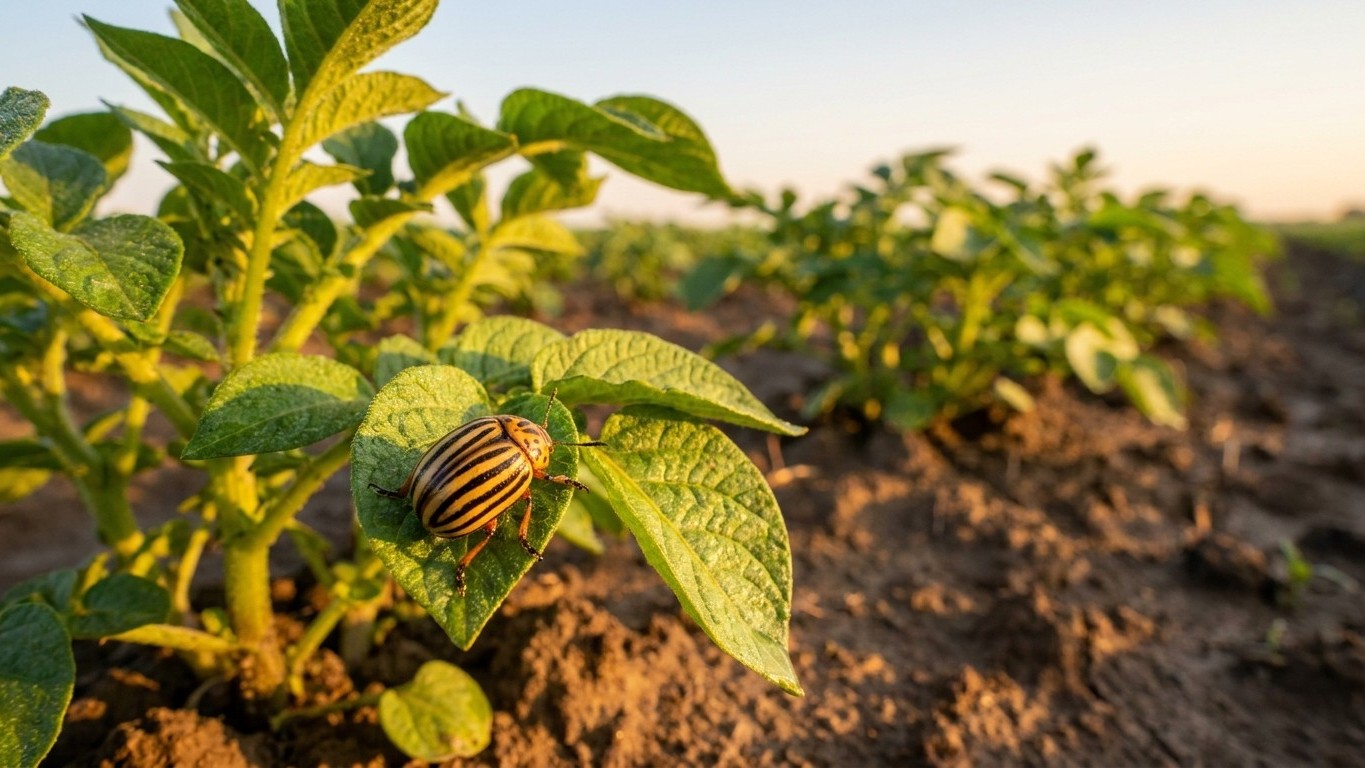

Colorado potato beetles start crawling out of the soil in Kansas as early as mid-April in the southeast and not until mid-May in the far northwest, tracking soil temperature more than the calendar. What actually stops them isn’t one product but a combination: crop rotation, hand removal early in the season, targeted biological insecticides like Bacillus thuringiensis, and rotating chemical classes because this beetle has a well-documented habit of shrugging off pesticides after a few seasons of repeated use.
Kansas growers deal with a pest that’s been chewing on nightshade-family plants in this exact region longer than potatoes have even been grown here. That history matters, because it explains why the beetle is so hard to eliminate and so quick to bounce back.
Why This Beetle Has Deep Roots in Kansas

The Colorado potato beetle didn’t start out as a potato pest at all. Long before European settlers planted the first potato fields on the Great Plains, the beetle was feeding on buffalobur (Solanum rostratum), a spiny, yellow-flowered weed native to Kansas, Nebraska, and the surrounding prairie states. Buffalobur still grows along roadsides and in overgrazed pastures across Kansas today, and it’s still a beetle magnet.
Once settlers started planting potatoes westward in the 1850s, the beetle simply switched hosts. Potato foliage turned out to be easier to reach in dense rows and far more nutritious than a scrubby prairie weed. The insect spread eastward from the plains states, reaching the Atlantic coast within about 25 years, an invasion speed that was remarkable for foot and wagon-era America. Kansas isn’t just a place where this beetle happens to live. It’s close to ground zero for where the pest problem began.
That origin story has a practical side effect for Kansas gardeners: buffalobur and related wild nightshades growing near a garden or field edge act as a reservoir. Beetles can build up numbers on weeds before potatoes even emerge, then move over once a preferred host is available. Mowing or pulling buffalobur along fence lines and ditches isn’t just tidy yard work. It removes a launching pad.
When Colorado Potato Beetles Show Up in Kansas
Adult beetles overwinter several inches deep in soil, usually at the edge of the previous year’s potato patch or in nearby weedy cover. They wait for soil temperatures to climb into the low 50s Fahrenheit before digging out, which is why timing shifts noticeably across the state.
In southeast Kansas, where spring soil warms fastest, emergence often begins in mid-to-late April. Central Kansas typically sees the first adults in early May. Western and northwestern counties, where spring soil temperatures lag by two to three weeks compared to the southeast, usually don’t see beetles moving until mid-to-late May. Kansas State University Research and Extension entomologists track this pattern every year because it directly affects when scouting should start.
Once adults emerge, they fly or walk to the nearest potato, eggplant, or tomato planting and start feeding almost immediately. Females lay clusters of 10 to 30 bright yellow-orange eggs on the underside of leaves within a week or two of emerging, and a single female can lay several hundred eggs over her lifetime. That’s the point where a small problem can turn into a stripped field in under a month.
Kansas summers are warm enough to support two full generations most years, and in unusually hot, early years a partial third generation can develop before frost. Each generation takes roughly 30 to 45 days from egg to adult, so a beetle population discovered in May can produce offspring feeding on the same plants by late June, and a third wave by August in warmer years. That compressed timeline is exactly why waiting to act until damage is obvious usually means the infestation is already established.
Identifying the Beetle at Every Stage
Confusing this pest with a harmless look-alike is common, so knowing what to check for at each life stage saves time.
- Adults: About 3/8 inch long, rounded and hard-shelled, with bright yellow-orange wing covers marked by ten distinct black stripes running lengthwise. The head has a small black triangle marking.
- Eggs: Bright orange-yellow, football-shaped, laid in tight clusters of 10 to 30 on the underside of leaves.
- Larvae: Reddish-orange and humpbacked when young, fading to a dull salmon-pink as they grow, with two rows of black spots along each side. Larvae do more damage than adults, since they feed almost nonstop through four growth stages before dropping to the soil to pupate.
- Damage pattern: Ragged holes starting at leaf edges, progressing to skeletonized leaves with only the veins left, usually beginning on lower and outer plants in a row.
A related Kansas insect, the false potato beetle, looks almost identical but tends to stick to horsenettle and rarely causes serious economic damage on cultivated potatoes. Checking stripe count and host plant helps rule it out, though for backyard purposes the control approach is similar enough that misidentification rarely causes real harm.
What Actually Stops Colorado Potato Beetles in Kansas
No single method holds this pest back for long, because it’s one of the fastest insects in North America at developing resistance to insecticides. Populations in several states have shown resistance to more than 50 different active ingredients over the decades since synthetic pesticides became widely available. That track record is why Kansas State University Extension recommends layering tactics rather than relying on one spray program.
Cultural controls that reduce the starting population
Crop rotation is the single most effective non-chemical tool available. Moving potato and eggplant plantings at least 200 to 300 feet from the previous year’s location forces overwintered adults to search farther for food, and many simply don’t survive the trip or find it in time to reproduce successfully. Rotating to an unrelated crop family for at least one full year interrupts the local buildup that happens when potatoes go in the same spot season after season.
Deep straw mulch around plants has shown real results in university trials, apparently because it interferes with the beetle’s ability to walk across open soil to reach host plants and provides cover for predatory insects like ground beetles that feed on CPB eggs and larvae. A related trick some Kansas growers use is a trench lined with plastic sheeting around the potato patch perimeter, which traps walking adults trying to migrate in from overwintering sites before they reach the crop.
Hand removal still works, especially early
Checking the undersides of leaves twice a week starting at first emergence and knocking egg clusters into a bucket of soapy water remains one of the most reliable methods for home gardens and small plots. Catching the first generation before it lays eggs prevents the population explosion that makes mid-summer control so much harder. This sounds tedious, and it is, but a 20-by-20-foot potato patch can realistically be checked in under ten minutes once the routine is established.
Biological and targeted chemical options
Bacillus thuringiensis subspecies tenebrionis (sometimes labeled Btt or “San Diego” strain) targets young larvae specifically and has essentially no impact on bees or beneficial insects, making it a solid first-line spray once larvae are spotted. Spinosad-based products offer another option with a different mode of action, useful for rotating away from Bt if larvae persist. Neem oil products can suppress feeding and disrupt molting in younger larvae, though they work best as a supplement rather than a standalone fix once populations are heavy.
For larger plantings where synthetic insecticides are part of the plan, rotating between different chemical classes each generation, rather than spraying the same product all season, is the practice Kansas State University Research and Extension specialists point to as the main defense against resistance. Spraying the same active ingredient repeatedly within one growing season is essentially training the surviving beetles to tolerate it, and their short generation time means that training happens fast.
Watching for the Second Wave
Kansas gardeners who treat the first generation and consider the problem solved are often surprised by a second flush of damage in July or August. Overwintered adults that survived spring control efforts, plus any larvae that escaped notice, mature into a new adult generation that lays another round of eggs. Continued scouting through late summer, not just in spring, is what separates a one-time nuisance from a season-long fight.
Fall cleanup matters more than most gardeners assume. Tilling potato and eggplant beds after harvest exposes beetles preparing to burrow down for winter, and removing plant debris where they might shelter cuts into next year’s starting population before it ever has a chance to build.
Related guides
- Colorado potato beetle in Oklahoma: When It Shows Up and What Stops It
- Colorado potato beetle in Maine: When It Shows Up and What Stops It
- Colorado potato beetle in Manitoba: When It Shows Up and What Stops It
- Colorado potato beetle in West Virginia: When It Shows Up and What Stops It
- Colorado potato beetle in Quebec: When It Shows Up and What Stops It