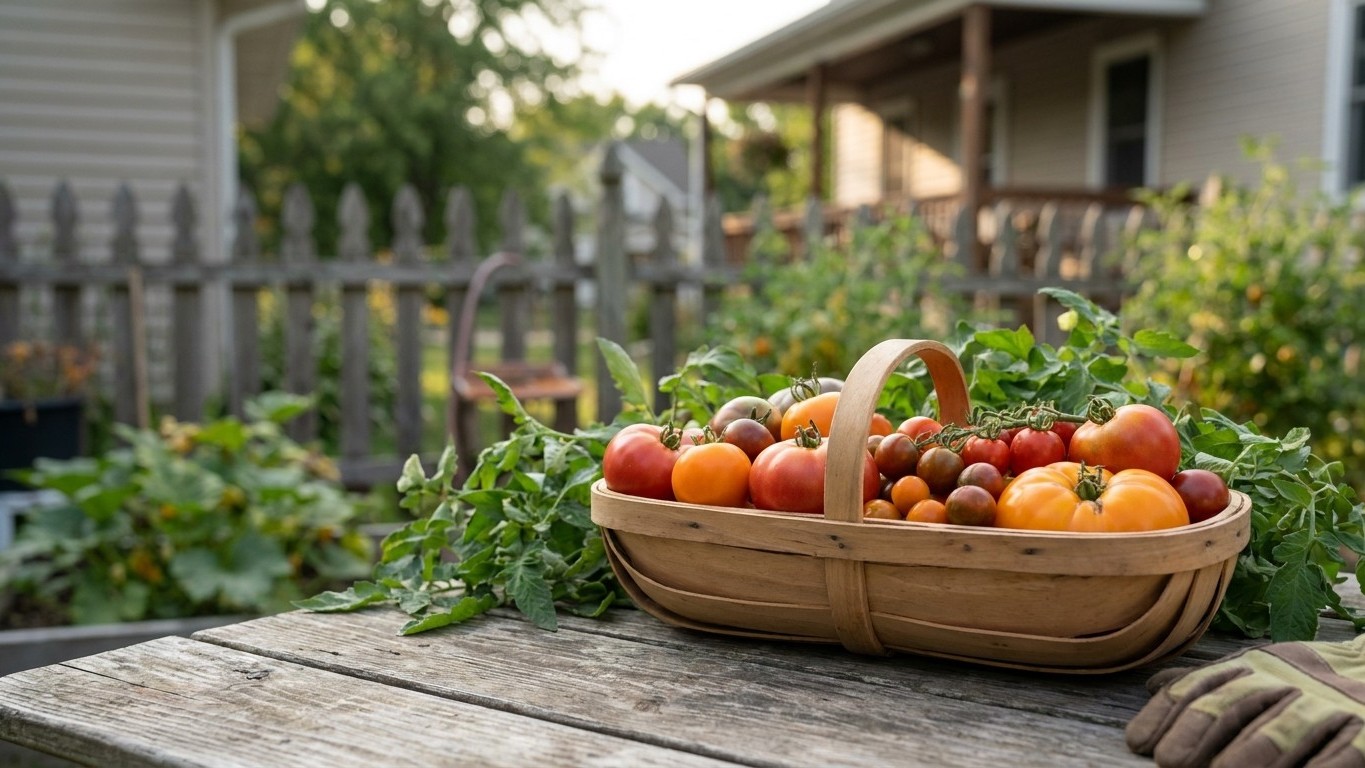

Tomatoes ripen in time almost anywhere in Wisconsin if the variety’s days-to-maturity fits inside the frost window. NOAA’s 1991-2020 climate normals put the last spring freeze at Milwaukee between April 16 and April 29, and the first fall freeze there between October 17 and October 29, which leaves most transplants five to six months to finish. Match the seed packet’s days-to-maturity number to that window before you buy, and treat anything past about 78 days as a variety you’re pushing rather than one this climate hands you easily.
What this comes down to in Wisconsin

Sakura’s fifty-five days on the seed packet sounds like a countdown you can trust, but that number assumes a transplant date and a climate that isn’t Milwaukee’s. Set out late April to mid May, Sakura still lands its first ripe cherry tomato by early July, with about 102 days to spare before frost — proof the packet number holds here, once you anchor it to the right start date. Sun Gold follows the same math, two days slower, sweeter, and just as safe.
Sakura

Sakura reaches its first ripe fruit around 55 days from transplant, among the fastest on this list, and produces small red cherry tomatoes in long clusters. Set out late April to mid May, it’s typically ripening by early July at Milwaukee, leaving about 102 days of margin before the first fall frost. It also carries intermediate resistance to nematodes and high resistance to tomato mosaic virus and both common races of fusarium wilt, which matters more in a garden that’s grown tomatoes in the same spot for years.
Sun Gold

Sun Gold matures in about 57 days and produces small, glossy orange-gold cherry tomatoes with a reputation for sweetness that outruns most red cherries. It ripens by early July on the same late April to mid May transplant schedule, with roughly 100 days of margin before frost. Its resistance to tobacco mosaic virus and fusarium wilt race 1 makes it a low-risk pick for a first-time grower who wants an early harvest without babying the plant.
Supersweet 100
Supersweet 100 needs about 60 days from transplant and produces heavy, long clusters of small red cherry tomatoes on a vigorous indeterminate vine. First ripe fruit typically shows up in mid July at Milwaukee, with about 97 days of margin left before frost. It resists both verticillium wilt and fusarium wilt race 1, which are two of the more common soil-borne problems in gardens that reuse the same tomato bed.
Juliet

Juliet also runs about 60 days to maturity and produces small, elongated grape tomatoes in heavy clusters, useful whole in salads or halved for a quick sauce. It reaches first ripe fruit by mid July with roughly 97 days of margin before the fall frost window, and its intermediate resistance to both early and late blight helps it hold up through Wisconsin’s humid August stretches better than an unprotected slicer.
Amalfi

Amalfi takes about 68 days and produces an elongated red plum-shaped fruit on a compact, determinate plant, bred for paste and canning rather than fresh slicing. It ripens by mid July with about 89 days of margin before frost, and its intermediate resistance to late blight, early blight, and nematodes makes it one of the sturdier choices for a gardener who’s had blight trouble in past seasons.
Cherokee Purple

Cherokee Purple runs about 72 days from transplant and produces a large, dusky purple-pink beefsteak with the deep, slightly smoky flavor heirloom growers plant it for. It’s typically ripening by late July at Milwaukee, with about 85 days of margin before the first fall frost. It carries no listed disease resistance, so it leans harder on soil health, air circulation, and crop rotation than the hybrids around it on this list.
Big Beef Plus

Big Beef Plus also needs about 72 days and produces a large, smooth red beefsteak suited to slicing for sandwiches and burgers. It ripens by late July with roughly 85 days of margin before frost, and it carries intermediate resistance to nematodes plus high resistance to gray leaf spot and tomato mosaic virus, giving it a broader disease-resistance package than the heirloom above.
Tiren
Tiren takes about 75 days and produces a medium-large, smooth red round fruit on a tall indeterminate vine, often grown for sauce as much as fresh eating. First ripe fruit lands around late July at Milwaukee, with about 82 days of margin before frost. Its resistance to verticillium wilt, tomato mosaic virus, and fusarium wilt race 1 makes it a reasonable pick for a longer-season paste tomato without pushing the calendar too far.
San Marzano II
San Marzano II is the longest season on this list at about 78 days, producing the classic elongated, narrow-pointed red paste tomato used for canned sauce. It’s typically ripening by late July at Milwaukee, with about 79 days of margin before the first fall frost, the tightest buffer of any variety named here. That’s still comfortable in an ordinary year, but it’s the one to skip if you’re planting late, gardening farther north, or working with anything shorter than a full growing season.
| Variety | Days to maturity | Growth habit | Key disease resistance | Margin before frost (Milwaukee) |
|---|---|---|---|---|
| Sakura | 55 | Indeterminate | Nematodes, ToMV, Fusarium 1/2 | 102 days |
| Sun Gold | 57 | Indeterminate | TMV, Fusarium 1 | 100 days |
| Supersweet 100 | 60 | Indeterminate | Verticillium, Fusarium 1 | 97 days |
| Juliet | 60 | Indeterminate | Early/late blight (intermediate) | 97 days |
| Amalfi | 68 | Determinate | Nematodes, late/early blight (intermediate) | 89 days |
| Cherokee Purple | 72 | Indeterminate | None listed | 85 days |
| Big Beef Plus | 72 | Indeterminate | Nematodes, gray leaf spot, ToMV | 85 days |
| Tiren | 75 | Indeterminate | Verticillium, ToMV, Fusarium 1 | 82 days |
| San Marzano II | 78 | Indeterminate | None listed | 79 days |
Working it out for your own garden
The method matters more than any single variety, because your own transplant date will shift a week or two from year to year. Start with NOAA’s 1991-2020 normals for Milwaukee: last spring frost April 16 to April 29, first fall frost October 17 to October 29. Add the variety’s catalog days-to-maturity to your transplant date, remembering that figure is counted from the day the plant goes into the ground, not from seed, and that it will run a few days longer in a cool or cloudy summer.
A variety that clears the window
Take San Marzano II at 78 days. Set out late April to mid May and count forward roughly eleven weeks: that lands first ripe fruit in late July, matching the catalog figure. Measured against Milwaukee’s earliest possible fall frost of October 17, that leaves about 79 days of open season, more than two months of extra ripening time even in a slow year. Show your own arithmetic as a range, never a single date, because a transplant window and a frost window are both ranges to begin with.
A variety that runs out of room
Now take a hypothetical 95-day heirloom slicer, a common days-to-maturity for many beefsteak heirlooms that aren’t on the list above. Transplanted late April to mid May, day 95 lands in early to mid August, which still clears Milwaukee’s earliest fall frost date by a wide margin. The real risk with a variety like that isn’t the Milwaukee-area calendar at all. It’s a cool, cloudy summer that pushes ripening back two or three weeks, or a garden farther north where the season is shorter to begin with, which is exactly the situation the shorter maturities and disease-resistance codes on the list above are built to avoid.
What changes across the state
Wisconsin isn’t one climate, and the Milwaukee figures above are a starting point, not a statewide fact. NOAA’s own caution on these normals notes that Lake Michigan delays the first fall freeze along the lakeshore, while inland southern Wisconsin typically freezes in early October and the north freezes far earlier still. That gap can run to several weeks between a lakeshore garden and one thirty miles inland, let alone one near the Michigan or Minnesota border.
The USDA’s hardiness map puts the state anywhere from zone 3b in the far north to zone 6a near the Illinois border and the Lake Michigan shoreline, and that spread tracks the frost dates closely: warmer zones generally mean a longer frost-free stretch, colder zones a shorter one. A gardener in the northern part of the state should treat every margin number as smaller than it looks at Milwaukee, and a gardener right on the lakeshore should treat the fall side of the window as a little more forgiving than inland figures suggest.
Elevation and local topography move things too, in ways no single station can capture. A low frost pocket at the bottom of a slope can see frost weeks before a garden a quarter mile away on higher ground, regardless of what the regional normals say. That’s a reason to treat every date as a planning range, not an instruction, and to watch your own thermometer and soil temperature as the season turns.
The mistakes this state punishes

The errors that cost Wisconsin gardeners a harvest are almost always calendar errors, not variety errors. Every one of the nine cultivars above finishes with real margin at Milwaukee’s frost dates, so a lost crop usually traces back to how the plant went in the ground rather than which cultivar it was.
- Setting transplants out too early. A warm stretch in early to mid April doesn’t mean the last frost has passed. NOAA’s normals put that date anywhere from April 16 to April 29 at Milwaukee, and a single cold night can set a tomato back by weeks even if it survives.
- Choosing a long-season variety for a short garden window. San Marzano II and Celebrity Plus both run 78 days and still finish comfortably at Milwaukee, but the same variety planted farther north, where frost arrives far earlier, can run out of room. Check your own region’s frost pattern before committing a full row to the longest-season variety on this list.
- Missing the pest window. Several of the insects that show up on Wisconsin tomatoes arrive at predictable points in the season, and treating too late costs more fruit than treating early. See Tomato Pests in Wisconsin: Which Ones Actually Show Up Here for what to watch for and when.
None of these mistakes are about the plant itself. They’re about matching the plant’s calendar to the state’s, which is the whole point of choosing a variety by days-to-maturity rather than by name recognition.
Checking this against your county
Everything above is anchored to one weather station near Milwaukee, and NOAA’s own data shows the fall frost date alone can shift by weeks between the lakeshore and the interior. Before you commit a full garden to any variety, check your county extension office for local frost records, and look at the University of Wisconsin’s own tomato growing guide through WISC Extension for management notes specific to your part of the state. A statewide figure is a starting point for planning, not a substitute for what’s happened in your own garden the last few years.
Common questions
Can I grow a 90-day tomato in Wisconsin at all?
Usually yes at Milwaukee, where NOAA’s normals allow up to roughly six months between frosts, but the margin shrinks fast farther north or in a cool summer. None of the cultivars run past 78 days, which keeps a comfortable buffer even in an average year.
Why did my tomatoes ripen so much later than the days-to-maturity said?
Catalog days-to-maturity figures are averages from a controlled trial, not a promise. Cool nights, cloudy stretches, and a late or stressed transplant can all push actual ripening a week or two past the printed number, which is why the margins in the table above matter more than the raw days-to-maturity figure alone.
Do disease-resistant varieties ripen faster too?
No, resistance codes and days-to-maturity are unrelated traits. A resistant variety like Big Beef Plus or Tiren still ripens on its own schedule. Resistance just means it’s less likely to lose leaves and vigor to a specific disease partway through the season, which indirectly protects the harvest but doesn’t speed it up.
Should I start with the shortest-season variety just to be safe?
Not necessarily. Every variety finishes with real margin before frost at Milwaukee, so the shortest-season options mainly buy you an earlier first harvest and a longer stretch of fresh fruit, not a rescue from a season that would otherwise fail. Pick based on what you want to eat or can, then check the margin as a second step.