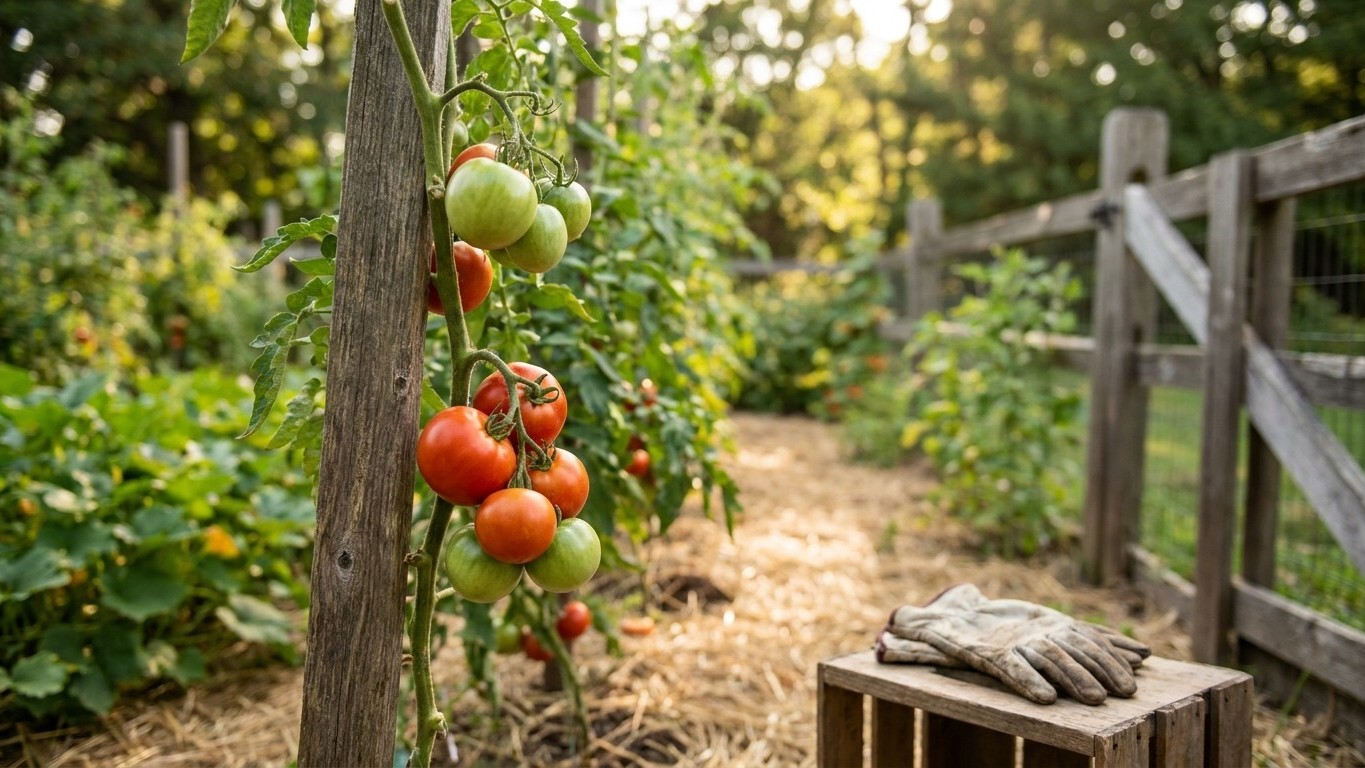

April 16 to April 29 is the window where Milwaukee’s last 32°F freeze typically falls, and that’s the earliest anyone near there should trust bare soil with a tomato transplant. Further north or at elevation, push that later — frost doesn’t read calendars, it just tapers off slower the farther you sit from the lake’s moderating warmth. A seedling six to eight weeks along, hardened off for a week outside, is what meets that date. Cold soil stalls roots even without frost, so patience past the average pays off.
When to plant Tomatoes in Wisconsin

NOAA’s National Centers for Environmental Information, drawing on the 1991-2020 climate normals recorded near Milwaukee, place the 32°F last freeze somewhere between April 16 and April 29. That spread exists because freeze risk tapers off gradually rather than stopping on a fixed day. Southern Wisconsin near Milwaukee sits toward the early end of the state’s frost calendar. Gardeners farther north, in the Northwoods or at higher elevation, should expect their own last frost to land later than this window and should treat the Milwaukee dates as the earliest realistic case, not their own.
Tomatoes are killed outright by frost, so nothing goes into open ground before that window has passed. Most experienced growers wait a week or two beyond the average date anyway, since a reading in the 30 to 70 percent probability band still carries real risk, and cold soil stalls a young transplant’s roots even on a night that never quite reaches freezing.
Counting back for seed starting
A tomato seedling needs roughly six to eight weeks of growth indoors before it’s a sturdy enough transplant to go outside. Count six weeks back from the early end of the Milwaukee window, April 16, and you land in early March. Count eight weeks back from the late end, April 29, and you land closer to the start of March. Worked together, that puts indoor sowing somewhere across late February through mid-March for most of southern Wisconsin, with growers farther north pushing a few weeks later to match their own delayed frost date.
Sow two seeds per cell about a quarter inch deep in a seed-starting mix, under grow lights held a few inches above the foliage as the seedlings stretch upward. Thin to the stronger seedling once true leaves appear, and pot up into a larger container if the transplant date is still weeks off and roots are already crowding the cell.
Hardening off and transplanting
Give transplants seven to ten days outside in gradually increasing doses of sun and wind before they go into the ground for good. Start with an hour or two in a shaded, wind-protected spot and add time each day. Skipping this step is the single most common reason a healthy-looking transplant sulks, wilts or scorches in its first week outdoors.
Move plants to their final bed only after the Milwaukee-area frost window has closed and overnight lows are staying comfortably above freezing. Warm soil matters as much as warm air, since tomato roots stall in cold ground even under a clear, frost-free sky. If a late cold snap is forecast after transplanting, cover plants overnight with a bucket, row cover, or cloche rather than risk losing them a week into the season.
Soil and site preparation
Tomatoes want at least six to eight hours of direct sun a day, and more helps in a state where cloudy stretches are common through early summer. Pick the sunniest spot available, away from the shade line of trees and fences. Keep some distance from black walnut trees too. Their roots release juglone, which can stunt or kill tomato plants even at a distance that looks safe.
Work compost or aged manure into the bed a few weeks before transplanting rather than the day of, so it has time to break down instead of competing with young roots for nitrogen. A loose, well-drained loam is the goal. Heavy clay, common across parts of the state, benefits from a raised bed or at least a mounded row, since tomato roots rot quickly in ground that stays soggy after rain. Gardeners working similarly heavy clay elsewhere face the same drainage tradeoffs, something covered in our guide to growing tomatoes in West Virginia, where hillside clay soils create their own version of the problem.
Test drainage before committing a bed to tomatoes. Dig a hole about a foot deep, fill it with water, and watch how long it takes to drain. Water still standing after several hours signals a site that needs amending, or raising, before it’s worth planting into.
Space plants generously. Indeterminate varieties that run all season need at least two to three feet between plants and three to four feet between rows if staked or trellised. Sprawling, unstaked plants want even more room. Crowded plants trap humidity in the foliage, which is exactly the condition that lets early blight and other fungal diseases take hold. Set cages or stakes in at planting time rather than weeks later, so you’re not driving a stake past an established root ball.
A thin mulch layer, straw or shredded leaves, can go down within a week or two of transplanting once the soil has had a chance to warm under open sun. Mulching too early traps cold into the soil and undoes some of the benefit of having waited for the frost window to close in the first place.
Varieties that suit Wisconsin
Southern Wisconsin’s growing season, bounded by NOAA’s frost data, runs from that mid-to-late April thaw to a first fall freeze that typically arrives in early October away from the lakeshore, a season on the order of five months for inland gardeners near Milwaukee. Areas close to Lake Michigan tend to freeze later in fall than inland sites, which stretches their season a little further, while gardeners farther north lose weeks off both ends. That season length is the main thing to weigh when picking a variety, ahead of flavor or fruit size.
Matching maturity to the season
Days-to-maturity figures on a seed packet are counted from the transplant date, not from seed, and they shift by a week or two depending on how warm and sunny the actual season turns out to be. Even the longest-season variety on this list fits inside a Milwaukee-area season: Amish Paste, at 85 days from transplant, set out at the tail end of the local frost window still has time to ripen well before an early-October freeze inland. Gardeners farther north, working a shorter frost-free stretch, are better served leaning toward the quicker cultivars instead.
| Variety | Days from transplant | Type | Notable resistance | Best use |
|---|---|---|---|---|
| Sun Gold | 57 | Indeterminate | Tobacco Mosaic Virus (High), Fusarium Wilt race 1 (High) | Snacking cherry, earliest to ripen |
| Sakura | 55 | Indeterminate | Nematodes (Int.), Tomato Mosaic Virus (High), Fusarium Wilt races 1,2 (High) | Fastest slicer-cherry on this list |
| Supersweet 100 | 60 | Indeterminate | Verticillium Wilt (High), Fusarium Wilt race 1 (High) | High-volume cherry |
| Jasper | 60 | Indeterminate | Late Blight (High), Early Blight (Int.) | Cherry with the strongest blight resistance here |
| Juliet | 60 | Indeterminate | Late Blight (Int.), Early Blight (Int.) | Grape/paste type, splits less than most cherries |
| Celebrity Plus | 78 | Determinate | Nematodes (Int.), Gray Leaf Spot (High), Tomato Mosaic Virus (High) | Compact all-purpose slicer |
| Amalfi | 68 | Determinate | Nematodes (Int.), Late Blight (Int.), Early Blight (Int.) | Paste tomato, compact plant |
| Big Beef Plus | 72 | Indeterminate | Nematodes (Int.), Gray Leaf Spot (High), Tomato Mosaic Virus (High) | Large beefsteak slicer |
| Cherokee Purple | 72 | Indeterminate | None listed | Heirloom slicer grown for flavor |
| Tiren | 75 | Indeterminate | Verticillium Wilt (High), Tomato Mosaic Virus (High), Fusarium Wilt race 1 (High) | Paste tomato, heavy disease package |
| Granadero | 75 | Indeterminate | Nematodes (Int.), Verticillium Wilt (High), Tomato Mosaic Virus (High) | Paste tomato for canning |
| Brandywine | 78 | Indeterminate | None listed | Heirloom beefsteak, needs the full season |
| San Marzano II | 78 | Indeterminate | None listed | Classic paste tomato for sauce |
| Amish Paste | 85 | Indeterminate | None listed | Longest-season paste, heirloom flavor |
Disease pressure and resistant hybrids
Wisconsin’s humid summers give fungal disease plenty of opportunity, so a variety’s resistance code matters as much as its days-to-maturity number. Celebrity Plus, Big Beef Plus, Amalfi, Tiren and Granadero all carry named resistance to at least one common wilt or mosaic virus, which buys some insurance in a wet year without changing how the plant is grown. The heirlooms, Cherokee Purple, Brandywine, San Marzano II and Amish Paste, carry no listed resistance and lean on good spacing, mulch and airflow to stay ahead of disease instead. None of these traits are a substitute for garden hygiene, but they narrow the odds in the plant’s favor before a single spray is needed.
What to plant alongside
Basil is the pairing most gardeners already do, and while the folklore claim that it repels tomato pests outright doesn’t hold up well under testing, basil takes the same water and light as tomatoes without competing hard for either, and it’s a genuinely useful ground cover between wide-spaced plants. Marigolds have a stronger case behind them: French marigolds have shown real suppression of certain root-knot nematodes in trials, which matters if nematodes have been a problem in that bed before.
Borage and other flowering herbs planted nearby draw in pollinators and predatory insects, useful in a crop that’s self-pollinating but still benefits from a bit of pollinator traffic to shake pollen loose. Onions and garlic tucked at the edge of a tomato bed don’t hurt and don’t help much either, beyond making efficient use of ground that would otherwise sit bare.
Keep tomatoes away from potatoes, peppers and eggplant beyond simple crop rotation. All four belong to the nightshade family and share the same soil-borne blights and wilts, so planting them next to each other, or in the same ground year after year, concentrates disease pressure rather than spreading it out. Corn is worth avoiding too, mainly because it can host the same corn earworm that attacks tomato fruit under the name tomato fruitworm. Brassicas like cabbage and broccoli compete for the same nutrients at a similar root depth and are best given their own bed rather than shoehorned in alongside tomatoes.
- Good neighbors: basil, marigolds (especially French marigolds), borage, onions, carrots
- Neutral, no real evidence either way: chives, parsley, lettuce as a living mulch
- Avoid: potatoes, peppers, eggplant, corn, brassicas in the same bed
Watering, feeding and support
Watering and feeding
Deep, infrequent watering beats a light daily sprinkle. Aim water at the soil rather than the foliage, and water early in the day so any leaves that do get wet have time to dry before evening, since damp foliage overnight is what lets fungal spores establish. Consistency matters more than the exact amount: swinging between bone-dry and soaked soil is what drives blossom end rot and fruit cracking, both covered in more detail below.
Feed at planting with a balanced fertilizer worked into the bed, then hold off on more nitrogen until the first flowers set. Too much nitrogen too early produces a tomato plant that’s all leaf and very little fruit. Side-dress with compost or a fruiting-formula fertilizer, one lower in nitrogen and higher in phosphorus and potassium, once fruit starts sizing up, and again three to four weeks later if the plant is still setting new trusses.
Staking, caging and pruning
Indeterminate varieties, which keep growing and fruiting until frost, need a stake, cage or trellis tall enough to support several feet of vine. Determinate varieties like Celebrity Plus and Amalfi stay more compact and can often get by with a shorter cage. Suckers, the shoots that emerge in the joint between the main stem and a branch, can be pinched off indeterminate plants to concentrate energy into fewer, larger fruit, though leaving a few unpinched gives a bushier plant with more total fruit if size matters less than volume. Determinate varieties should not be pruned this way, since removing growing points cuts into their fixed, one-time fruit set.
Common problems

Diseases and disorders
Blossom end rot shows up as a flat, sunken, leathery brown-black patch on the bottom of the fruit while the rest looks fine. It’s caused by uneven watering interrupting calcium uptake, not a lack of calcium in the soil itself, so the fix is a steady watering rhythm and mulch, not a calcium spray. Fruit cracking, either fine circular cracks around the top or deep radial splits, comes from the same root cause: a dry spell followed by heavy rain or a big drink swells the fruit faster than the skin can stretch.
Leaves that curl upward and feel leathery but stay green are usually a physiological response to heat, wind or uneven watering and correct themselves once conditions settle. Leaves that curl alongside yellowing, mottling or stunted new growth point toward a viral infection instead, most often spread by aphids, and there’s no cure once a plant is infected. Pull and discard infected plants rather than composting them.
Sudden wilting of one whole side of the plant, or the entire plant, even with moist soil, points to Fusarium or Verticillium wilt, both soil-borne fungi that clog the plant’s water-conducting tissue. Several varieties on the table above, including Supersweet 100, Sun Gold, Tiren and Granadero, carry named resistance to one or both, which is the main defense since neither disease has a reliable in-season cure. Gardeners further east dealing with the same wilt pressure under different humidity patterns can compare notes in our guide to growing tomatoes in Connecticut.
Insect pests
Tomato hornworms, thick green caterpillars several inches long with white diagonal stripes, strip foliage fast and are easiest to control by hand-picking them off in the early morning or evening when they’re most active and visible. Aphids cluster on new growth and the undersides of leaves, and a strong water spray or insecticidal soap knocks back a light infestation before it spreads virus between plants. Flea beetles chew small round holes in young leaves and are most damaging on seedlings just after transplanting, when row cover left on until flowering keeps them off without chemicals.
- Blossom end rot: sunken dark patch on fruit bottom, fix watering consistency
- Cracking: splits or rings on the fruit shoulder, fix the same way
- Viral leaf curl: curling plus yellowing and stunted growth, remove the plant
- Wilt: sudden one-sided or whole-plant collapse, favor resistant varieties next season
- Hornworms, aphids, flea beetles: hand-pick, spray, or row cover depending on the pest
Pests that actually show up in Wisconsin
Wisconsin’s extension guide to garden insects lists more than a dozen species, but most of them never touch a tomato plant. Squash vine borer, cucumber beetles, squash bugs, the cabbage-family pests like imported cabbageworm and cabbage maggot, plus the corn pests, are all real threats if you grow those crops alongside your tomatoes, but they leave tomato foliage and fruit alone. The University of Wisconsin-Madison Division of Extension’s A2088, Managing Insects in the Home Vegetable Garden, is the reference for that full list. For tomatoes specifically, four pests on it matter.
Colorado potato beetle is the one to watch first. It moves onto potatoes in May according to the extension guide, and where potatoes and tomatoes share a garden it spreads to tomato foliage just as readily, since both are in the nightshade family. You’ll see ragged, chewed leaf margins before you spot the black-and-yellow-striped adults or the dark orange, humpbacked larvae underneath. Hand-pick both stages into a bucket of soapy water. It’s the only control that reliably keeps small plantings ahead of the damage.
Flea beetles show up on young transplants early in the season, riddling leaves with tiny round shot holes, so many that a badly hit seedling looks like it’s been sprayed with buckshot. Established plants usually outgrow the damage, but a floating row cover over transplants at planting time keeps the beetles off while the plant is still small enough to suffer real setback.
Aphids cluster on the undersides of leaves and new growth, curling and yellowing the foliage they feed on and leaving a sticky residue behind. A strong jet of water knocks most of a colony off, and that alone is often enough. Aphids matter beyond the direct damage too, since they’re the main way the viral infections described above spread from plant to plant.
Cutworms work at night and are a transplant-stage problem only: a healthy-looking seedling is simply severed at the soil line and found lying on the ground the next morning. A cardboard collar pushed an inch into the soil around each transplant stops them cold. The related common stalk borer can tunnel into stems later in the season, causing sudden wilting of a single stem, but it’s far less common in home gardens than cutworm losses at planting time.
Harvest and end of season
Harvest and ripening
Pick tomatoes once they’ve colored up fully and give slightly to a gentle squeeze. Fruit left on the vine past that point doesn’t improve, it just sits exposed to cracking, sunscald and whatever’s chewing nearby. Twist or snip the fruit off rather than yanking, which can tear the stem and open a wound that invites rot. Store ripe fruit at room temperature out of direct sun rather than in the refrigerator, since cold storage below the mid-50s dulls both flavor and texture.
As frost approaches
Inland southern Wisconsin, including the area around Milwaukee, typically sees its first fall freeze in early October, while the immediate lakeshore runs later thanks to the moderating effect of Lake Michigan, and gardens farther north freeze earlier still. Once a fall frost is forecast, pick every fruit showing any color at all, since green tomatoes that have started to turn will usually ripen indoors on a windowsill or in a paper bag over the following one to two weeks. Fruit that’s still fully green and hard rarely ripens well off the vine and is better used green, fried or pickled, than left to gamble on a late warm spell.
Pull the whole plant once the first hard freeze has actually hit, and clear the bed of dropped fruit and fallen foliage rather than leaving it to overwinter, since that debris is where blight and wilt spores spend the winter waiting for next year’s crop.
Local help
County-level frost dates, soil testing and variety trial results vary across a state as long as Wisconsin, and the Milwaukee figures above won’t match conditions in Superior or Eau Claire. The Wisconsin guides hub on this site covers other regional growing questions, and the University of Wisconsin-Madison Division of Extension runs county offices that offer soil testing and localized planting guidance specific to your area.
Where to Go Next
Once you’ve got a feel for the general timing and challenges of growing tomatoes here, the details matter. Start with counting back from your frost window, which works out your actual planting dates from NOAA’s climate normals rather than a generic calendar date — useful whether you’re in Milwaukee or further north where that frost window shifts.
Picking the right plant matters just as much as picking the right day. Tomato varieties that ripen in time walks through which days-to-maturity numbers actually fit inside a Wisconsin growing season, so you’re not left with a plant full of green fruit when the first hard freeze rolls in.
And once your plants are in the ground, something is going to come after them. Which pests actually show up here narrows the long list of possible tomato problems down to the six insects that cause nearly all the reported damage in Wisconsin gardens, in roughly the order they tend to appear, so you know what to watch for and when.
Common questions
Can I plant tomatoes before the last frost if I cover them?
Row cover or a cloche can protect a transplant through a light, brief cold snap, but it’s not a reason to plant weeks ahead of the Milwaukee-area frost window. Cold soil stalls root growth even when a cover keeps the plant itself from freezing, so an early-covered plant often ends up no further ahead than one planted on schedule.
Why are my tomato leaves curling but the plant still looks healthy otherwise?
Leaves that curl upward but stay green and firm are usually reacting to heat, wind or an uneven watering pattern, and they typically flatten back out once conditions even out. Curling paired with yellowing, mottled color or stunted new growth is a different problem, likely viral, and that plant should come out of the garden.
Do I need to rotate where I plant tomatoes every year?
Yes, and it matters more than most gardeners assume. Soil-borne diseases like Fusarium and Verticillium wilt persist in the ground for years, so planting tomatoes, or any other nightshade, in the same spot every season builds up exactly the pathogens that resistant varieties are bred to fight off.
My tomatoes have plenty of flowers but no fruit is forming. What’s wrong?
Poor fruit set is usually temperature-driven. Blossoms can drop without setting fruit during a stretch of nights that stay too warm or days that run unusually hot, since pollen becomes less viable outside a fairly narrow range. It usually corrects itself once temperatures moderate, and there’s rarely anything to spray for it.
Is it worth starting a second round of transplants for a fall crop?
It’s a gamble in most of Wisconsin, since a second planting needs to reach fruiting size well before the fall freeze arrives, and inland southern parts of the state typically freeze in early October. A grower near the lakeshore, where fall frost arrives later, has a slightly better shot at it than one farther inland or north.