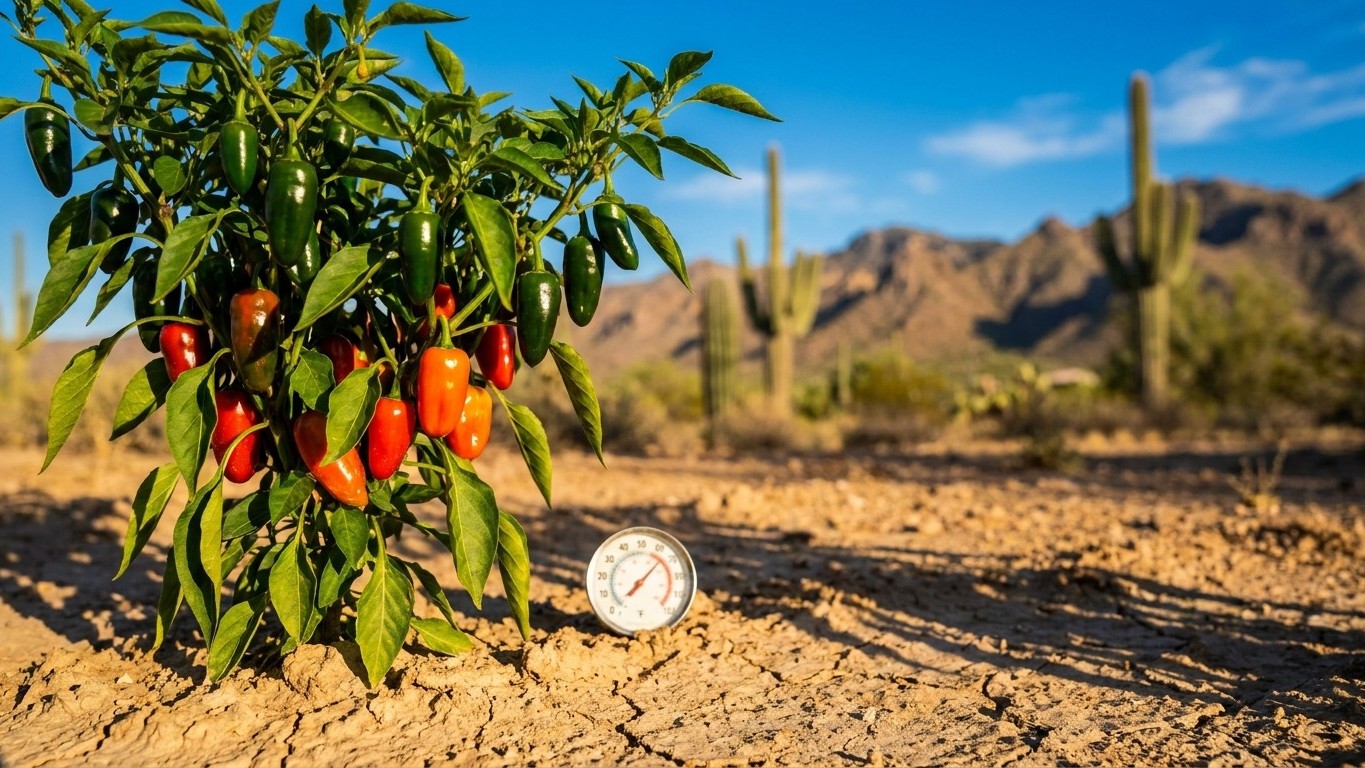

Pick peppers once the fruit reaches full size and the walls feel firm and glossy. Clemson Cooperative Extension puts that point at about 70 to 85 days after transplanting. What happens next matters as much as the picking. Most people carry the harvest straight to the refrigerator, and that is the mistake. A pepper is a warm-season fruit, and standard fridge cold pits and softens it. A cool spot at 45 to 50 °F holds it better. Here is how that works, and where to find that spot in a house.
Keeping them, and for how long
The Home & Garden Information Center at Clemson Cooperative Extension states the optimal storage conditions for peppers as 45 to 50 °F with 80- to 90-percent relative humidity, for two to three weeks. Both numbers matter. The temperature protects the flesh, and the humidity keeps the walls from losing water and wrinkling. You can read the full guidance in the Clemson pepper fact sheet.
Two to three weeks is the ceiling. It describes sound fruit, picked at the right stage and held in that exact range. A pepper with a bruise, a split or a bite taken out of it will go sooner. So will any pepper kept a few degrees warmer or in dry air. Plan on the short end, and treat the long end as a bonus.
Why does the refrigerator damage peppers?
The range of 45 to 50 °F is warmer than a domestic refrigerator runs. Below about 45 °F, peppers pit and soften, a problem called chilling injury. The damage often does not show on the day the pepper goes in. It appears a few days later as small sunken spots, then as soft, watery patches where rot gets a foothold. A pepper that looked perfect on Saturday can be mush by the next weekend, and many gardeners blame the variety or the weather when the cause was the cold shelf.
Dry air is the second hazard. A bare pepper on an open shelf loses water through its skin and shrivels, even at the right temperature. A loosely closed or perforated bag slows that loss and helps hold the humidity near the 80 to 90 percent range. Do not seal the fruit tight, because trapped moisture invites mold.
Which peppers are worth storing?
Only the sound ones. Cut each fruit from the plant with pruners, leaving a short stem, instead of twisting it off. Pulling can snap a branch and open a wound on the fruit. Pick on a dry day, handle the peppers gently, and skip any with soft spots or insect damage. A pepper nibbled by a pest is already open to rot, and the guide to what eats pepper in South Dakota, and when shows which marks to look for. Eat those first, or cut away the damaged part and cook them the same day.
Leave unwashed fruit unwashed until you use it. Water on the skin speeds decay. If a harvest is bigger than you can use in two to three weeks, slice the extras and freeze or dry them. Peppers chopped for cooking do fine in the freezer, and a cut pepper has no use for a pitting-proof shelf anyway.
Where in the house that actually is
A thermometer settles this faster than any rule of thumb, because houses differ. But the general picture holds. The refrigerator is too cold, a heated living space is too warm, and a garage swings with the weather. Each of those fails in a different direction.
Rooms where people live run well above 50 °F, so peppers kept on a counter ripen and soften within days. An attached garage can look like a clever answer, particularly in early fall. Then a sunny afternoon pushes it warm and a clear night drops it toward freezing. That daily swing is rough on fruit. Late in the season, when northern fall nights turn hard, a garage can freeze a shelf of peppers overnight.
The room that usually comes closest is a basement, especially an unheated corner or a cellar room away from the furnace and the water heater. Concrete walls and floors hold a steady temperature through the day and the night, and basements tend to carry the humidity peppers like. Other candidates are an unheated mudroom, a closet on a north wall, or a cool pantry against an exterior wall. None of them is guaranteed to land between 45 and 50 °F, which is why you measure.
How do you check a spot with a thermometer?
Pick a candidate shelf, set it off the floor and away from ducts and pipes, and leave a min-max thermometer there for two or three days before any peppers go in. A min-max model records the coldest and warmest readings, so you see the overnight low and the afternoon high instead of a single snapshot. Skipping this step is how a good harvest ends up in a spot that is 15 degrees too warm or just under the pitting line, and you only find out when the fruit goes soft.
A small hygrometer, which reads humidity, is worth a few dollars too. If the reading sits well under 80 percent, use the loose bag or a lidded container with a few holes. If it sits above 90 percent and you see condensation, open the bag a little and check the fruit every few days for mold. When the thermometer shows the spot running above 50 °F, move to a cooler shelf or accept a shorter storage time. When it reads below 45 °F, the spot is a refrigerator in disguise, and the peppers will pit there too. If no corner of the house fits, cook, freeze or dry what you cannot eat soon.
Common questions
When should I pick peppers before the first fall frost?
Pick every fruit that has reached full size when frost is in the forecast, even if it is still green. Frost damages the plant and the fruit, and a pepper left out on a freezing night will not store. Fruit that is full size and firm will keep ripening to color on a counter, though slowly, and it will not match what it would have been on the plant. Fall frost usually arrives earlier in suburban and rural gardens than at an airport weather station, often by one to two weeks and more at elevation. Your county extension office can tell you the local pattern.
Can peppers go in the refrigerator at all?
Whole, fresh peppers hold up poorly there, because standard refrigerator cold sits below the point where they begin to pit and soften. A cut pepper, a cooked pepper or a leftover half is different. It is already a perishable food, and the fridge is the right place for it. Use cut peppers within a few days. The goal for whole fruit is the cool spot at 45 to 50 °F, and the fridge is a fallback only for what you plan to eat very soon.
Why are my plants flowering but giving me nothing to pick?
Pepper fruit set fails at both ends of the temperature scale: nights below 55 °F or days above 90 °F, according to Utah State University Extension. At the Sioux Falls reference station, NOAA NCEI climate normals show about 13.8 days a year reaching 90 °F or more, so the hot end is limited there but still real in a hot stretch. The cool end is harder to judge from a normal. Watch your own nights, with a thermometer by the plants, because night lows vary a lot from one yard to the next. The guide to why peppers fail to set fruit in South Dakota covers the causes and fixes.
When do I set out transplants so the fruit has time to ripen?
Utah State University Extension says transplants need 8 to 10 weeks indoors, and the soil should reach 60 °F before they go outside, after frost. At the Sioux Falls reference station, NOAA NCEI 1991-2020 Climate Normals put the last spring frost between April 29 and May 9. That is a city figure, and a suburban or rural garden usually sees its last frost later, so check your county. Then count the 70 to 85 days to harvest from the day you transplant. For the full season plan, see growing peppers in South Dakota.