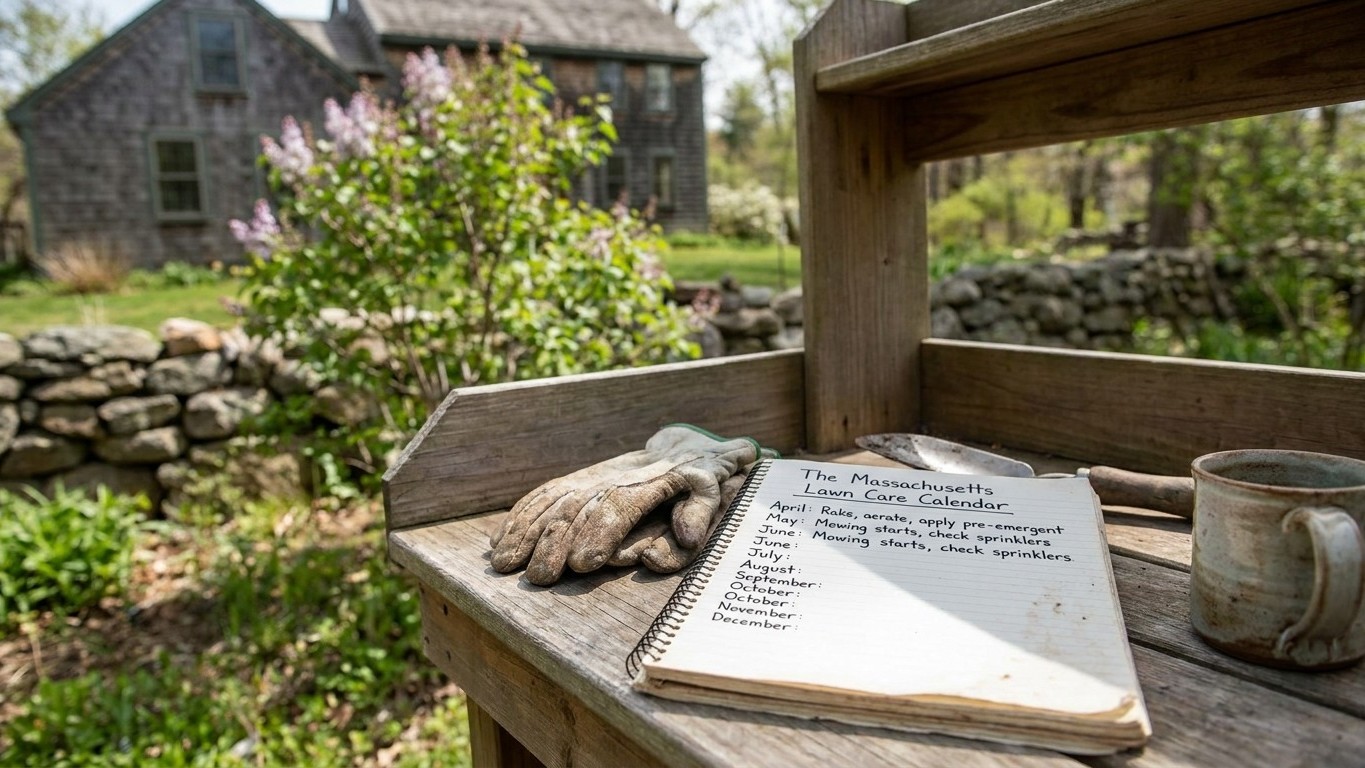

Kentucky bluegrass, tall fescue, fine fescue, perennial ryegrass, rough bluegrass — that’s the whole roster for a Massachusetts lawn, and every one of them is cool-season, built to shrug off a New England winter rather than fake a green Southern one. Boston’s first fall freeze lands somewhere between November 3 and November 14, and that window, not the calendar month, is what actually decides when you seed, feed, or stop mowing. Move inland or uphill and the date creeps earlier.
The short answer for Massachusetts
Massachusetts lawns run on cool-season grass: Kentucky bluegrass, tall fescue, fine fescue, perennial ryegrass and rough bluegrass are the species Clemson Cooperative Extension’s HGIC 1214 and Penn State Extension list as the ones that actually survive a New England winter and a Massachusetts summer. Boston, the reference city used to place the state, falls into what we classify as a cool-season zone. Warm-season turf like bermudagrass or zoysia never truly establishes here, because it goes fully dormant at the first hard frost and doesn’t reliably green back up the following spring.
The calendar below follows Clemson’s HGIC 1219 tall fescue maintenance schedule, the closest published species-level guide to what a Massachusetts lawn actually grows, since tall fescue is one of the five recommended species and its guidance transfers to the others with only minor timing shifts.
Every date on it bends around one number. NOAA’s 1991-2020 normals put Boston’s first fall freeze between November 3 and November 14, measured at Logan Airport, the mildest station in the state. Your own safe date for fall seeding or a last feeding depends on how far you sit from the coast, your elevation, and which of the five grasses you planted, since fine fescue tolerates a colder push than perennial ryegrass does.
Working through the year

Clemson’s HGIC 1219 calendar lays out the order of operations for a tall fescue lawn, and the same order works for the other four cool-season species named above, with the calendar dates shifted later to match New England’s colder, later spring.
Late winter into spring (March to May)
HGIC 1219 calls for a pre-emergent crabgrass treatment timed to soil temperature rather than a calendar date, followed by a first mow once the grass is actively growing, kept at 2.5 to 3.5 inches. That mowing range holds in Massachusetts, but Clemson’s own calendar is written for South Carolina and runs weeks ahead of what New England sees. Many Massachusetts lawn keepers use forsythia bloom as a rough stand-in for a soil thermometer when timing that pre-emergent. Skip a heavy spring nitrogen feeding. Cool-season grass puts most of its root growth into fall, and a big spring dose mostly feeds top growth you’ll be mowing off within weeks.
Summer (June to August)
Raise the mower to the top of that range and leave it there through summer heat. A taller cut shades the soil and slows the drought stress that turns cool-season lawns brown in July and August, though brown here means dormant, not dead. Water deeply and infrequently rather than daily, and hold off on nitrogen almost entirely. Feeding a heat-stressed lawn in July is one of the fastest ways to burn it.
Fall (September into November)
This is the main event on a cool-season calendar. Overseed thin patches in early to mid September, while soil is still warm enough for fast germination but air temperatures have started to drop. Choosing which of the five species to overseed with is worth reading up on in The Best Grass Seed for Massachusetts Lawns before you buy a bag. Aerate around the same window, before or alongside overseeding, since a core-aerated lawn takes seed far better than an unbroken sod surface. Working backward from NOAA’s Boston frost window of November 3 to November 14, get seed down at least six to eight weeks ahead of it so roots have time to establish before the ground cools for good; that puts the safe seeding start in early to mid September near Boston, earlier inland where frost arrives sooner.
Late fall (into the frost window)
Keep mowing until growth stops, lowering back toward the short end of the range for the last cut or two, since long grass matted under snow invites mold. A final nitrogen feeding in the weeks before the ground freezes is standard on HGIC 1219’s calendar and helps the lawn store energy for an earlier green-up next spring.
What changes across Massachusetts
NOAA’s 1991-2020 normals used above are measured at Boston’s Logan Airport, a waterfront station and the mildest spot in the state. Every inland or upland location frosts earlier in fall and thaws later in spring than that number suggests, and the gap isn’t small.
The Berkshires in the far west sit at real elevation, and cold air pools in those valleys overnight, so a Berkshire lawn commonly loses growing season at both ends compared with a Boston-area yard. Fall seeding and aeration need to move earlier there, and spring mowing starts later. The Connecticut River Valley through Springfield and Northampton runs milder than the surrounding hills but still trails coastal Boston.
Cape Cod, the Islands and the South Coast sit at the opposite end. Ocean water holds its warmth into fall, and these areas typically see their first freeze arrive later than Boston’s own range, which means a mow, an overseed or a fall feeding can often run a week or two past what an inland yard can risk.
Boston itself is a warm outlier even among coastal towns, partly from heat held in pavement and buildings. A suburb with more open ground and less pavement, even a few miles inland, will often frost before the city does. Treat the NOAA range as a starting point and watch your own yard’s first frost over a season or two before trusting one week of it.
The mistakes this climate punishes
A few errors show up reliably on Massachusetts lawns, and each one has a specific cause tied to the state’s cool-season climate rather than bad luck.
- Seeding cool-season grass in late spring instead of fall. Bluegrass or ryegrass seeded in May germinates into June heat with roots too shallow to survive July drought, and most of that planting fails by August, not from bad seed but from missing the cool window it needed to root in.
- Cutting too short during a heat wave removes the leaf area a cool-season lawn needs to shade its own roots. The damage doesn’t show right away; it shows up two to three weeks later as thinning, browned patches that can look like disease but are really drought stress stacked on a bad mow.
- Feeding nitrogen in summer pushes soft top growth a heat-stressed lawn can’t support, and that flush is often what actually triggers a fungal outbreak rather than the heat alone.
- Skipping the fall nitrogen application costs the lawn its main window for root growth and stored energy. That gap is invisible in October but shows up as slower, thinner green-up the following April.
- Planting a warm-season species because a mixed bag at the store was cheap sets up guaranteed failure. Bermuda, zoysia and centipede go fully dormant at the first hard freeze and don’t reliably return in a Massachusetts spring, leaving bare patches a cool-season lawn next door never shows.
Checking this against your county
Massachusetts runs from ocean-moderated Cape Cod to the real elevation of the Berkshires, so treat the frost window and calendar timing as a starting point rather than a fixed date for your own yard. The University of Massachusetts Extension publishes county-level guidance, soil testing and turf diagnostics that can confirm the actual frost pattern, soil type and disease pressure for your specific town. If you haven’t settled on which of the five cool-season species to plant, that decision belongs in Massachusetts Lawn Care before you commit to any date on this calendar.
Common questions
Can I plant grass seed in spring in Massachusetts?
You can, but it’s the harder path for cool-season grass. Seed put down in spring gets only a few cool weeks before summer heat arrives, so roots stay shallow going into the first drought stretch, and germination rates usually run lower than a fall seeding. Fall, timed back from NOAA’s first-frost window for Boston, is the stronger bet if your schedule allows it.
My lawn turned brown in July, is it dead?
Probably not. Kentucky bluegrass and tall fescue go dormant and brown under summer drought stress as a survival response, not death, and most green back up within a couple of weeks once regular watering or rain resumes. Give it three to four weeks of consistent moisture before assuming it needs reseeding.
Should I use Kentucky bluegrass or tall fescue?
Both are on Clemson Cooperative Extension’s list of species suited to a cool-season lawn like Massachusetts runs, and they trade off differently. Kentucky bluegrass spreads and self-repairs through rhizomes but wants more water, while tall fescue roots deeper and holds up better through a dry August but won’t fill bare patches on its own. Fine fescue and perennial ryegrass sit at other points on that same trade-off, mostly around shade tolerance and wear.
When do I stop mowing for the winter?
Keep mowing as long as the grass keeps growing, and stop only once growth stalls near the first freeze. NOAA’s 1991-2020 normals put that window at Boston between November 3 and November 14, earlier inland and in the Berkshires, later on Cape Cod. Lower the blade for the final cut or two so the lawn isn’t going into winter matted down under wet leaves and snow.