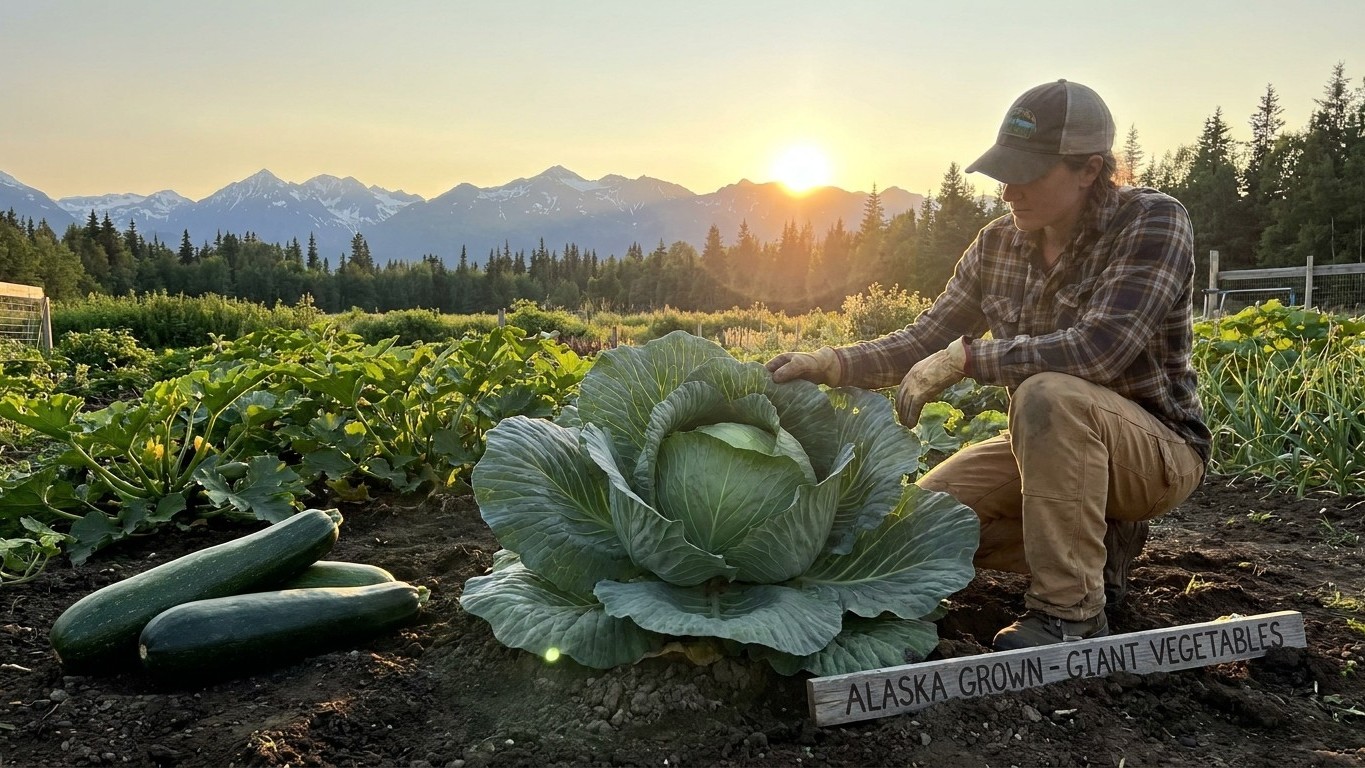

Short summers, ridiculously long days, and soil that ranges from rich glacial silt to solid permafrost: that’s the real math behind growing anything in Alaska. The payoff is real too. Southcentral Alaska regularly produces cabbages topping 100 pounds and zucchini the size of a toddler, all thanks to nearly round-the-clock sunlight in June and July. But the same climate that builds giant vegetables also cuts the growing window down to a fraction of what gardeners in Ohio or Georgia take for granted. Success here means picking the right crops, the right zone, and the right tricks to stretch a season that sometimes barely lasts 100 days.
The Growing Season Is Short, But the Light Makes Up for It

Anchorage typically sees its last spring frost around mid-May and its first fall frost by mid-September, leaving roughly 105 to 120 frost-free days. Fairbanks, deeper in the Interior, works with less: last frost near the end of May, first frost in early September, often just 90 to 100 days total. Compare that to a place like Kansas City, which routinely gets 180-plus frost-free days, and the gap becomes obvious, which is why cold-hardy staples like Growing Potatoes in Alaska remain such a reliable choice for local gardeners, alongside other hardy root vegetables such as those covered in Growing Parsnips in Alaska, Growing Carrots in Alaska, and Growing Beets in Alaska, not to mention quick-maturing leafy greens as shown by Growing Spinach in Alaska, while heat-loving crops require more careful planning, as detailed in Growing Peppers in Alaska.
What Alaska lacks in duration, it partly recovers in daylight hours. Around the summer solstice, Fairbanks gets close to 22 hours of direct sunlight, and areas north of the Arctic Circle experience true 24-hour daylight for weeks. Anchorage isn’t far behind, averaging about 19 hours of light in late June. Plants photosynthesize almost continuously during that stretch, which is why Palmer’s Alaska State Fair has produced record-setting cabbages weighing over 100 pounds and pumpkins pushing past 2,000 pounds in past competitions, results that owe much to the techniques behind Growing Pumpkins in Alaska, giants that also raise the question of When to Carve a Pumpkin in Alaska once fall arrives. The trade-off: that same intense light and short season means many warm-season crops never get enough cumulative heat, regardless of how long, a challenge tackled head-on in Growing Sweet Corn in Alaska the sun stays up.
The University of Alaska Fairbanks Cooperative Extension Service tracks local frost dates by region and is the most reliable source for planning planting windows, since microclimates within the state can shift those dates by two or three weeks in either direction.
Zones and Microclimates Vary More Than People Expect
Alaska isn’t one climate. The USDA Plant Hardiness Zone Map places parts of the state anywhere from zone 1a in the far north to zone 8a in pockets of the Southeast Panhandle, a spread wider than almost any other state.
Southeast Alaska (Juneau, Ketchikan, Sitka)
Coastal, maritime, and comparatively mild. Winters rarely get brutally cold and summers stay cool and damp. Ketchikan sits close to zone 8a, which allows for a longer, gentler season better suited to crops like lettuce, kale, and even some berries that would struggle further north. Rain is the bigger challenge here, not cold. Some areas see over 150 inches of precipitation annually, so drainage matters as much as sunlight.
Southcentral Alaska (Anchorage, Palmer, Wasilla)
This is the state’s agricultural heart, largely because of the Matanuska Valley’s glacial silt soil and long summer daylight. Zones here generally fall between 3b and 5b depending on elevation and proximity to water. It’s the region behind most of Alaska’s famous giant-vegetable stories, and it hosts the state’s largest concentration of small farms and community gardens.
Interior Alaska (Fairbanks, Delta Junction)
Continental climate: brutally cold winters (sometimes dropping past minus 40°F), but surprisingly warm, dry summers that can hit the 80s. Zones sit around 1b to 3b. The short frost-free window is offset by intense daytime heat and light, making it viable for fast-maturing vegetables if timed carefully.
Arctic and Western Alaska
Zone 1a territory in many spots, with permafrost close to the surface and a growing season that can shrink to just 60 to 80 days. Outdoor food gardening here leans almost entirely on cold-hardy root crops and greens grown in raised beds or high tunnels, since the ground itself often won’t cooperate.
Soil Is Often the Bigger Obstacle Than Cold
A lot of first-time Alaska gardeners assume temperature is the main hurdle. Soil usually causes more headaches. Much of the state sits on glacial till or discontinuous permafrost, meaning frozen ground can lurk just a foot or two below the surface even in July. That frozen layer blocks drainage, keeps root zones cold longer into the season, and can create standing water that suffocates plants.
Southcentral’s glacial silt, ironically, is both a blessing and a nuisance. It’s mineral-rich and holds moisture well, which explains part of the region’s giant-vegetable reputation, but it also compacts easily and drains poorly without amendment. Much of Alaska’s native soil runs acidic too, often in the 5.0 to 6.0 pH range, which suits potatoes and blueberries but needs lime adjustment for crops like brassicas or peas that prefer closer to neutral.
Raised beds have become close to standard practice across the state for a simple reason: they warm up faster in spring than ground-level soil, they sidestep permafrost and drainage problems, and they let gardeners control the soil mix directly instead of fighting what’s already there. Filling beds with a blend of compost, aged manure, and coarser mineral soil solves most of the acidity and compaction issues in one step.
What Actually Grows, and What Needs Extra Help
Cold-hardy, fast-maturing crops are the backbone of Alaska gardening. Kale, cabbage, broccoli, carrots, beets, radishes, peas, and leaf lettuce all tolerate cool nights and mature quickly enough to fit inside even the Interior’s tighter window. Potatoes do exceptionally well statewide, partly because the region’s acidic soil suits them and partly because they don’t mind cool nights the way tomatoes do.
Warm-season crops are a different story. Tomatoes, peppers, cucumbers, and squash generally need protection to produce reliably anywhere outside the mildest coastal pockets. That’s where high tunnels and greenhouses come in. Unheated high tunnels, essentially large hoop structures covered in plastic sheeting, have become the single biggest game-changer for Alaska vegetable growers over the past two decades, extending the effective season by four to six weeks on each end and raising daytime soil temperatures enough for heat-loving plants to actually set fruit.
Herbs like cilantro, dill, and parsley also do well outdoors during the peak light months, and berries, especially currants, raspberries, and some hardy strawberry varieties, tend to thrive statewide since many are native or naturalized to subarctic conditions already.
Extending the Window: Cold Frames, Tunnels, and Timing
Cold frames remain the simplest tool for pushing both ends of the season. A basic wood-framed box with a clear lid can add two to three weeks of usable growing time in spring and fall by trapping daytime heat and buffering nighttime cold, no electricity required.
High tunnels go further, and Alaska has seen real investment in them, partly through USDA Natural Resources Conservation Service cost-share programs that have funded hundreds of tunnels for small growers across the state over the past fifteen years. Inside one, soil temperatures run consistently higher, wind exposure drops to near zero, and frost risk on the shoulder seasons is largely eliminated.
Starting seeds indoors under grow lights six to eight weeks before the last frost date is standard practice for anything that needs a head start, tomatoes and peppers especially. Transplanting hardened-off seedlings right after the last frost, rather than direct-seeding, is often the difference between a harvest and a plant that never quite catches up before September.
Local Cooperative Extension offices, along with resources like the Georgeson Botanical Garden in Fairbanks, publish region-specific planting calendars that account for these swings far than any national gardening guide could. For anyone gardening north of the Alaska Range, checking those local dates before ordering seeds saves a season of guesswork.
Where to check before you plant
A single set of frost dates cannot describe a state that stretches from the temperate coast to the Arctic Circle. Homer and Fairbanks can differ by a month in when the ground is safe to plant, and even towns forty miles apart across a mountain range see different last-frost averages. Treat any figure in this article as a starting point, not a fixed rule for your yard.
The University of Alaska Fairbanks Cooperative Extension Service uaf.edu keeps district offices across the state, each tracking soil temperatures, frost records, and growing-degree days for its own area. That matters because their numbers come from stations near you, not from a statewide average that flattens out real differences in elevation, wind, and daylight. A garden in a river valley warms weeks earlier than one on a nearby ridge, and only local data catches that.
Before ordering seed or setting a transplant date, call or check the website of your nearest district office. Ask specifically for last-frost and first-frost averages for your community, not the region. Five minutes on that call can save a tray of pepper seedlings started too early, or a tomato crop planted too late to size up before the light fades in fall.
Putting the Season to Work: Crop by Crop
Knowing the frost dates and soil temperatures is only useful once you point it at something you’re actually planting. Garlic is the clearest case: the crop needs six to eight weeks of soil under 40°F to split into a proper head, which is exactly the cold Alaska hands it every fall without being asked. Tomatoes sit at the other end of the risk scale — they’re not off the table, but a tight outdoor planting window bounded by the state’s late last-spring freeze means the calendar decides the crop as much as the gardener does. And not everything in the yard is a food crop at all; the ground under your feet has its own rules, which is why cool-season grass is the only real option for Alaska lawns, a call driven by winter lows that no warm-season variety is built to survive. Read any of these three next to the frost and soil numbers already covered here, and the planting decisions mostly make themselves.