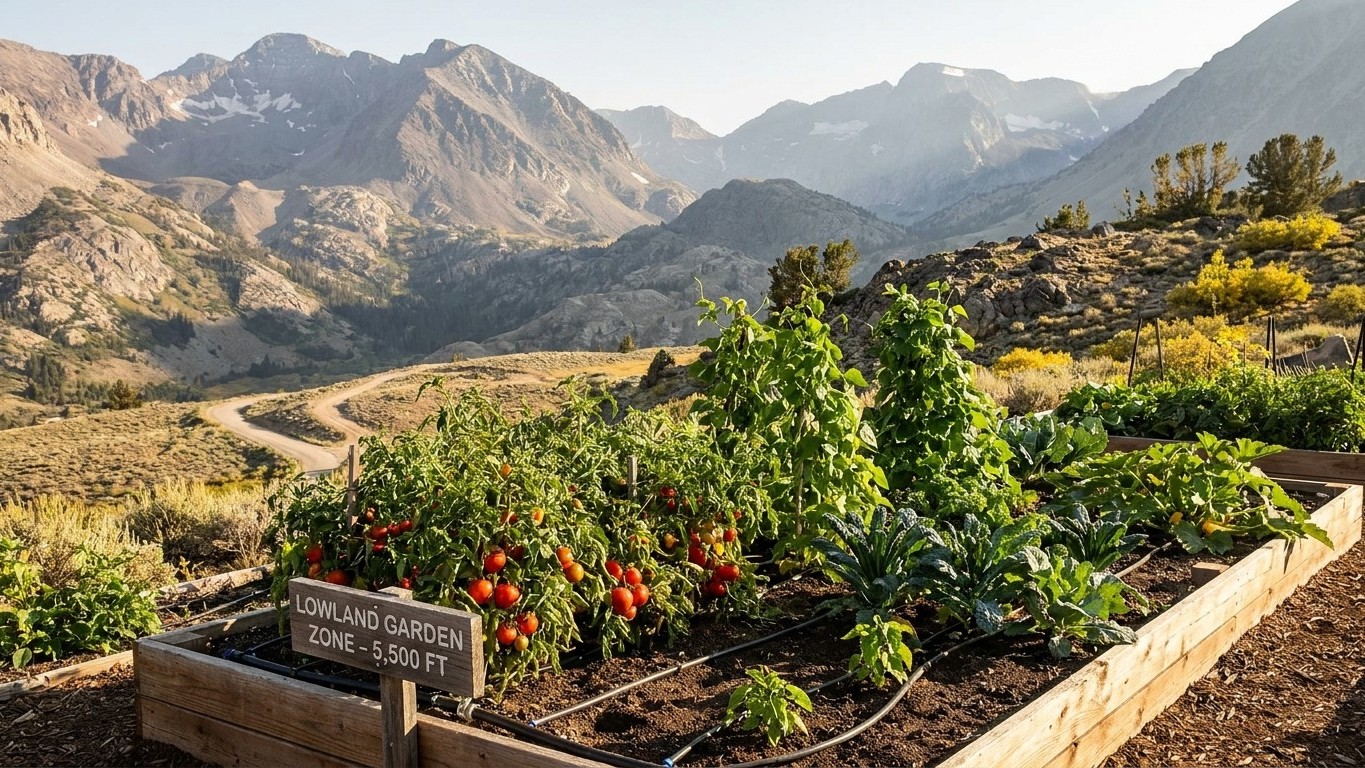

Colorado gardening comes down to four hard variables: elevation that swings by thousands of feet within a single county, a frost-free window that can be as short as 60 days in the mountains, alkaline clay soil that resists nearly everything you plant in it, and roughly 15 inches of annual precipitation that forces most gardeners into drip irrigation or xeriscaping. Master those four, and the state’s famous sunshine works in your favor instead of against you.
Why One Statewide Growing Guide Doesn’t Work

Colorado spans USDA Hardiness Zones 3b to 7a, according to the USDA Plant Hardiness Zone Map. That’s a wider range than most states cover, and it’s driven almost entirely by elevation. Denver and the Front Range corridor sit mostly in zones 5b and 6a. Drive two hours west into the mountains, past Leadville or Fairplay, and you land in zone 3b or 4a, where some years frost is possible in any month.
This matters more than a zip code ever could. A gardener in Grand Junction, at roughly 4,600 feet, is working with a longer, warmer season than someone in Estes Park at 7,500 feet, even though both are technically “Colorado gardening.” The general rule of thumb foresters and extension agents use: every 1,000 feet of elevation gain shaves off roughly 3 to 5 degrees Fahrenheit and shortens the growing season by a couple of weeks. That’s not a minor adjustment. It’s the difference between growing tomatoes outdoors versus needing a greenhouse or high tunnel to get any red fruit at all.
The Real Growing Season: Shorter Than Most Newcomers Expect
In the Denver metro area, the average last spring frost lands around May 10 to 15, and the first fall frost typically arrives in late September to early October — timing that also shapes When to Carve a Pumpkin in Colorado if you’re growing your own for Halloween. That gives you a frost-free season of roughly 150 to 160 days, which sounds workable until you compare it to Kansas City or Nashville, where gardeners get closer to 190 to 200 days.
Move up into the foothills or mountain valleys and that number collapses fast. Towns above 8,000 feet routinely see a frost-free window of 60 to 90 days, sometimes less in a cold year. Gardeners in places like Alma or Breckenridge treat any tomato harvest as a bonus, not an expectation, and lean instead on cold-hardy crops that can handle a surprise frost in July — which is exactly why Growing Potatoes in Colorado is such a reliable strategy at higher elevations, alongside other resilient root vegetables like beets, perennial staples such as, and at lower, warmer elevations, Growing Sweet Corn in Colorado Growing Asparagus in Colorado, and even leafy greens, since Growing Spinach in Colorado tolerates cold snaps that would wipe out warm-season crops, and even Growing Pumpkins in Colorado can succeed at lower elevations with the right timing, and Growing Beets in Colorado follows the same logic. Growing Carrots in Colorado follows the same logic, with cold-hardy varieties like , while lower, warmer valleys still have enough heat for Growing Peppers in Colorado>Growing Parsnips in Colorado, which shrug off cold snaps and even sweeten after a frost.
Here’s the part that trips up transplants from milder climates: Colorado’s spring and fall frosts aren’t gradual. A 70-degree afternoon can drop to 28 degrees overnight when a cold front rolls off the Rockies. Gardeners who don’t keep row cover or old bedsheets on hand for surprise frost warnings lose entire pepper and squash plantings in a single night, sometimes in early June.
Season Extension Is Standard Practice, Not a Luxury
Because the window is tight, cold frames, low tunnels, and wall-of-water plant protectors show up in more Colorado backyards than in almost any other state. Starting tomatoes and peppers indoors six to eight weeks before the last frost date is close to mandatory if you want ripe fruit before the first fall frost. Direct-seeding warm-season crops outdoors and hoping for the best is a strategy that works in Georgia. In Colorado, it often just wastes seed packets.
Soil and Water: The Two Obstacles That Outlast the Weather
Most Front Range and Eastern Plains soil is heavy clay with a pH between 7.5 and 8.5, well into alkaline territory. That pH range locks up iron, manganese, and phosphorus, which is why so many new Colorado gardeners fight yellowing leaves (iron chlorosis) on plants that would look fine in more acidic soil back east. Blueberries, azaleas, and other acid-loving plants are close to a lost cause in unamended native soil here.
The fix isn’t complicated, but it’s ongoing. Working several inches of compost into beds every year, using raised beds filled with purchased garden soil, and choosing plants adapted to alkaline conditions all help. Colorado State University Extension’s soil testing labs (available through county extension offices) are the standard way growers figure out exactly what they’re dealing with before planting rather than guessing.
Water is the second constraint, and it’s a legal one as much as a climate one. Colorado’s water law is based on prior appropriation, meaning rain barrel use was restricted statewide for decades. That changed with a 2016 law allowing residents to collect rainwater from rooftops in two barrels up to 110 gallons combined, but the state’s semi-arid climate still means most gardens need supplemental irrigation almost every week from May through September. Cities including Denver, Aurora, and Colorado Springs impose watering schedules and restrictions during dry years, and xeriscaping (landscaping designed around low water use) has gone from a niche idea to standard practice for lawns and ornamental beds alike.
Hail, Wind, and Sun: The Factors Most Guides Skip
Colorado’s Front Range sits inside what meteorologists call “Hail Alley,” the region stretching from Wyoming through Colorado into western Nebraska that sees more large hail events than almost anywhere else in North America. Storms between late May and August can drop hail large enough to shred tomato plants and strip lettuce to stems in under ten minutes. Gardeners who’ve been through even one bad hailstorm season tend to invest in hail netting or portable covers they can throw over beds when the sky turns that particular shade of green.
Wind is the quieter problem. Chinook winds, warm downslope gusts that can hit 40 to 60 mph, dry out soil and stress young transplants even in what looks like mild weather. Windbreaks, whether a fence line, a row of shrubs, or simple stakes and mesh around new seedlings, aren’t decorative here. They’re often the difference between a transplant surviving its first week and snapping at the stem.
Then there’s the sun itself. At elevation, UV exposure is significantly higher than at sea level, roughly 10 to 12 percent more intense for every 1,000 feet of elevation gain according to EPA estimates on UV and altitude. That means plants can sunscald even when air temperatures feel mild, and gardeners often need to shade tender seedlings or newly planted trees for their first season, something rarely necessary in lower-elevation states.
What Actually Grows Well Here
Cool-season vegetables are the reliable performers across most of the state. Spinach, kale, lettuce, peas, radishes, and root vegetables like carrots and beets tolerate the swinging temperatures and can go in the ground weeks before the last frost date. Potatoes do well in the heavier clay soils once amended, and they’re a staple in higher-elevation gardens where warm-season crops struggle.
For warm-season crops, success depends heavily on elevation and microclimate. Along the Front Range and lower elevations, tomatoes, peppers, and squash can produce a solid harvest if started indoors early and given wall protection or a sunny south-facing spot near a building’s heat-retaining wall. Above 7,500 feet, growers often shift toward cold-hardy varieties bred for short seasons, or they rely on cold frames and greenhouses rather than open ground.
Native and regionally adapted plants make ornamental gardening far easier than fighting the climate with imports. Blue grama grass, penstemon, yarrow, Rocky Mountain columbine, and rabbitbrush are all built for low water, alkaline soil, and wind, and they anchor most successful xeriscape designs. Fruit trees, particularly apples and some hardy cherry varieties, do fine in the Western Slope’s Grand Valley, which has a longer season and better air drainage than the Front Range, but late spring frosts still knock out blossoms in a bad year.
A Practical Starting Checklist
- Check your specific elevation and zone before buying seeds; a packet rated for zone 6 may fail outright at 8,000 feet.
- Get a soil test through your county extension office before amending anything blindly.
- Keep frost cover on hand from mid-May through early June and again in September.
- Install drip irrigation early; overhead watering wastes water fast in this climate and encourages fungal issues in the low humidity swings.
- Build in wind protection for any new transplant, even in what looks like a calm week.
Gardeners who move to Colorado from wetter, lower states often spend their first season fighting the place instead of reading it. The ones who do well tend to make peace with a shorter calendar, treat their soil as a multi-year project rather than a one-time fix, and keep a tarp within reach from May through September, because in this state, the forecast can change before you finish reading it.
Where to check before you plant
Every number in this piece comes from data centered on one city, and Colorado does not hold still long enough for that to be reliable statewide. Drive an hour in almost any direction and you gain or lose a thousand feet of elevation, which can shift your last frost date by two or three weeks in either direction. A planting calendar that works in a Front Range valley can put seedlings in the ground three weeks too early for a mountain valley or a high plains town, and at that elevation a single missed frost warning can end a season before it starts.
Colorado State University Extension extension.colostate.edu maintains the research on varieties, soil amendments, and pest pressure that actually holds up at altitude, rather than generic advice written for lower, wetter states. It is a legitimate first stop for anyone unsure whether a technique suits their conditions.
Past that, find your county extension office. They track local frost patterns, soil test results, and microclimate quirks specific to your area, and they can tell you what your particular ground and elevation actually require, not what works two counties over.
Where to Go Next for Specific Crops
The freeze dates and heat numbers above play out differently depending on what’s actually in the ground, so it’s worth looking at the specifics. If you’re planning a fall planting, growing garlic in Colorado walks through why the state’s cold snaps arrive earlier than most gardeners expect, and how the first fall freeze around Denver — typically landing between September 30 and October 12 — shapes when cloves need to go in. For the lawn itself, Colorado lawn care covers the awkward middle ground Denver sits in, caught between summers hot enough to punish cool-season grass and winters cold enough to kill off anything warm-season, and what that means for feeding schedules. And if tomatoes are the goal, growing tomatoes in Colorado lays out the real last-frost window — May 1 to May 11 for the Denver area — and why treating that window as a guarantee rather than a probability is how seedlings end up dead on a cold morning. Each of those pages goes deeper into planting dates, varieties, and the local pressures that make Colorado gardening its own thing.