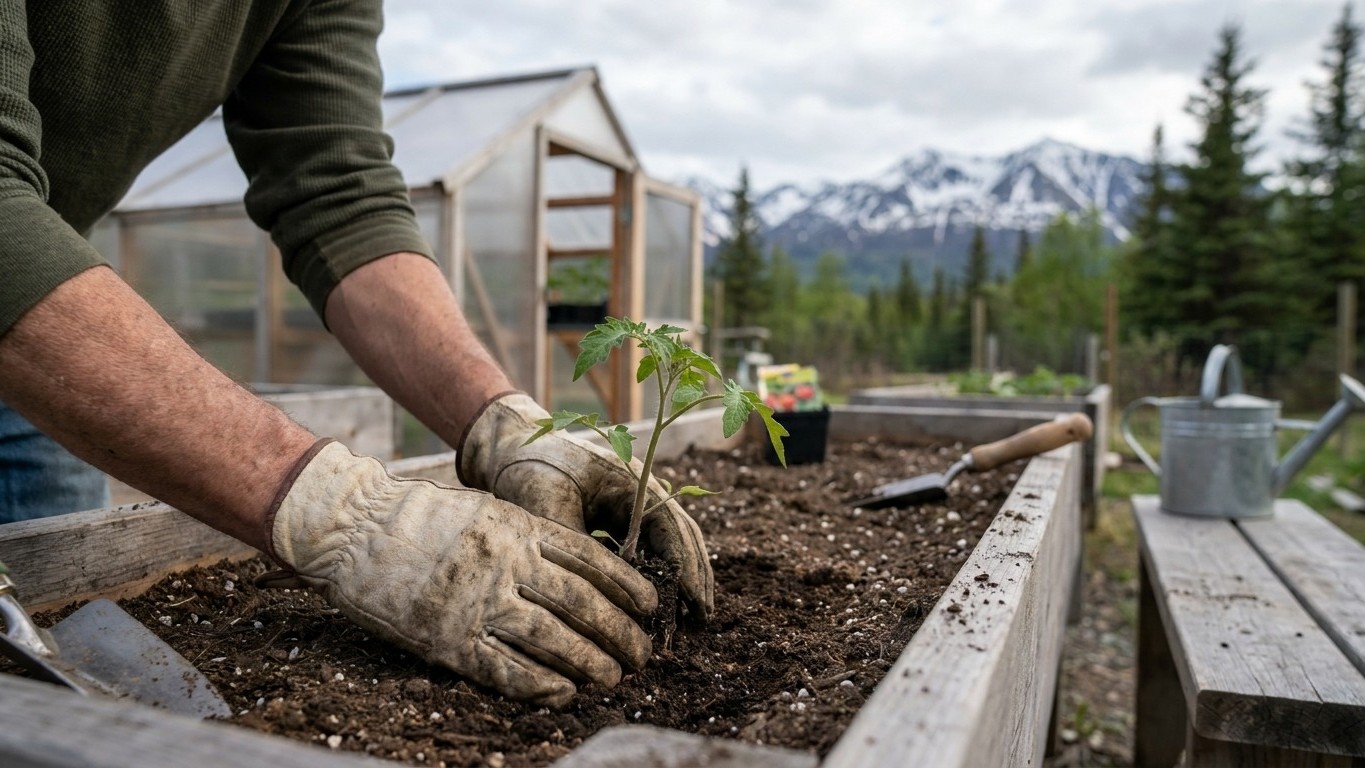

You’ve got about 143 frost-free days to work with here in Anchorage, and that’s the number every tomato date in your garden has to bend around. Set your transplant date for the back half of the last-frost window, around May 3 to May 12, then count backward six to eight weeks for when to start seed indoors, rather than trusting the date on the seed packet. Check that packet’s days-to-maturity number next — it decides whether your tomato has any real cushion before the fall freeze shows up.
What this comes down to in Alaska

Anchorage’s frost-free stretch, as measured by NOAA’s National Centers for Environmental Information at station USW00026451, runs about 143 days from a last spring freeze of May 3 to May 12 to a first fall freeze of September 22 to October 1. That’s the entire frame a tomato plant has to work with here, from the day it goes into the ground to the day the first hard freeze ends the season. Almost nowhere else these seed packets are sold has a season this short, which is why the packet’s own days-to-maturity number matters more in Alaska than it does in most states.
Tomatoes in this state are always transplants, never direct-seeded outdoors. The frost window above tells you when it’s safe to move a hardened-off seedling into the garden. It does not tell you when to start the seed indoors, and mixing up those two dates is the error that costs Alaska gardeners the most ripe fruit. Indoor sowing has to happen weeks earlier, timed to the transplant window, a step covered in more depth on growing tomatoes in Alaska if you haven’t started seed yet.
It’s also worth remembering that this figure comes from Anchorage specifically. The city sits in one of the mildest pockets of the state, so the same NOAA percentages calculated for the Interior or the far north describe a shorter, colder version of this same math, not a different method. Everything below assumes you’ll adjust the arithmetic to your own location rather than borrowing Anchorage’s dates outright.
Working it out for your own garden
The method is simple even though the exact day never is. Start from the last spring frost range, subtract the number of weeks your seedlings need indoors before they’re ready to transplant, and subtract the days-to-maturity figure printed on the seed packet from the first fall frost range to see how much room you have left over. Every step produces a range, not a single date, because the input is a range.
- Take the spring frost window: May 3 to May 12, per NOAA’s 1991-2020 normals for the Anchorage station.
- Tomato seedlings typically need six to eight weeks indoors before they’re stocky enough to transplant.
- Count six to eight weeks back from May 3-May 12 and you land in late March to mid April for indoor sowing, not a single Tuesday in March.
- Add the packet’s days-to-maturity figure to your transplant date to find your expected first-ripe window, then compare that to the fall frost range.
Run a real example. Sakura, a cherry tomato listed at 55 days from transplant, set out in the mid-May to late-May window this catalogue figure assumes, ripens by mid July and still has roughly 64 days of margin before the September 22 to October 1 fall freeze arrives. That’s a wide cushion, useful in a cool or cloudy summer when growth runs behind the packet’s number. Amish Paste, at 85 days from transplant, set out in that same window ripens by mid August with about 34 days of margin left. Both finish before frost on paper, but the paste tomato’s margin is a third of the cherry tomato’s, which is the gap a bad August can close.
What changes across the state
Anchorage’s numbers are a starting point, not a statewide rule. The USDA’s Plant Hardiness Zone Map puts Alaska anywhere from zone 1a to zone 8a, which is one of the widest spreads of any state on the map and a sign of how little one figure can tell you about a place this size. Coastal areas near the Gulf of Alaska tend to run milder and cloudier, which slows tomato ripening even when the frost dates look similar to Anchorage’s. Interior areas, away from the moderating effect of open water, swing colder in both directions: a harder late freeze in spring and an earlier one in fall, which shortens the usable season on both ends at once.
Elevation moves the same numbers again. Gardens sitting in low ground or a valley bottom collect cold air on a still night and can see frost when a garden a few hundred feet upslope stays clear, so two properties a short drive apart can carry genuinely different practical frost dates even though they’d show the same NOAA station data. Local daylight length is the one factor that pulls the other way. Alaska’s long summer days push growth hard once the plant is established, and that’s part of why the state’s short season still produces ripe tomatoes at all, but daylight cannot substitute for lost degree-days if a plant goes in too early or gets checked by cold.
None of this changes the underlying method. Recalculate from your own last-frost range rather than assuming Anchorage’s May 3 to May 12 window applies where you garden, especially if you’re in the Interior, on the coast, or at any real elevation above town.
The mistakes this state punishes

The most expensive mistake is transplanting into cold soil after a warm stretch fools you into thinking spring has arrived early. Air temperature can climb into pleasant territory days before the soil catches up, and a tomato seedling set into cold ground stalls for a week or two even if it never sees an actual frost. That stall eats directly into the ripening margin calculated above, and it’s the reason the cultivar with the widest margin still sometimes finishes late.
The second is choosing a long-season variety without checking whether the state’s window actually allows it. San Marzano II and Amish Paste, both listed at 78 to 85 days from transplant, carry real margins of 41 and 34 days respectively when set out in the mid-May to late-May window their catalogue figures assume. That margin holds in an average year, but it disappears fast in a cool, cloudy one, so a long-season paste tomato is a bigger bet here than a 55-to-60-day cherry or slicer. A fuller rundown of which cultivars fit this season is worth a look on Tomato Varieties That Ripen in Time in Alaska before you commit a full flat of seedlings to one you might have to pull green.
The third is skipping the hardening-off period to save a few days against the calendar. A seedling moved straight from a warm windowsill or grow-light setup into an Alaska garden, even inside the safe frost window, can suffer wind and cold-shock damage that costs more growing time than the hardening-off period itself would have. Give the plant a week of graduated outdoor exposure before it goes in the ground for good, rather than treating the transplant date as the finish line.
Checking this against your county
Anchorage’s NOAA figures are a reference point, not a guarantee for your yard. The University of Alaska Fairbanks Cooperative Extension Service, listed through the USDA’s land-grant extension directory, keeps local guidance for districts across the state and is the right place to confirm frost timing, soil temperature, and season-length advice specific to your borough. Local pest pressure also varies enough by region that it’s worth checking separately, and Tomato Pests in Alaska: Which Ones Actually Show Up Here covers what actually shows up on tomato plants around the state rather than what shows up nationally.
The Moon calendar is a separate, older custom: see when to plant tomatoes by the moon, written as tradition rather than fact.
Common questions
Can I just direct-seed tomatoes outside in Alaska to skip all this math?
No. The frost-free window at Anchorage runs about 143 days by NOAA’s normals, and even the fastest cultivars on a seed packet need more total time from seed to ripe fruit than that once you add the weeks a tomato seed takes to germinate and grow to transplant size. Direct-seeded tomatoes in this state generally run out of season before they set ripe fruit.
What if my last frost actually comes after May 12 this year?
It happens. NOAA’s range is built from a 30 to 70 percent freeze-probability band over the 1991-2020 period, which means individual years fall outside it in both directions. Watch your local forecast in the two weeks around your planned transplant date rather than treating May 12 as a guarantee, and hold seedlings under cover a little longer if a cold pattern is sitting over the area.
Do I need a greenhouse or high tunnel to hit these dates?
Many Alaska gardeners use one, since it buys extra weeks on both ends of the season and protects against exactly the cold-soil and wind-shock problems described above. Whether you need one depends on your specific site and cultivar choice, and that’s a call your local extension office can help you make based on conditions they see in your district every season.
How late can I transplant and still get ripe tomatoes before frost?
It depends entirely on the cultivar’s days-to-maturity figure and how much margin that leaves before your local fall frost. A 55-to-60 day cherry tomato transplanted even a couple of weeks past the ideal window still generally has room, while an 80-plus day paste tomato has far less margin to spare and is riskier to transplant late.